HL7 Integration Services: Bridging Legacy & Modern Healthcare

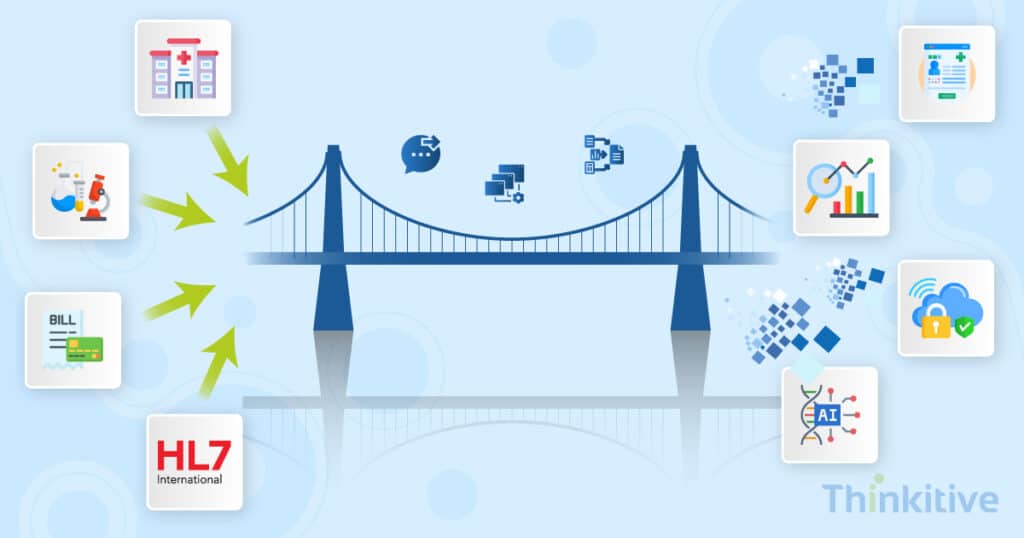
You will find hundreds of blogs on the internet recommending that you switch to FHIR APIs as their healthcare interoperability solution. Though the initiative is good, the reality is far different.
You see, several studies suggest that around 73-76% of the total healthcare systems still rely on legacy systems for their day-to-day activities, right from clinical and operations to financials. In this ecosystem, switching to just a single dedicated standard is like disrupting connectivity with more than half of the systems.
In reality, HL7 vs FHIR is good to compare, but healthcare systems use both; let’s try to understand with an example. Legacy systems, laboratory systems, and radiology systems use HL7 v2 standards. On the other hand, patient portals, mobile health apps, and AI-based healthcare applications use FHIR or FHIR APIs based on a standard for connectivity.
In this scenario, as a healthcare provider, your systems need to be compatible with both these standards. In fact, HL7 integration services are the perfect tool—or solution in this case—that can help you bridge both legacy workflows and real-time API connectivity.
On that note, let’s see how to bridge legacy HL7 systems with FHIR APIs and the intricacies that lie in HL7 integration for modern healthcare systems. So, without further ado, let’s get started!
Core Elements of HL7 Integration Services in Healthcare
Let’s start with the core elements of HL7 integration services in healthcare, and for that, you need to understand the HL7 v2 messaging workflows. These are basically standardized message types that are used to exchange healthcare data between systems.
Here are some of the most common messages included in these standard messaging types:
- ADT: Patient admission, discharge, and transfers
- ORM: Orders for labs, imaging, and other services
- ORU: Clinical results and observations
- MDM: Medical documents and reports
Apart from the standards, there are also interface engines that promote exchanges between systems. The role of HL7 interface engines is nothing but to act as a central hub that receives, transforms, validates, and routes HL7 messages between different healthcare systems to achieve seamless interoperability.
You can also use certain integration platforms to connect your system with EHRs, labs, billing systems, or any third-party applications. Some of the widely popular integration platforms are Mirth Connect, Rhapsody, Cloverleaf, and Middleware. These platforms automate message routing, transformation of data, and monitor them during transmission.
However, this is where you are most likely to encounter some challenges. You see, since these practices require data normalization, custom HL7 implementations become quite difficult. The reason behind this is the different data formats used by different healthcare systems. Here, HL7 integration services help you in standardizing and normalizing data in the right standard so that accurate information can be exchanged across systems.
Why is HL7 Integration Foundational?
FHIR and APIs are the modern healthcare standards or interoperability options that have arisen as an option for HL7. However, despite their rise and popularity, HL7 continues to be the core for clinical workflows in hospitals and healthcare networks. This is what makes it essential to connect legacy systems with modern healthcare applications.
Navigating the Standards Shift: Choosing the Right Integration Framework
Despite the relevance of HL7 healthcare integrations, you cannot ignore the shift from transitional message-based data exchanges to an API-driven architecture. Now, HL7 messaging is still widely used, but as modern healthcare applications are relying on APIs to enable faster and more flexible access to clinical data, navigating the shift from HL7 to APIs needs to be understood.
For this, we first need to understand the difference between HL7 and FHIR. Here is a simplified table for your understanding:
| Aspect | HL7 v2 | FHIR |
| Communication Model | Message-based data exchange | API-based data exchange |
| Data Access | Sends entire messages between systems | Retrieves specific data on demand |
| Integration Method | TCP/IP and MLLP protocols | RESTful APIs over HTTP |
| Best For | Hospital workflows, labs, billing, legacy systems | Mobile apps, patient portals, cloud platforms |
| Implementation Complexity | More complex and customized | More standardized and developer-friendly |
| Real-Time Accessibility | Limited | High |
| Modern Healthcare Readiness | Supports existing infrastructure | Designed for modern interoperability |
If you were looking for healthcare interoperability solutions, then you must have encountered RESTful APIs. Now, there is a striking difference between RESTful APIs and traditional communication protocols, and understanding them is critically important to understand the shift and choose the right framework. After understanding, you would probably know how to convert legacy HL7 to FHIR RESTful services.
So, FHIR APIs typically use RESTful web services over HTTP. This makes the system easier to integrate with cloud and mobile applications. On the other hand, HL7 integration relies on TCP/IP and MLLP protocols, which are specifically designed for system-to-system communication within healthcare networks.
When looking for HL7 integration services, you must assess your system for its interoperability readiness. This evaluation should be based on factors such as real-time data access, mobile application support, cloud adoption, scalability, and integration complexity. Once you understand this, the further choices become much clearer, allowing you to choose the right integration framework for your system.
Choosing the Right Interoperability Standard
Choosing the right standard for your system can be a hassle if you don’t know what to expect from it. And the best way to choose the interoperability standard is to align it with your existing infrastructure and business needs. Many healthcare practices are still using HL7 as their core clinical workflows while adopting FHIR APIs to support certain aspects of their system, like patient-facing applications, cloud platforms, analytics, or other emerging digital healthcare solutions.
The Technical Blueprint: Bridging Legacy HL7 Systems with Modern FHIR APIs
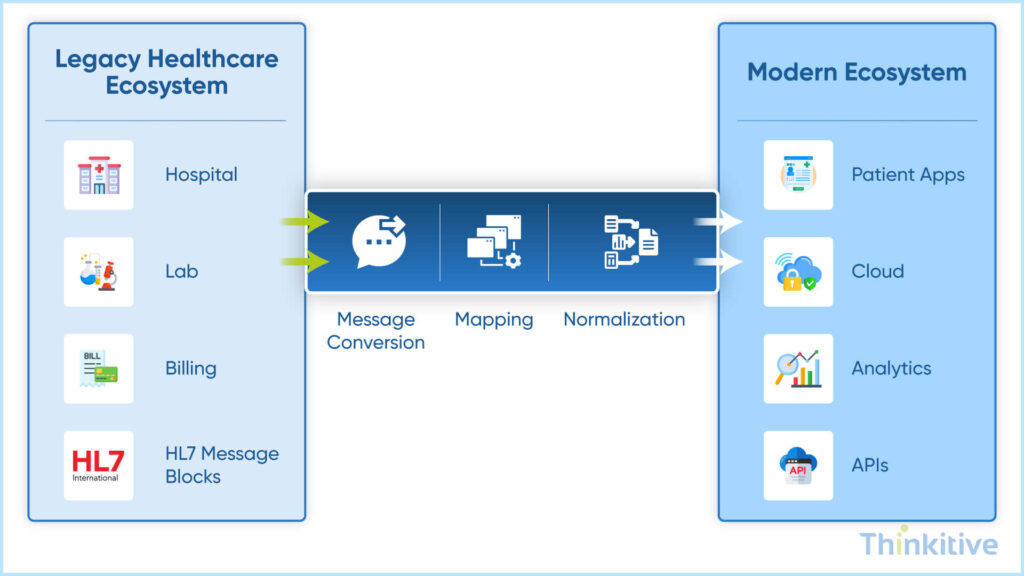
Bridging legacy HL7 systems with modern FHIR APIs is a complicated process. Let’s have a look at the entire process step-by-step.
The very first step in this is to convert HL7 messages into FHIR APIs. For this data, modernization is required, and integration engines or middleware can be used. This enables legacy systems to exchange data with modern digital health platforms without the need to replace the entire system.
The next step in this is data mapping, where you have to map HL7 data to FHIR resources, or in simple terms, translate the HL7 message segments into standardized FHIR resources. For instance, patient demographics can be mapped to patients, visit information to encounters, prescriptions to medication, and so on and so forth.
In our research, many healthcare practices have adopted FHIR resources alongside HL7 interfaces. This approach is unique in its own way and allows practices to introduce modern interoperability capabilities without disrupting clinical operations.
In fact, most of the healthcare environments include a mix of hospitals, specialty practices, ambulatory clinics, laboratories, and third-party applications. Here, HL7 integration services help these systems in exchanging data seamlessly across both HL7 and FHIR frameworks.
During this transition, different healthcare systems use different clinical coding standards. Now, during integration, you need to translate them and align the data across terminologies such as:
- SNOMED CT
- LOINC
- RxNorm
- ICD-10
Automated Data Normization
With the rise of AI in healthcare systems, you can automate the data normalization processes, which will standardize the clinical data before exchanging. It can have an immense impact on your integration, improving data quality, reducing errors, and enabling scalable interoperability across diverse healthcare applications.
Here is a short table to help you understand this process better:
| Integration Component | Purpose |
| HL7-to-FHIR Transformation | Converts legacy HL7 messages into modern FHIR APIs |
| Data Mapping | Aligns HL7 segments with FHIR resources |
| Hybrid Interoperability | Supports both HL7 and FHIR workflows simultaneously |
| Terminology Translation | Standardizes clinical codes across systems |
| Data Normalization | Improves consistency and data quality |
| Integration Middleware | Automates routing, transformation, and monitoring |
NOTE: A successful modernization strategy is not to replace HL7, but to use integration middleware, FHIR APIs, and terminology standardization to connect legacy systems with modern interoperability frameworks.
Operationalizing Modern API-Driven Healthcare Connectivity
The transition to API-driven interoperability is the need of the hour. This is the reason why healthcare practices are increasingly complementing traditional HL7 messaging with RESTful APIs. This allows them to be more flexible, enabling real-time access to clinical and operational data across systems.
Apart from this, API-driven architecture makes it easier for your system to connect with cloud-based solutions, which can be used for scheduling, telehealth, billing, care coordination, and patient engagement while maintaining interoperability with existing healthcare systems.
On top of that, webhooks and event-driven integrations allow your system to receive updates in real-time when a clinical or administrative event occurs. This reduces delays and improves the responsiveness of the system.
Furthermore, as the use of APIs for exchanging grows, your practice must manage rate limits, throttling policies, security controls, and version updates to ensure consistent performance and reliable data exchange across systems. This is one of the best ways to govern your APIs and assess their performance.
Last but not least, as your practice grows, your data, applications, and network will also grow. This is why your modern interoperability framework must be scalable in nature. It must support increasing data volumes, multiple applications, and networks while maintaining availability, security, and compliance.
Here are some of the best practices for modern HL7 integration:
- Maintaining HL7 support for legacy systems
- Adopting FHIR APIs for new applications
- Implementing robust monitoring and error handling
- Standardizing terminology and data models
- Designing for scalability and cloud readiness
- Ensuring security and regulatory compliance
Side-by-Side Comparison: The Hybrid Integration Matrix
Healthcare practices are modernizing their technology stack, and this is where they have to decide whether to maintain traditional HL7 interfaces or to adopt FHIR APIs or implement a hybrid interoperability strategy.
Well, before getting into these intricacies, let’s first know the core differences between HL7 and FHIR integration architecture.
| Feature | HL7 v2/v3 | FHIR APIs |
| Data Format | Pipe-delimited messages | JSON/XML resources |
| Communication Model | MLLP over TCP/IP | HTTPS REST APIs |
| Delivery Style | Event-driven messaging | Real-time request/response |
| Integration Complexity | High | Moderate |
| Mobile/Web Support | Limited | Strong |
| Authentication | Interface-level security | OAuth 2.0 / SMART on FHIR |
| Scalability | Moderate | High |
| Cloud Readiness | Limited | Excellent |
| Best Fit | Legacy hospital systems | Modern healthcare applications |
When to Modern HL7 vs Adopt FHIR
You should consider modernizing existing HL7 interfaces when they need to maintain compatibility with legacy systems. This is to be part of the ecosystem and minimize disruptions while improving interoperability.
And you should consider native FHIR implementation for a better choice for new healthcare applications that require real-time data access, mobile support, cloud deployment, etc.
The Hybrid Integration Strategy
Most healthcare organizations do not require a single integration model like HL7 or FHIR, which is why a hybrid integration strategy is what allows providers to continue leveraging existing HL7 infrastructure while exposing data through FHIR APIs for modern applications, analytics platforms, AI solutions, and patient-facing experiences.
NOTE: HL7 remains essential for supporting legacy clinical systems, while FHIR drives modern healthcare innovation. A hybrid integration strategy enables organizations to bridge both worlds, ensuring interoperability without requiring a complete technology overhaul.
SMART on FHIR & Embedded Clinical Applications
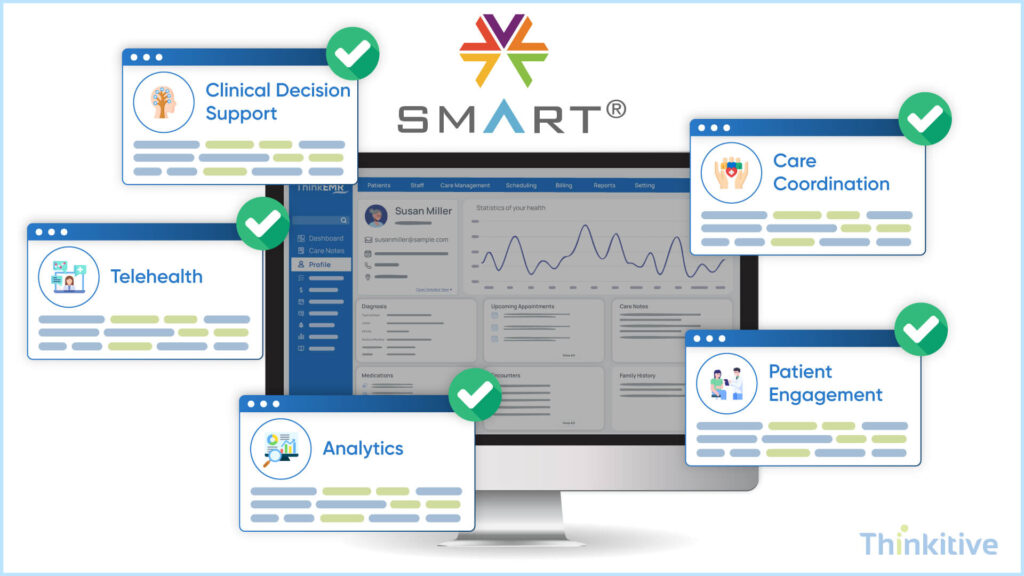
If your dependency is majorly on healthcare applications, then the SMART on FHIR framework enables these healthcare applications to securely integrate with EHR systems using FHIR APIs. In simple words, it allows healthcare applications to access clinical data while maintaining security, privacy, and interoperability standards.
The best part of SMART on FHIR integration is that it uses industry protocols such as OAuth 2.o and SMART App Launch to authenticate users and control access to healthcare data. This ensures that providers, patients, and third-party applications can securely interact with EHR systems.
With SMART on FHIR integrations, applications can also be launched directly from within the EHR system. This gives clinicians and patients seamless access to tools such as clinical decision support, care coordination, patient engagement, telehealth, and analytics while aligning them with their primary workflows.
And since SMART on FHIR integration relies on standardized APIs and data models, you can create applications that work across multiple EHR platforms with minimal customization, improving scalability and reducing integration complexity.
SMART on FHIR supports interoperability beyond traditional healthcare systems by enabling secure data exchange across cloud platforms, digital health applications, remote patient monitoring solutions, and patient-facing services.
Enterprise Adoption: Scaling FHIR-Based EHR Integration
With time, your practice will grow, and it will grow your digital ecosystem. This is why your system and integration architecture should be capable of managing. Here, FHIR becomes a key enabler of interoperability across hospitals, clinics, laboratories, payer systems, and third-party applications. Enterprise adoption focuses on creating a standardized framework for secure and scalable healthcare data exchange.
However, you need to understand that FHIR implementation is more than just API development. You must establish a process for deployment, performance monitoring, validation, error management, and ongoing maintenance so that your system is always reliable.
Furthermore, as healthcare data moves across multiple systems and cloud environments, you need to ensure that your data stays safe at all times. Implement strong security controls, including authentication, authorization, encryption, audit logging, and API governance to protect sensitive patient information.
Here are some of the regulatory and interoperability requirements that you must meet:
- ONC certification
- USCDI data standards
- TEFCA interoperability framework
- 21st Century Cures Act requirements
Healthcare organizations are increasingly adopting FHIR because it supports modern application development, cloud-native architectures, patient engagement initiatives, analytics platforms, and cross-system interoperability. Its API-first approach simplifies integration while providing the flexibility needed for future digital transformation efforts.
Conclusion: Building a Future-Ready Healthcare Interoperability Strategy
As the interoperability landscape continues to change, the hybrid model of HL7 and FHIR ecosystems will continue to define healthcare interoperability modernization. And for good reasons, as it only makes the processes faster and smoother.
That is why you must balance legacy infrastructure stability with API-first innovation with HL7 FHIR EHR integration for scalable healthcare transformation. And last but not least, before making any decision, know your business and clinical needs, and design a future-proof interoperability with a blend of HL7 and FHIR interoperability solutions to align with the evolving healthcare ecosystem.
On that note, let’s get your system accessed by our EHR integration expert and know what your system requires.
Frequently Asked Questions
HL7 integration services help healthcare organizations connect EHRs, laboratories, billing platforms, imaging systems, and other applications to enable secure healthcare data exchange. These services support interoperability by facilitating the transmission, transformation, and validation of clinical information across disparate systems.
HL7 healthcare integration typically relies on message-based communication for exchanging clinical data between systems, while FHIR APIs use modern web technologies to provide real-time access to healthcare information. Many organizations use both standards together to support legacy and modern interoperability requirements.
HL7 interface engines act as middleware that routes, transforms, validates, and monitors healthcare data exchanged between systems. Solutions such as Mirth Connect, Rhapsody, and Cloverleaf are commonly used for HL7 interface engine development and enterprise interoperability management.
Bridging legacy HL7 systems with modern FHIR APIs typically involves using integration engines or middleware platforms to transform HL7 messages into FHIR resources. This approach enables healthcare organizations to modernize interoperability without replacing existing clinical systems.
The main difference in the FHIR vs HL7 comparison is that HL7 uses message-based communication, while FHIR relies on RESTful APIs and standardized resources. HL7 remains widely used in hospitals, whereas FHIR is designed to support cloud applications, mobile solutions, and modern healthcare interoperability initiatives.
SMART on FHIR integration enables healthcare applications to securely access EHR data using standardized APIs and authentication protocols. It supports embedded clinical applications, patient-facing solutions, and cross-platform interoperability while maintaining strong security and access controls.
RESTful healthcare APIs allow applications to retrieve and exchange clinical data in real time using standard web protocols. They are commonly used to support patient portals, telehealth platforms, mobile applications, analytics tools, and cloud-based healthcare solutions.
Organizations typically use interoperability platforms, mapping tools, and transformation engines to convert legacy HL7 workflows into FHIR services. This process standardizes healthcare data and makes it accessible through modern API-based architectures.
Common challenges include custom HL7 implementations, inconsistent data formats, terminology mapping, interface maintenance, security requirements, and integration complexity. Effective HL7 integration for modern healthcare systems requires strong governance, monitoring, and data standardization practices.
Yes. Most healthcare organizations operate hybrid interoperability environments where HL7 supports existing clinical workflows and FHIR enables modern applications and APIs. This approach allows organizations to adopt healthcare interoperability solutions gradually while preserving investments in legacy infrastructure.
Interface engines serve as the backbone of many healthcare interoperability solutions by facilitating message routing, transformation, monitoring, and error handling. They help organizations integrate multiple systems while supporting both HL7 messaging and FHIR-based workflows.
Hybrid ecosystems combine the reliability of HL7 messaging with the flexibility of FHIR APIs. This approach supports digital transformation initiatives, cloud modernization, patient engagement, AI-powered applications, and scalable healthcare interoperability across diverse technology environments.


