Building Multi-Specialty EHR: Architecture for Group Practices

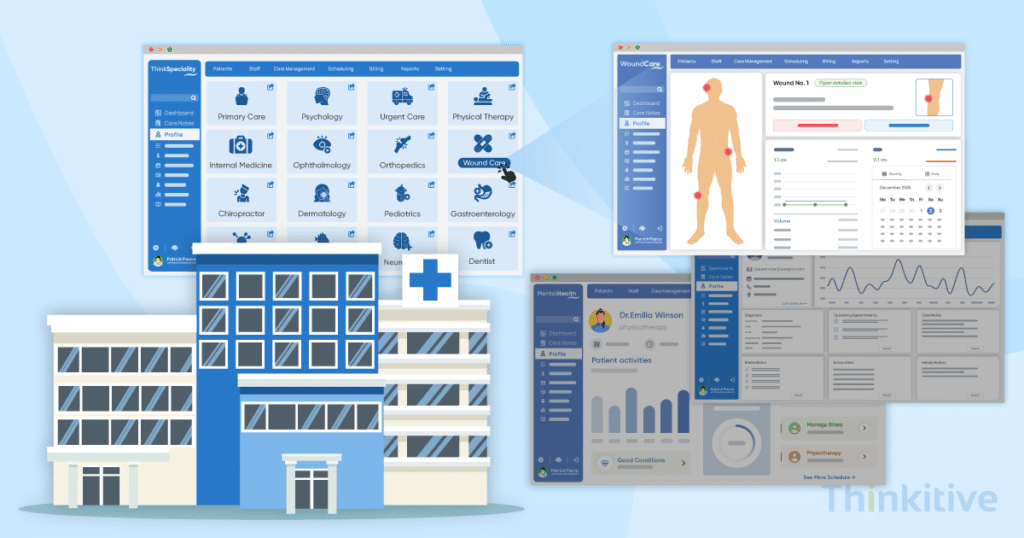
As healthcare practices are expanding across specialties, locations, and care teams, managing group practices becomes increasingly complex. Despite this, many healthcare staff and providers still rely on the EHR system to accommodate their unique and diverse clinical workflows.
For instance, according to the American Medical Association, almost 22.5% of physicians spend more than eight hours weekly using EHR after their working hours, which is usually referred to as pajama time. And if you are to measure time, then on average every physician devotes almost 13 hours per week to indirect patient care activities.
Some of these activities involve documentation, reviewing results, and managing orders. This not only increases the administrative burden but also complicates and overwhelms the process when multiple specialties are compiled together in a rigid, one-size-fits-all system.
For instance, if your practice has multiple specialties like cardiology, pediatrics, orthopedic surgery, and behavioral health, then the documentation requirement for all these workflows is quite unique and requires specialty-specific templates and workflows. To address these issues and eliminate data silos and operational complexity, many practices are opting for specialty-specific EHR development for their multi-specialty EHR.
These multi-specialty EHR systems are built on a modular and configurable architecture. They combine shared patient records, specialty-specific workflows, centralized administration, and enable seamless interoperability so that a consistent experience is delivered across specialties.
However, the question that you might ask here is, ‘How to support multiple specialties in one EHR?’
Well, let’s see exactly that in this blog and explore the architectural principles so that you can get the best EHR architecture for group practices.
So, without further ado, let’s get started!
Get Assessment and Recommendations on Your System Architecture for Multi-Specialty EHR –
Get Free Assessment
Key Takeaways
- A multi-specialty EHR enables multiple specialties to operate on one platform while maintaining specialty-specific workflows.
- Shared patient records, modular architecture, and centralized administration improve care coordination across departments.
- Specialty-specific modules allow each department to customize documentation, templates, and clinical workflows without affecting others.
- Scalable architecture, HL7 FHIR interoperability, and role-based access prepare group practices for future growth.
- Planning for configurability and expansion helps healthcare organizations onboard new specialties without rebuilding the platform.
What Is a Multi-Specialty EHR and How Does It Support Group Practices?
Healthcare organizations are moving towards multi-specialty practice, bringing different specialties, providers, and clinic locations under one umbrella. This has improved access to care, but at the same time increases the complexity of managing clinical workflows, patient records, and administrative operations.
In such cases, a multi-specialty EHR helps providers by giving them a unified platform that supports diverse specialties without compromising their unique clinical requirements.
Unlike traditional EHR systems, these software systems are not optimized for a single specialty and can configure specialty-specific templates, documentation styles, order sets, and clinical workflows while maintaining shared patient records. This allows providers across specialties to access the same patient history, medications, allergies, lab results, and care plans, ensuring better care coordination and continuity of care.
Why Group Practice Needs a Unified Platform
Group practices need a unified platform because they depend on collaboration between providers, administrative staff, and multiple departments. Now, using a separate EHR results in fragmentation, duplicate documentation, complex integrations, and inconsistent reporting.
Here, a Group practice EHR, which is a unified platform, can eliminate data silos by centralizing patient data, streamlining referrals, simplifying administration, and enabling organization-wide reporting, helping practices to deliver well-coordinated and quality care.
Common Challenges
Here are some of the common challenges you’re likely to encounter during this:
| Aspect | Description |
| Scope | Designing a multi-specialty EHR goes beyond combining multiple specialties into a single application |
| Requirements | Must support specialty-specific workflows while ensuring data consistency, security, interoperability, and scalability |
| Specialty Needs | Each specialty requires unique documentation, forms, and clinical processes |
| Platform Goal | All specialties must operate on the same platform without affecting the experience of other departments |
Balancing Standardization with Specialty-Specific Workflows
The success of a multi-specialty EHR depends on balancing organizational standardization with clinical flexibility. For instance, you can standardize the core functions and functionalities such as patient registration, scheduling, billing, security, and interoperability.
On the other hand, configurable specialty modules allow you to customize documentation templates, order sets, and workflows to the specific needs of your specialty.
Due to this modular architecture, you can scale efficiently, onboard new specialties with ease, and deliver a consistent user experience without sacrificing specialty-specific functionality.
Switch from Legacy to Modern with EHR Data Migration –
Read Complete GuidePlanning a Multi-Specialty EHR for Group Practices
Before you move ahead with the development of a multi-specialty EHR, you need to first figure out how different specialties, providers, and locations will work together on a single platform. Careful planning ensures the system remains scalable, secure, and adaptable as the organization grows.
How to Build a Multi-Specialty EHR for Group Practices
1. Identify shared and specialty-specific clinical workflows.
2. Define user roles, departments, and organizational hierarchy.
3. Design a shared patient data architecture.
4. Build modular specialty-specific components.
5. Enable interoperability using HL7 FHIR and secure APIs.
6. Plan for scalability, security, and future expansion.
Other than that, here is a detailed table to help you understand different stages of planning and everything that you need to know about it.
| Architecture Planning Area | What to Consider | Impact on Your Multi-Specialty EHR |
| Clinical Workflow Design | Identify which workflows should be shared across the organization and which require specialty-specific customization, such as documentation, templates, order sets, and assessments. | Ensures every specialty follows workflows tailored to its clinical needs without creating separate systems. |
| User Roles & Organizational Hierarchy | Define providers, nurses, administrative staff, billers, and department-level access using Role-Based Access Control (RBAC). Account for multiple specialties, locations, and departments. | Strengthens data security while enabling users to access only the information relevant to their responsibilities. |
| Shared Data Architecture | Determine how patient demographics, medications, allergies, lab results, referrals, and clinical notes will be shared across specialties while protecting sensitive information. | Enables seamless care coordination through a unified patient record and eliminates data silos. |
| Scalability & Future Expansion | Design a modular architecture that can easily support new specialties, providers, clinic locations, integrations, and evolving healthcare regulations. | Reduces redevelopment efforts and ensures the platform remains scalable, interoperable, and future-ready. |
Core Components of a Multi-Specialty EHR
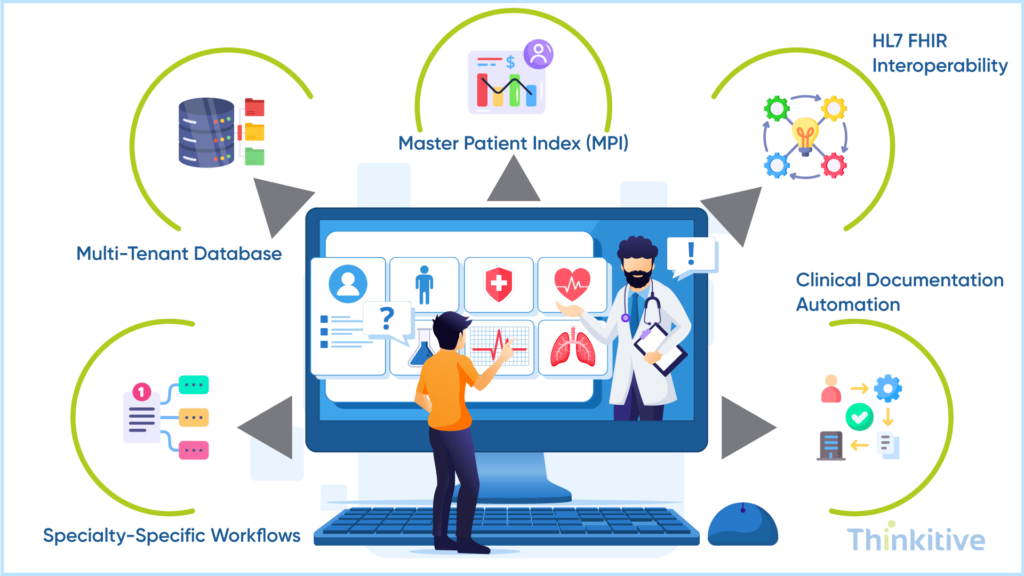
The success factor of your multi-specialty EHR depends on its architecture. Here, a well-designed architecture should enable multiple specialties to work independently while sharing patient information, administrative functions, and connected healthcare services.
By combining modular workflows, a unified data model, interoperability, and automation, you can build an EHR that supports scalability and is future-ready.
On that, here are some of the core components of a multi-specialty EHR:
Build Modular Specialty-Specific Clinical Workflows
Every medical specialty is unique, and depending on the practice, its clinical processes can also differ. For instance, a cardiologist relies on ECG reports, cardiac risk assessments, and medications. At the same time, a behavioral health provider requires psychotherapy notes, outcome assessments, and treatment plans. Here, designing a single workflow for both these specialties can lead to unnecessary complexity and lower physician productivity.
Here, a modular architecture comes to the rescue by separating specialty-specific workflows from the core platform. Due to this, certain common features like patient registration, scheduling, billing, and patient communication remain standardized for all.
However, each specialty can configure its own documentation templates, clinical forms, order sets, and care pathways. This allows providers to add new specialties or modify existing workflows without disrupting the entire EHR system.
Design a Multi-Tenant Healthcare Database
Multi-tenant healthcare database design should be in such a way that it supports multiple departments, clinical locations, and providers while maintaining a centralized source of truth for information. Here, a multi-tenant database architecture makes it possible by allowing different specialties and locations to operate within the same platform while securely managing organizational data.
This way, instead of maintaining separate databases for every department, you can store shared information such as demographics, appointments, medications, allergies, and billing data in a unified structure. On top of that, it also simplifies maintenance, improves reporting, reduces data duplication, and enables your platform to scale as new providers, specialties, or locations are added.
Create a Master Patient Index (MPI)
One of the biggest and most distinct advantages of a multi-specialty EHR is maintaining a single, unified patient record. This is what is called a Master Patient Index, where it assigns every patient a unique identity and allows providers across specialties to access the same medical history, diagnoses, medications, allergies, laboratory results, referrals, and imaging reports.
This MPI will also help in eliminating duplicate patient records, improving care coordination, and ensuring that every provider works with consistent and up-to-date patient records.
Support HL7 FHIR Interoperability
Healthcare practices rely on a wide ecosystem of connected healthcare service providers for information. Here, supporting interoperability standards such as HL7 and FHIR enables your EHR to exchange healthcare information securely and efficiently with these external systems. Due to this connected architecture, manual data entry is reduced, clinical decision-making is improved, and complete access to patient information is ensured without the need to switch applications.
Enable Clinical Documentation Automation
Documentation is one of the most time-consuming tasks for healthcare providers. Here, with clinical documentation automation and integrated AI documentation tools, you can significantly reduce this burden by automatically generating structured clinical notes, diagnoses, and procedure codes, patient encounter summaries, and capturing specialty-specific information.
When combined with configurable workflows, clinical documentation automation adapts to the requirements of each specialty while maintaining consistent documentation standards across the organization. This not only improves physician efficiency but also enhances documentation quality, coding accuracy, and overall patient care.
Scaling a Multi-Specialty EHR Platform
A scalable architecture ensures the EHR can grow alongside the organization without requiring frequent redesigns or disrupting patient care. Here are some of the best practices that you can adopt for the scalability of a multi-specialty EHR:
| Best Practice | Why It Matters | Implementation Tip |
| Build a Modular Architecture | Enables independent development and deployment of specialty-specific modules without affecting the core platform. | Separate core services (patient management, billing, scheduling) from specialty-specific workflows and AI services. |
| Design for Performance from Day One | Growing patient volumes, providers, and clinic locations can slow down poorly designed EHRs. | Use cloud infrastructure, database optimization, caching, and load balancing to maintain consistent performance. |
| Adopt API-First Interoperability | Healthcare ecosystems continue to expand with labs, pharmacies, telehealth, and third-party applications. | Build standardized integrations using HL7, FHIR, and secure APIs instead of custom point-to-point connections. |
| Keep Clinical Workflows Configurable | Clinical requirements evolve with new specialties, regulations, and organizational processes. | Use configurable templates, forms, order sets, and workflow engines instead of hardcoded business logic. |
| Plan for Continuous Updates | Frequent feature releases, security patches, and compliance changes should not interrupt patient care. | Decouple the application into independent modules and support automated testing and phased deployments. |
| Prioritize Security & Compliance | Protecting patient data is critical as users, locations, and integrations increase. | Implement Role-Based Access Control (RBAC), encryption, audit logs, and regular compliance reviews. |
Optimizing Multi-Specialty EHR for Long-Term Growth
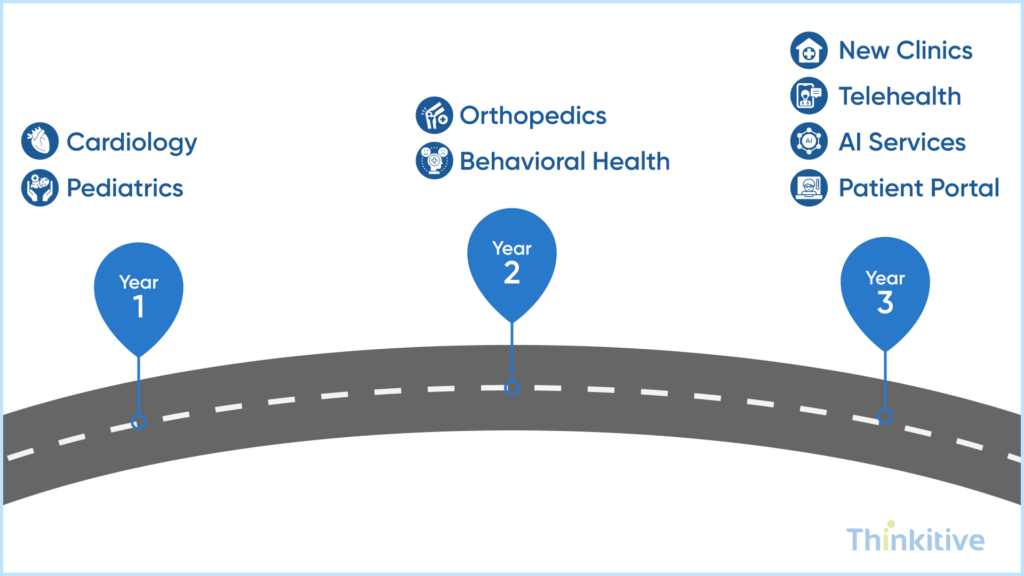
With the right architecture, you can indeed have a multi-specialty EHR, but that’s not all. You see, the architecture should be capable enough to support the continuous evolution of the system as your practice grows.
Furthermore, as new specialties, providers, clinic locations, and healthcare technologies are introduced, your EHR system should be able to adapt to these unique workflows without disrupting existing clinical workflows.
That is why you should keep an eye on monitoring system adoption, workflow performance, and clinical feedback to understand how you can improve your system. In this, audit logs can provide you with valuable insights about the internal workings of the software.
At the same time, keeping the architecture flexible makes it easier to accommodate new regulatory requirements, interoperability standards, and AI-driven capabilities. With continuous optimization, a multi-specialty EHR can remain efficient, scalable, and aligned with the changing needs of both healthcare providers and patients.
Choose The Right Multi-Specialty EHR Architecture –
Book Free ConsultationConclusion
Combining multiple specialties into a single platform is what building a truly multi-specialty EHR is all about. It involves careful planning and a well-planned architecture that supports specialty-specific workflows, unified patient records, and scalable interoperability.
By adopting a modular, configurable, and futuristic approach, you can improve care coordination, streamline operations, and adapt to the changing clinical and regulatory requirements.
So, whether you’re developing a completely new EHR platform or customizing your existing one, invest smartly in the right EHR architecture today. Let’s kick-start your multi-specialty EHR project with a system assessment from our custom EHR development experts.
Frequently Asked Questions
A Multi-Specialty EHR is an electronic health record system designed to support multiple medical specialties within a single healthcare organization. It enables each specialty to use its own documentation templates, clinical workflows, and order sets while maintaining a unified patient record, centralized administration, and seamless data sharing across departments.
Building a multi-specialty EHR starts with designing a modular architecture that supports shared patient records while allowing each specialty to maintain its own documentation templates, workflows, and clinical processes. A scalable platform with role-based access, interoperability, and configurable specialty modules ensures long-term flexibility as the organization grows.
A Group Practice EHR is built to support multiple providers, specialties, departments, and clinic locations on a single platform. Unlike traditional EHR systems that often focus on a single specialty, it offers shared patient records, centralized management, specialty-specific workflows, and enterprise-level scalability for growing healthcare organizations.
To support multiple specialties in one EHR, organizations should adopt a modular architecture that separates core services from Specialty-Specific Clinical Workflows. This allows each specialty to configure documentation templates, order sets, and care pathways while sharing patient records, scheduling, billing, and administrative functions.
Specialty-Specific Clinical Workflows are customized clinical processes designed to meet the unique requirements of individual medical specialties. These workflows include specialty-specific documentation templates, assessment forms, order sets, treatment plans, and clinical decision support, helping providers deliver more efficient and accurate patient care.
Multi-Tenant Healthcare Database Design enables multiple specialties, providers, or clinic locations to operate on the same EHR platform while securely managing organizational data. It improves scalability, simplifies maintenance, reduces data duplication, and supports future expansion without requiring separate database infrastructures.
HL7 FHIR enables a Multi-Specialty EHR to exchange healthcare information with laboratories, pharmacies, imaging centers, billing systems, patient portals, and other connected applications. Supporting standardized data exchange improves interoperability, reduces manual data entry, and enhances care coordination across specialties.
A Master Patient Index (MPI) is a centralized system that assigns every patient a unique identifier. It links patient records across specialties, providers, and clinic locations, ensuring authorized clinicians can access a complete and accurate medical history while minimizing duplicate records and improving continuity of care.
Clinical Documentation Automation uses technologies such as AI-powered documentation, smart templates, and automated note generation to reduce clinicians’ administrative workload. It can also adapt documentation to different specialties, helping improve consistency, coding accuracy, and overall provider productivity across a multi-specialty practice.
The best EHR architecture for group practices is a modular, configurable, and Scalable EHR Platform that combines specialty-specific workflows, a Master Patient Index, and interoperable APIs such as HL7 FHIR, secure role-based access, and a multi-tenant database. If you’re wondering how to build a multi-specialty EHR for group practices, the focus should be on creating a flexible architecture that supports future growth, seamless integrations, and efficient care delivery without compromising specialty-specific requirements.


