Database Architecture You Should Use to Build EHR

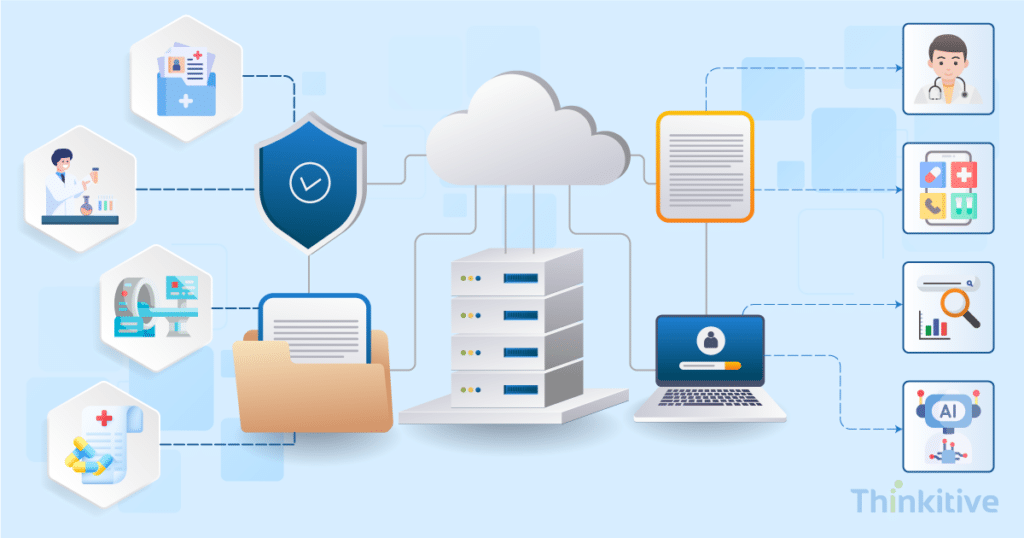
Did you know that the healthcare industry generates nearly 30% of the world’s total data volume?
Yes, a report by RBC Capital Markets suggests that at this annual growth rate, healthcare will continue to grow as one of the fastest-growing data domains across industries. And for your system to store, organize, secure, and retrieve information, database architecture is critically important.
Furthermore, the rise in data in the healthcare industry has also attracted data breaches and other cyber threats. That is why many practices that are looking to build their own EHR system are looking at specific EHR database architecture that allows them to be secure, scalable, and interoperable.
Choosing the right EHR database architecture for your EHR is important because the data is complex; for instance, a single patient encounter typically generates demographics, clinical notes, diagnoses, medications, lab results, medical images, billing records, audit logs, and FHIR resources.
Due to this, your EHR software requirements go beyond just choosing SQL and NoSQL in your EHR tech stack. In fact, it is more about designing the foundation that can support transactional, consistency, compliance, interoperability, and future scalability without compromising performance.
That’s why choosing the right EHR database architecture is critical for building a secure, scalable, and future-ready healthcare platform. On that note, in this blog, let’s explore the different EHR database architectures and know which one suits you best. Along with that, let’s also address one of the most common questions: ‘How to design a scalable EHR database?’
So, without further ado, let’s get started!
Consult EHR Expert for Database Architecture –
Get Free Consultation
Understanding EHR Database Architecture Requirements
The Electronic Health Records System is quite unique in nature. Unlike other applications, it manages healthcare data that is interconnected, continuously growing, and highly sensitive. Due to this, the requirement of the healthcare industry is also unique as the system needs to store the information accurately, retrieve it instantly, and it must be protected at all times.
That is why choosing the right EHR database architecture requires understanding your unique requirements. Let’s see what the things that you need to emphasize are:
Types of Healthcare Data an EHR System Manages
Modern-day EHR systems have moved beyond storing patient records. Today, they act as an epicenter for almost all the clinical, administrative, and financial data. These healthcare data include:
- Patient demographics and medical history
- Clinical notes and encounter documentation
- Diagnoses, allergies, and medications
- Laboratory and diagnostic imaging results
- Prescriptions and e-prescriptions
- Appointments and scheduling data
- Insurance, claims, and billing information
- Audit logs and user activity
- FHIR resources and interoperability data
- Medical documents and attachments
Core Requirements of an EHR Database Architecture
Each of the data types mentioned above needs to have different storage, retrieval mechanisms, and security requirements. On the basis of this, here are some of the core requirements of your EHR database architecture that should not be compromised:
- High performance: Retrieve patient records within seconds, even during peak usage.
- Scalability: Support growing patient volumes, additional healthcare providers, and expanding clinical services.
- High availability: Ensure uninterrupted access to patient information through redundancy and failover mechanisms.
- Data integrity: Maintain accurate and consistent patient records using reliable transaction management.
- Security and compliance: Protect sensitive health information with encryption, role-based access controls, and comprehensive audit logging.
- Interoperability: Enable seamless data exchange using standards such as HL7 and FHIR.
- Disaster recovery: Minimize downtime and data loss through automated backups and replication.
Key Principles of EHR Database Design
The database is like one layer of a modern EHR platform. Now, this works alongside the application layer, APIs, integration engine, caching layer, search engine, analytics platform, and cloud infrastructure.
All these components work together to deliver a secure, scalable, and high-performing healthcare platform. And this is why choosing the right architecture is critically important to bind them all together.
One of the major aspects of this is EHR database design. Here are some of the key principles of EHR database design that you must follow:
- Model relationships efficiently to avoid duplicate or inconsistent clinical data.
- Prioritize ACID-compliant transactions for patient-critical information.
- Separate transactional, search, and document storage workloads where appropriate.
- Design for horizontal and vertical scalability from the beginning.
- Optimize indexing and caching to improve query performance.
- Incorporate security and compliance into the architecture rather than treating them as afterthoughts.
Choosing the Best Database for EHR Development
Selecting the right database is one of the most important architectural decisions that you will make. Now, typically, your core requirement will be to store large volumes of clinical data and ensure fast access, transactional integrity, regulatory compliance, and seamless interoperability with other healthcare applications.
There are several databases that are capable of supporting healthcare applications for managing complex relationships and strict consistency. Here, understanding the strengths and trade-offs of each option can actually help you build the right foundation.
Here is a quick comparison table between the most prominent databases that you can choose from:
| Evaluation Factor | PostgreSQL | MySQL | MongoDB | Microsoft SQL Server |
| Database Type | Relational | Relational | NoSQL Document | Relational |
| Structured Clinical Data | Excellent | Strong | Moderate | Excellent |
| Scalability | Strong | Strong | Excellent | Strong |
| Data Consistency | Excellent | Strong | Moderate | Excellent |
| FHIR Data Handling | Strong | Moderate | Excellent | Strong |
| HIPAA Compliance Support | Excellent | Strong | Strong | Excellent |
| Reporting & Analytics | Excellent | Strong | Moderate | Excellent |
| Flexibility for Evolving Data Models | Moderate | Moderate | Excellent | Moderate |
| Enterprise Adoption | High | High | Growing | High |
| Best Use Case | Enterprise EHR Platforms | Small-Mid Healthcare Systems | Interoperability & Flexible Data Models | Large Enterprise Healthcare Systems |
Relational vs. NoSQL: Which One to Choose?
PostgreSQL, MySQL, and Microsoft SQL services are some of the preferred choices of relational databases. They are excellent at managing structured clinical data and support ACID transactions for accuracy and consistency.
On the other hand, MongoDB is one of the prominent examples of NoSQL databases. It offers greater flexibility for handling semi-structured and document-based data. This makes these databases more useful for storing FHIR resources, clinical documents, logs, and interoperability data.
Now, the choice depends on your needs and requirements.
Which Database is Best?
Most modern EHR platforms choose PostgreSQL as their primary database. It is excellent in transactional consistency, scalability, security features, and native support for JSON data.
On the other hand, if you have already invested in the Microsoft ecosystem, then Microsoft SQL Server can be a good choice along with MongoDB as a relational database.
Step-by-Step Guidance for Building Your Own EHR –
Get Free ConsultationBuilding a Scalable EHR Database Architecture
Choosing the right EHR database is only the first step towards building a scalable EHR database architecture. Your EHR platform should rely on a combination of technologies that work together and deliver high performance, reliability, scalability, and interoperability.
That is why many practices are increasingly removing their dependency on a single database and adopting a hybrid architecture where each component is optimized for a specific workload.
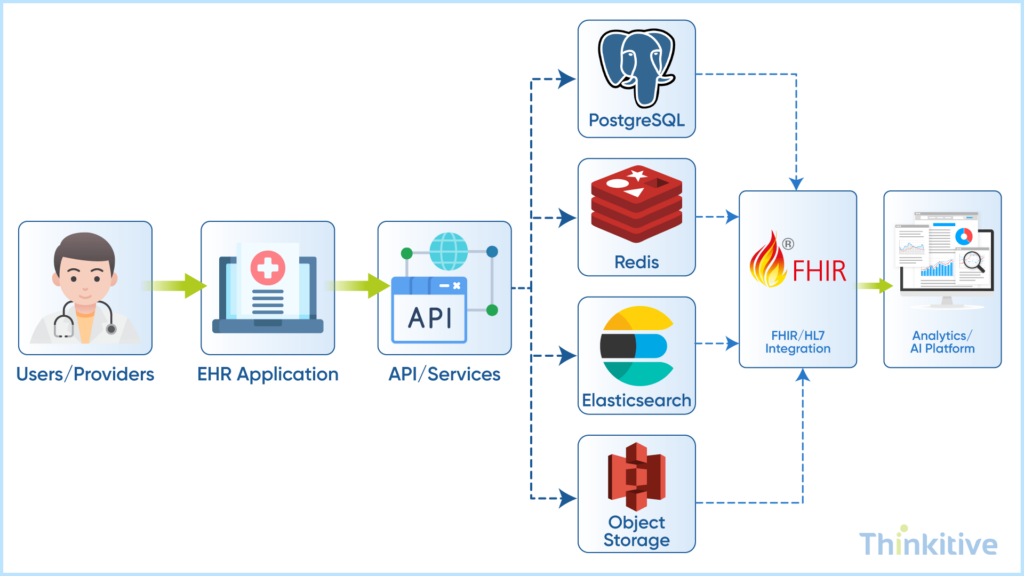
This is how your EHR database architecture would typically look:
| Layer | Purpose | Recommended Technology |
| Primary Database | Store patient records, encounters, medications, billing, and clinical data | PostgreSQL |
| Cache Layer | Speed up frequently accessed data | Redis |
| Search Engine | Fast search across patient records and clinical notes | Elasticsearch / OpenSearch |
| Object Storage | Medical images, scanned documents, PDFs | Amazon S3 / Azure Blob Storage |
| Analytics Database | Reporting and population health analytics | Snowflake / BigQuery |
| Integration Layer | HL7, FHIR and third-party integrations | Mirth Connect / FHIR Server |
For a scalable EHR database, selecting the most powerful database is usually not the ideal scenario. That is why you should combine a reliable relation with caching, search, object storage, and interoperability services.
On that note, here are some considerations when designing a scalable EHR database:
- Design for growth: Structure the database to accommodate increasing patient records, providers, and healthcare facilities without major redesigns.
- Ensure high availability: Use replication, automated failover, and regular backups to minimize downtime and maintain continuous access to patient information.
- Maintain data consistency: Implement ACID-compliant transactions to ensure every clinical update is accurate and reliable.
- Optimize performance: Use indexing, caching, and query optimization to reduce response times and improve user experience.
- Support interoperability: Enable seamless data exchange through FHIR APIs and HL7 standards without affecting database performance.
- Separate analytical workloads: Keep reporting and analytics separate from transactional databases to avoid slowing down day-to-day clinical operations.
- Build for AI readiness: Organize data in a way that supports predictive analytics, clinical decision support, ambient AI, and other AI-powered healthcare workflows.
Here is a simple architectural structural diagram for better clarity.
Securing a HIPAA-Compliant EHR Database
EHR database security is a critical component of HIPAA compliance; that is why the security aspects of your database cannot be simply ignored. The right database helps in safeguarding patient data while ensuring authorized users can access the information they need to deliver care.
Some of the key requirements for a HIPAA-compliant EHR database are:
- Data encryption: Encrypt PHI both at rest and in transit to protect against unauthorized access.
- Role-based access control (RBAC): Restrict database access based on user roles and responsibilities.
- Authentication and authorization: Ensure only verified users and applications can access sensitive healthcare data.
- Audit logging: Record every access, modification, and deletion of patient records to maintain accountability.
- Backup and disaster recovery: Protect data availability through automated backups, replication, and recovery plans.
- Data integrity: Prevent unauthorized modifications and maintain accurate patient records through transactional consistency.
Designing for Long-Term Compliance
HIPAA compliance is not just a combination of a few security controls. It is basically the result of designing an architecture that supports compliance from the bottom up. For instance, database encryption, access controls, immutable audit logs, and continuous monitoring must be integrated into the platform rather than kept for later.
On top of that, your EHR database architecture should also support compliance with HITECH requirements, with complete audit trails and monitoring of database access. This is the only way you can detect suspicious activity, investigate security incidents, and meet breach notification obligations when necessary.
Interoperability & Healthcare Database Management
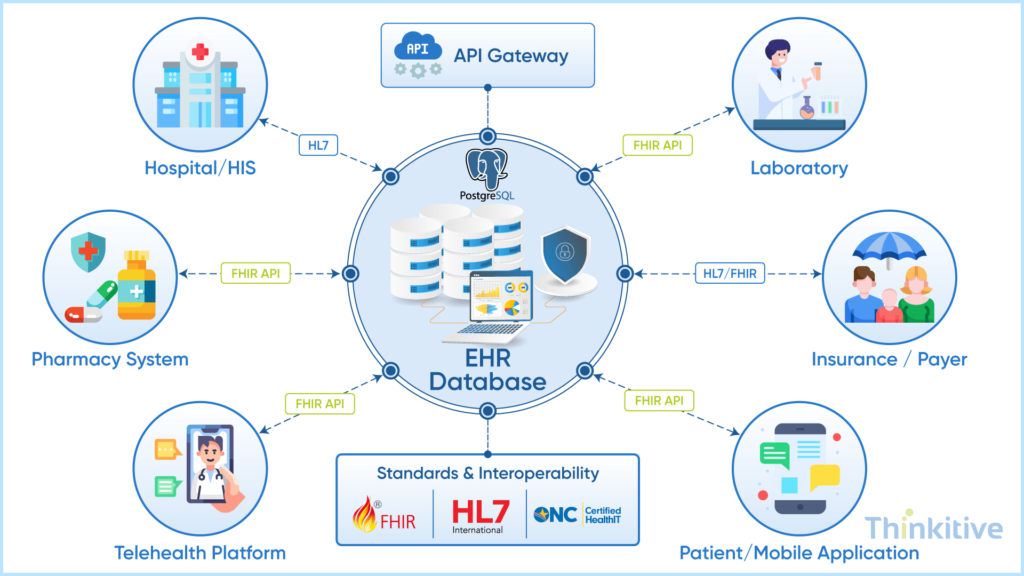
Modern healthcare systems are constantly exchanging information with other disparate systems like hospitals, laboratories, pharmacies, payers, etc. Due to this, interoperability is one of those aspects of building your own EHR that must be well-thought-out during the EHR database design.
The best way to support seamless data exchange is by allowing your database to work with widely adopted healthcare standards. Some of the most prominent interoperability standards:
- FHIR (Fast Healthcare Interoperability Resources): Enables secure API-based exchange of patient data with modern healthcare applications.
- HL7: Supports communication with legacy healthcare systems, laboratories, pharmacies, and hospital information systems.
- ONC Certification Requirements: Encourage standardized data exchange, interoperability, and secure patient access to health information.
Maintain Consistent & Reliable Healthcare Data
True interoperability depends on accurate and consistent underlying healthcare data. Here are some of the capabilities that your EHR database architecture must provide you:
- Maintaining a single source of truth for patient records.
- Eliminate duplicate and inconsistent clinical data.
- Supporting standardized coding systems such as ICD-10, SNOMED CT, LOINC, and RxNorm.
- Preserve data integrity across internal and external systems.
Build For Future Healthcare Integrations
Healthcare interoperability will continue to evolve with new APIs, connected devices, AI applications, and regulatory requirements. Designing a flexible database architecture today makes it easier to integrate future technologies without restructuring your entire data model.
Furthermore, by adopting standardized data models and interoperability-ready database design, you can build an EHR system that can exchange information seamlessly while ensuring scalability, security, and compliance.
Choosing the Right Database Architecture for Your EHR
The choice of the right database architecture is not predefined. The right approach depends on your practice’s size, clinical workflows, interoperability requirements, regulatory obligations and long-term growth plans.
Some of the factors that you should consider and some questions that you must ask are:
- Scalability: Can the architecture support growing patient volumes, additional providers, and multiple healthcare locations?
- Performance: Will it continue to deliver fast access to patient records as the system expands?
- Compliance: Does it support HIPAA, HITECH, and other healthcare security requirements?
- Interoperability: Can it integrate seamlessly with FHIR APIs, HL7 interfaces, laboratories, pharmacies, and third-party healthcare applications?
- Maintenance: Is the architecture easy to monitor, back up, and maintain over time?
- Cost: Does it balance infrastructure, licensing, and operational costs with long-term business needs?
For organizations choosing a hybrid architecture, PostgreSQL is typically combined with technologies such as Redis, Elasticsearch, object storage, and FHIR-enabled integration services to balance performance, scalability, security, and interoperability. This is to balance performance, scalability, security, and interoperability.
Book a Demo To See Your Database Architecture Function in Real-Time –
Book Free DemoConclusion
The success of an EHR system depends on more than its features, but also on the right database architecture. That is why a well-designed EHR database requires you to support secure data storage, high performance, scalability, interoperability, and regulatory compliance while adapting to future healthcare needs.
Furthermore, rather than relying on a single database technology, modern EHR platforms often combine relational databases with complementary tools for caching, search, analytics, and interoperability. By choosing a database architecture that aligns with your clinical workflows and long-term growth plans, you can build an EHR system that delivers reliable performance today and remains ready for the evolving demands of healthcare tomorrow.
Still wondering how to build an EHR from scratch? Let’s start your development journey with system assessment to gather your needs and requirements to choose and curate the right EHR database architecture for your EHR software.
Frequently Asked Questions
EHR database architecture is the underlying framework that defines how an Electronic Health Record (EHR) system stores, organizes, secures, and retrieves healthcare data. A well-designed EHR database architecture supports high performance, scalability, interoperability, and regulatory compliance while ensuring patient information remains accurate, secure, and readily accessible.
An effective EHR database design includes structured data models, relational tables, indexing strategies, access controls, audit logging, backup and disaster recovery, and interoperability support. Modern EHR systems also incorporate caching, search engines, object storage, and integration services to improve performance and scalability.
The best database for EHR development depends on your organization’s requirements. For most healthcare applications, PostgreSQL is the preferred choice because it provides strong transactional consistency, scalability, security, and native JSON support for FHIR resources. However, many modern EHR platforms use a hybrid architecture that combines relational databases with complementary technologies such as Redis and Elasticsearch.
When comparing PostgreSQL vs MongoDB for EHR, PostgreSQL is generally better suited for managing structured clinical data due to its ACID compliance and strong relational capabilities. MongoDB excels at handling flexible, document-based data such as FHIR resources and clinical documents. Rather than choosing one over the other, many healthcare organizations use PostgreSQL as the primary database and MongoDB for specialized workloads.
Designing a HIPAA-compliant EHR database requires implementing encryption for data at rest and in transit, role-based access controls, authentication, audit logging, backup and disaster recovery, and continuous monitoring. The database architecture should also maintain data integrity and support compliance with HIPAA and HITECH security requirements.
If you’re wondering how to design a scalable EHR database, start by choosing a reliable relational database, optimizing indexing, implementing caching, enabling database replication, and separating transactional and analytical workloads. A scalable architecture should also support interoperability, high availability, and future growth without compromising performance or data consistency.
Effective healthcare database management ensures patient data remains accurate, secure, and readily available. It includes activities such as performance monitoring, indexing, backup management, replication, query optimization, and data governance. Proper database management helps improve system responsiveness, reduce downtime, and support long-term scalability.
Relational databases are typically the preferred choice for storing structured clinical data because they provide strong consistency and transactional reliability. NoSQL databases are useful for managing document-based or rapidly evolving data models. In most cases, healthcare organizations benefit from an EHR tech stack that combines relational and NoSQL databases to support different workloads within the same platform.
A well-designed EHR database architecture enables interoperability by supporting healthcare standards such as FHIR and HL7, making it easier to exchange data with laboratories, pharmacies, hospitals, and other healthcare systems. It also supports healthcare analytics by separating reporting workloads from transactional databases, allowing organizations to generate insights without affecting the performance of day-to-day clinical operations.


