Building Clinical Efficiency with Ambient AI Scribes: Cutting Documentation Time by 70%

Do you know what the biggest problem that healthcare providers have to face on a daily basis is?
Believe it or not, it’s writing for the time we live in – typing.
Seeing a doctor write or type just feels so weird, right? We always imagine them working with patients or studying something physical and taking notes, anything but typing.
And that is the biggest problem right now. You see, according to a study by the American College of Physicians, for every hour a physician spends on patient care, they have to spend two additional hours on EHR and administrative work. This is the reason it feels weird to see doctors, especially physicians, typing.
Moreover, this is the tip of the iceberg; the more you dig into such problems, the more it paints a scary picture. You see, back in 2016, when EHR was just trying to reach every hospital in the United States, the AMA reported that only 27% of physicians’ time went into seeing their patients.
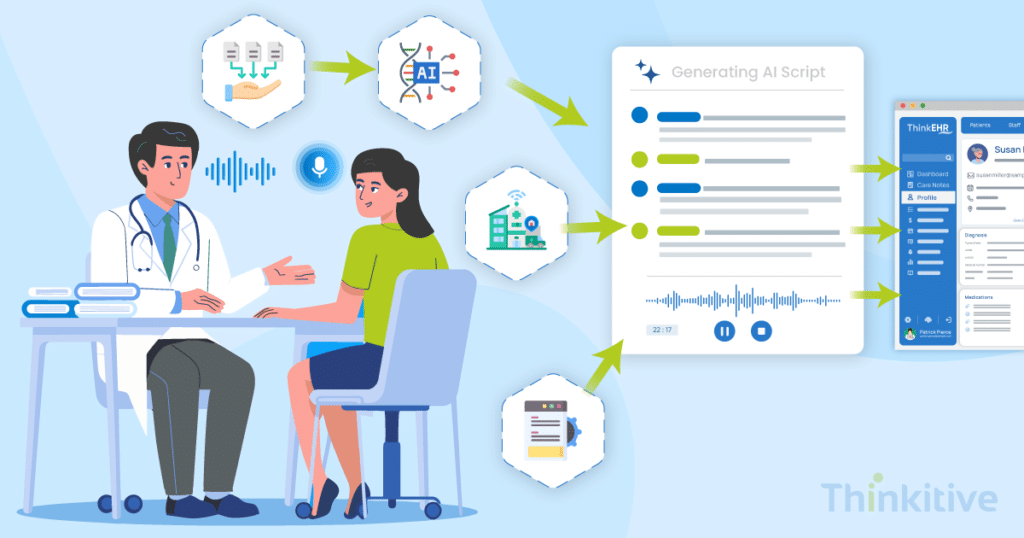
Interestingly, one of our recent ventures with custom AI medical scribe development completely changed the equation by automatically listening to patient-provider conversations, generating structured clinical notes, and updating documentation within the EHR.
This helped reduce clinical documentation time by up to 70%. Instead of spending unwanted time on documentation after every consultation, providers could review these AI-generated notes and make quick edits if needed, and that’s it.
In this blog, let’s explore how AI-powered custom EHR development with an AI scribe feature can help you automate clinical documentation and give your providers the time they need with patients without compromising on the quality of care being delivered.
So, without further ado, let’s get started!
What It Takes to Build an Ambient AI Scribe
Building an AI clinical documentation solution or simply an AI medical scribe is more than just converting speech to text. It is a combination of ambient conversation capturing, medical AI, structured clinical documentation, and seamless EHR integration to automate the entire documentation workflow. And all these technologies together help providers spend less time documenting and more time on patient care.
Here are the core components of custom AI medical scribe:
- Ambient Conversation Capture: Listens to patient-provider conversations in real time, filters background noise, and identifies different participants without requiring manual dictation.
- Medical NLP & LLM Processing: Understands medical terminology, clinical context, medications, diagnoses, and treatment plans instead of producing a simple transcript.
- SOAP Note Generation: Automatically converts conversations into structured Subjective, Objective, Assessment, and Plan (SOAP) notes that are ready for physician review.
- EHR Write-Back: Updates encounter notes, medications, diagnoses, allergies, follow-up tasks, and other structured clinical data directly within the EHR after provider approval.
Ambient AI vs Dictation vs Human Scribes
Healthcare organizations have relied on human scribes and voice dictation technologies for years, yet the manual efforts that it required contributed to saving little to no time. However, ambient AI documentation takes it a step further by understanding clinical conversations and automatically generating structured notes within the EHR system.
| Capability | Human Scribe | Voice Dictation | Ambient AI Scribe |
| Automatically captures patient conversations | ❌ | ❌ | ✅ |
| Understands clinical context | Limited | ❌ | ✅ |
| Generates structured SOAP notes | Manual | ❌ | ✅ |
| Updates EHR documentation | Manual | Manual | ✅ |
| Requires additional staffing | ✅ | ❌ | ❌ |
| Scales across multiple providers | Limited | Moderate | High |
Build vs Buy: Why Custom AI Scribes Deliver Greater Value
Many healthcare practices start with off-the-shelf solutions as they are easy to deploy. Having said that, as your workflows become more specialized and integration requirements increase, the platform starts showing its limitations.
With custom AI medical scribe development, you can achieve better flexibility, deeper EHR integration, and complete ownership of clinical workflows. But still, the decision between buying and building can be daunting. On that note, here’s a quick table to help you make a better choice:
| Off-the-Shelf AI Scribe | Custom AI Scribe |
| Generic documentation workflows | Tailored to specialty-specific workflows |
| Limited EHR integrations | Deep integration with existing EHRs and clinical systems |
| Fixed templates and prompts | Fully customizable documentation templates and AI prompts |
| Vendor-controlled product roadmap | Complete ownership and flexibility for future enhancements |
| Limited workflow automation | End-to-end documentation and workflow automation |
The Engineering Behind the Time Savings
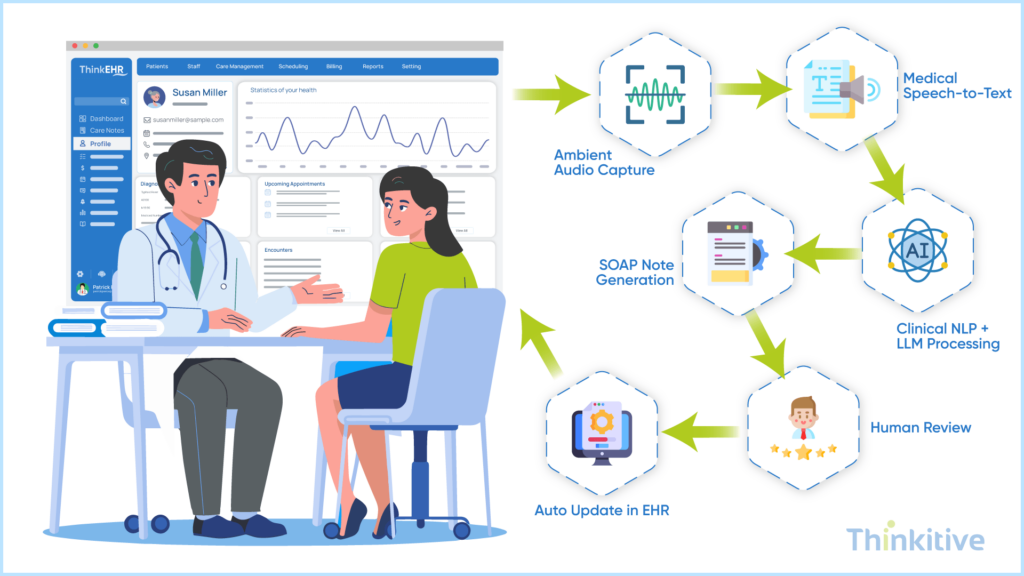
The time savings offered by an AI medical scribe come from multiple technologies working together rather than a single AI model. This is the only reason it can work, from capturing conversations in real time to generating structured documentation and updating EHR.
Each step in this helps in eliminating repetitive administrative work and reduces the time providers spend on clinical documentation. Let’s have a look at the engineering behind this:
Real-Time Transcription & Ambient Capture
Unlike traditional dictation, ambient AI captures patient-provider conversations as they happen without interrupting the clinical workflow. The system will automatically identify the speakers, filter background noise, recognize medical terminology, and convert conversations into accurate clinical transcripts in real time.
Specialty-Aware Clinical Intelligence
Clinical documentation varies across specialties, and modern AI models are trained to recognize these differences. They generate structured SOAP notes, identify diagnoses and procedures, and suggest relevant ICD-10 and CPT codes, creating documentation that supports both patient care and downstream revenue cycle workflows.
Human Review & EHR Integration
AI is built to help you deliver better care, and it should act like an assistant and not give the entire process into its hands. That is why before documentation is routed back to the EHR, you need to review and approve the notes generated by the system. Once they are approved, the system will update encounter notes, diagnoses, medications, and other clinical records. This way you can ensure documentation remains accurate while significantly reducing manual efforts.
Engineering for Accuracy, Security & Compliance
Reducing clinical documentation time is only valuable if the deployed AI can deliver accurate, secure, and compliant documentation. Modern AI medical scribes are designed with safeguards that protect patient data, keep clinicians in control, and ensure every AI-generated recommendation is transparent and traceable to its origin.
On that note, here are some ways you can build AI clinical documentation solutions for accuracy, security, and compliance:
HIPAA-Compliant Architecture & Data Handling
Since you deal with Protected Health Information (PHI), protecting it becomes your fundamental responsibility. Furthermore, as you will be implementing an AI medical scribe into your EHR system, it becomes one of your core requirements. Furthermore, these modern solutions are built with healthcare-grade security measures to safeguard your data throughout the documentation lifecycle.
Some of the key safeguards in this include:
- HIPAA-compliant data handling and storage
- End-to-end encryption for data in transit and at rest
- Role-based access controls and secure authentication
- Comprehensive audit logs to monitor system activity
Accuracy & Clinical-in-the-Loop Design
These AI modules are designed to support clinicians, and the mechanism needs to be designed in the same way. For instance, instead of directly updating patient records, AI can prepare structured draft documentation that your providers have to review, edit (if necessary), and give approval before it becomes part of the patient’s medical record.
This is how you can achieve this:
- Human-in-the-loop review before EHR updates
- Specialty-aware AI models trained for clinical documentation
- Structured SOAP note generation instead of raw transcripts
- Provider approval before documentation is finalized
Auditability & Edge-Case Handling
Clinical documentation should always be transparent and traceable, whether it is generated by AI. Along with that, your AI medical scribe should also include governance mechanisms that can help your practice monitor AI-generated documentation and confidently manage complex or unusual clinical scenarios.
Here are some of the capabilities that your AI medical scribe module must include:
- Complete audit trails for AI-generated documentation
- Version history for edits and approvals
- Exception handling for complex clinical encounters
- Traceable workflows to support compliance and quality audits
EHR Integration – Core Strength of Your Custom AI-Medical Scribe
The entire AI medical scribe mechanism, right from capturing conversation to sending it to the EHR system, can work only if it is seamlessly integrated into the existing EHR ecosystem. So, rather than functioning as a standalone documentation tool, it must become a part of the clinical workflow and ensure patient records remain accurate, synchronized, and readily accessible.
Have a look at this table to know about it in detail:
| Integration Capability | How It Works | Business Value |
| FHIR & HL7-Based EHR Integration | Connects with leading EHR platforms such as Epic, Cerner, athenahealth, Allscripts, NextGen, and other HL7/FHIR-enabled systems. | Eliminates duplicate data entry while enabling smooth interoperability across healthcare systems. |
| Ambient Clinical Intelligence | Integrates AI documentation with broader clinical workflows, enabling structured notes, clinical insights, coding support, and workflow automation from a single conversation. | Creates a connected clinical ecosystem instead of treating AI documentation as a standalone feature. |
| Continuous Data Synchronization & Security | Keeps patient records synchronized across integrated systems while maintaining secure data exchange, auditability, and compliance. | Ensures accurate patient records, minimizes data inconsistencies, and simplifies ongoing maintenance. |
Conclusion
Clinical documentation should be a quick process, not something on which your providers should spend most of their time. By combining ambient conversation capture, intelligent clinical documentation, seamless EHR integration, and clinical oversight, AI medical scribes can significantly reduce administrative burden while improving accuracy in documentation.
Furthermore, as healthcare practices continue to evolve and embrace AI-powered solutions, the focus is slowly shifting from simplifying and digitizing documentation to making it smarter, faster, and more connected.
So, what are you waiting for? Integrate an AI medical scribe into your custom EHR development, and connect with our expert to learn how.
Frequently Asked Questions
An ambient AI scribe is an AI-powered clinical documentation solution that listens to patient-provider conversations in real time, understands medical context, and automatically generates structured clinical notes. Instead of relying on manual dictation, it uses speech recognition, medical NLP, and large language models (LLMs) to create review-ready documentation while integrating seamlessly into clinical workflows.
Ambient AI scribes reduce documentation time by automating note creation during the patient encounter. They capture conversations, generate structured SOAP notes, identify clinical entities, and prepare documentation for provider review. This eliminates repetitive administrative work and allows clinicians to spend more time with patients and less time charting.
To build an AI clinical documentation solution, organizations need ambient speech capture, medical speech recognition, clinical NLP, large language models (LLMs), SOAP note generation, EHR integration, and secure cloud infrastructure. Ambient clinical documentation development also requires clinician review workflows, audit logging, and compliance with healthcare regulations.
Voice dictation simply converts speech into text, while human scribes manually document patient encounters. An ambient AI scribe goes further by understanding clinical context, generating structured SOAP notes, suggesting diagnoses and codes, and preparing documentation for EHR review without disrupting the provider’s workflow.
The decision depends on organizational goals. Off-the-shelf solutions offer faster deployment, while custom AI medical scribe development provides greater flexibility, specialty-specific workflows, deeper EHR integration, and long-term control over clinical documentation processes. Organizations building their own healthcare platforms often benefit more from custom development.
Modern ambient AI scribes use standards such as FHIR and HL7 to exchange clinical information with existing EHR platforms. Effective AI scribe EHR integration allows structured notes, diagnoses, medications, and encounter data to flow directly into patient records after provider approval, minimizing duplicate documentation.
AI analyzes patient-provider conversations, extracts clinically relevant information, and organizes it into structured Subjective, Objective, Assessment, and Plan (SOAP) notes. Providers then review and approve the generated documentation before it becomes part of the patient’s medical record.
As part of custom healthcare AI development, AI medical scribes are designed with HIPAA-compliant data handling, encryption, role-based access controls, secure authentication, and audit logging. These safeguards help protect Protected Health Information (PHI) while maintaining regulatory compliance throughout the documentation lifecycle.
Human review ensures clinical accuracy, patient safety, and regulatory compliance. While AI can generate high-quality draft documentation, providers remain responsible for reviewing, editing, and approving notes before they are written back into the EHR, reducing the risk of documentation errors.
When evaluating custom AI medical scribe development, look for ambient conversation capture, specialty-aware documentation, SOAP note generation, AI scribe EHR integration, clinician review workflows, ICD-10 and CPT support, HIPAA compliance, audit trails, and scalable architecture that fits your clinical workflows.
Yes. Modern ambient AI scribes can be trained to support specialty-specific documentation for primary care, cardiology, orthopedics, behavioral health, pediatrics, pain management, and other specialties. This enables more accurate documentation that reflects each specialty’s unique clinical workflows and terminology.
Real-time ambient conversation capture allows providers to focus on patient interactions instead of documenting during or after the visit. The AI continuously captures conversations, generates structured notes, and prepares documentation for review, improving workflow efficiency and reducing administrative burden.
Integrating an ambient AI scribe into a custom EHR helps reduce provider burnout, improve documentation quality, increase coding accuracy, streamline clinical workflows, and support faster reimbursement. Combined with custom healthcare AI development, organizations can build intelligent, scalable clinical workflows tailored to their operational needs.


