How to Build EHR Revenue Cycle Management Module


Did you know 60% of medical group leaders reported higher claim denial rates than the previous year?
The Medical Group Management Association (MGMA) reported this trend, highlighting the immense pressure on the healthcare industry both clinically and financially. Ideally, the claims denial rate should naturally reduce, but the scenario seems to be completely opposite.
With regard to this, another study by the MGMA suggested that denials and appeals are the largest source of revenue leakage for more than 48% of medical practices. And its impact is huge to miss out on.
Having said that, for any healthcare practice, Revenue Cycle Management is the financial backbone of every practice. Furthermore, with EHR systems becoming the epicenter for almost everything, practices are looking to EHR features to build to streamline their revenue cycle, which would ensure providers are being reimbursed accurately and reduce the administrative overhead as well.
However, the reimbursement process is becoming complex with every passing day. You see, it does not include just billing and coding; it starts from patient registration, insurance verification, coding submission, payments, and then denial management. It’s a continuous process that ends with reimbursement.
In an attempt to simplify this process, a survey by the Healthcare Financial Management Association (HFMA) reported that more than 40% of organizations are considering AI-powered Revenue Cycle Management as their top priority for 2026.
But let’s be honest here, building an EHR RCM module for modern clinics goes beyond creating billing screens or claim forms. Today it is more about designing a connected financial ecosystem that integrates patient intake, clinical documentation, coding, payer communication, payment processing, analytics, and AI-driven automation for seamless workflow.
On that note, let’s explore how to build an EHR RCM module for your practice, right from the core components to the AI capabilities that can be included to maximize reimbursements and improve operational efficiency.
So, without further ado, let’s get started!
Why You Should Build Your EHR for Better RCM –
Get Free Consultation
What Does an EHR RCM Module Need to Do?
An EHR RCM module should allow practices to seamlessly manage and automate the entire financial journey of a patient from registration to final reimbursement, while contributing to minimizing claim denials, stopping revenue leakage, and reducing administrative efforts.
As discussed earlier, your revenue cycle is not one process, but a sequence of interconnected workflows, which consists of many smaller processes. Typically, the healthcare claims processing workflow follows this workflow:
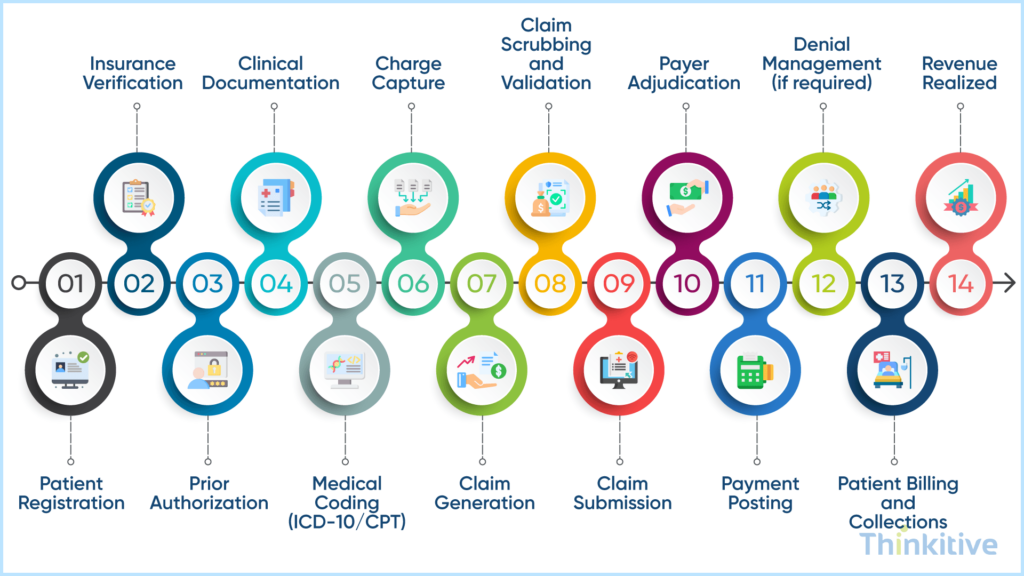
Now, if you have looked at the workflow, then you realize that every stage depends on the accuracy of the previous one. So, even a small error early in the workflow can lead to delayed reimbursement, claim denials, or lost revenue.
This is why revenue cycle management EHR modules are being designed to connect every financial workflow into a single automated process. This way, practices don’t get to treat billing as a standalone function.
Here is a table that outlines each stage of the revenue cycle, what your EHR RCM module needs to build, and the data required to support it for better understanding:
| RCM Stage | What the Module Must Build | Data It Depends On |
| Patient Access | Patient registration, insurance verification, and eligibility checks | Patient demographics, payer ID, insurance plan details |
| Charge Capture | Encounter-based charge capture and charge entry workflows | Clinical documentation, ICD-10/CPT/HCPCS codes |
| Claim Generation | 837 claim creation, validation, and claim scrubbing | Encounter data, diagnosis and procedure codes, payer-specific rules |
| Claim Submission | Clearinghouse integration or direct payer claim submission | Validated 837 transaction and payer connectivity |
| Remittance Posting | 835 ERA processing and automated payment posting | Electronic Remittance Advice (ERA), payer payment details |
| Denial Management | Denial work queues, reason code mapping, and appeal tracking | Claim status, CARC/RARC denial codes, payer responses |
| Patient Billing | Patient statement generation, payment collection, and balance management | Patient responsibility, copays, deductibles, outstanding balances |
How Do You Build an RCM Module Into Your EHR?
The revenue cycle management EHR modules should be built around your system dependencies rather than the typical steps in the revenue cycle. This way you can ensure each workflow has the data and integrations required to function reliably and independently.
Building an EHR RCM module indeed involves mapping the patient revenue journey, but it’s not the same as mapping. You see, the revenue cycle begins with patient registration and ends with reimbursement, but the EHR RCM development process starts with foundational workflows and integrations that enable every subsequent module.
On that note, here are the stages that represent the practical approach to building a scalable and connected EHR revenue cycle management module:
- Map the Revenue Cycle and Define the Handoffs: Start by mapping your complete revenue cycle and identify where information moves from one workflow to another. This will help you understand the workflows and lets you define how clinical documentation, coding, billing, and payer interactions connect. In this, you must also focus on establishing parallels between clinical data transitions into financial data.
- Establish Payer Connectivity First: Before building claims processing, you need to understand that eligibility and insurance verification are necessary, right? That is why you should integrate your system with clearinghouses and payer systems. A working EDI pipeline ensures that future claims submissions, status inquiries, remittance advice, and other payer transactions can be supported reliably.
- Link Charge Capture to the Clinical Encounter: Charges should be generated directly from clinical documentation rather than entered manually after the visit. Connecting charge capture with diagnoses, procedures, and provider documentation reduces duplicate data entry and improves billing accuracy.
- Build Claim Assembly and Claim Scrubbing: Develop workflows that generate standardized claims and validate them against payer-specific rules before submission. Combining this with automated claims scrubbing allows you to identify missing information, coding inconsistencies, and formatting errors that commonly lead to denials.
- Build Claim Status Tracking and Remittance Posting: Once the claims are submitted, the system should automatically be able to track their status, process electronic remittance advice (ERA), and reconcile payments. This not only improves visibility into the reimbursement process but also reduces manual follow-up.
- Build Denial Management, Appeals, and Patient Billing: The focus in this final stage is on managing denied claims, tracking appeals, generating patient statements, collecting balances, and delivering financial reports. With this, you basically connect all the preceding workflows, which allows you to gain complete visibility into your revenue performance, which you can use to optimize on the opportunities.
Where the Clinical System and the Financial System Meet
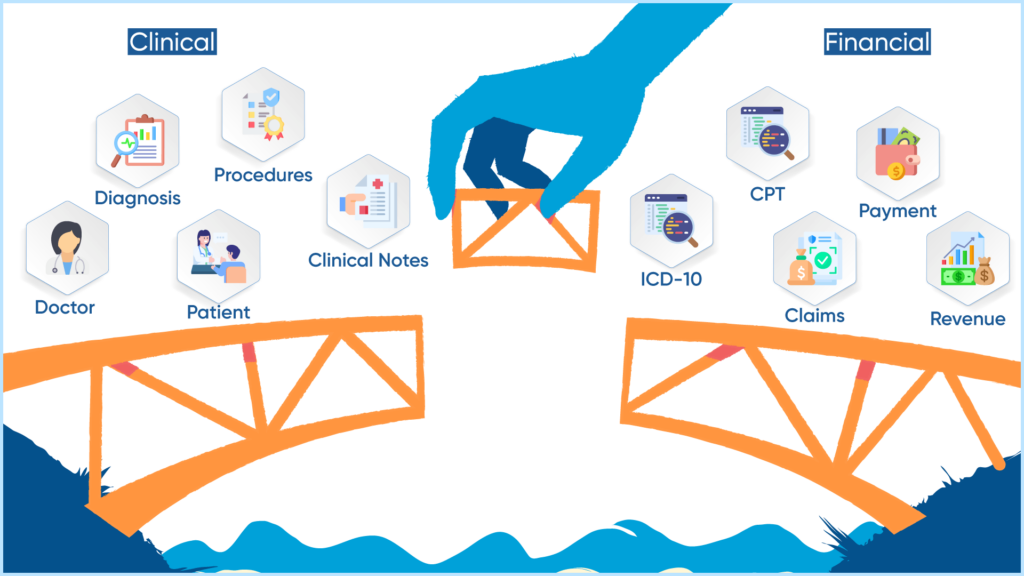
The foundation of an EHR revenue cycle management module is the encounter-to-charge workflows. This ensures that clinical documentation is automatically translated into accurate financial transactions.
In your revenue cycle, the post critical point would be where clinical care transitions into billing. Here, once a provider documents a patient encounter, that information should automatically generate diagnoses, procedures, and billable charges without any need for manual re-entry.
With this process, coding accuracy will improve and minimize administrative efforts.
Furthermore, by linking charge capture directly to the patient encounter, clinical and financial teams would have the same source of truth rather than maintaining separate records and reconciling data later.
However, in this, you must ensure that every update made during the clinical workflow must seamlessly flow into the financial workflow, reduce delays, and improve reimbursement accuracy.
This connected approach is what differentiates an EHR RCM module from standalone billing software. So, rather than operating a separate financial application, integrating RCM workflows into EHR systems can be much more convenient, and documentation, coding, billing, and reimbursement functions as one continuous workflow.
Collecting What You Bill
An effective EHR Revenue Cycle Management module doesn’t end with claim submission, and that’s the difference between a good system and a great system. An effective EHR RCM module will track, manage, and optimize every step until the payment is successfully collected.
You see, submitting a claim is just one part of the revenue cycle. The system should automatically track claim status, identify delays, and notify revenue cycle teams when payer action is required. One of the best ways to overcome such challenges is through proactive follow-up, which helps in preventing aging and improves reimbursement timelines.
Furthermore, you also have to draw parallels with how the user behaves. As not every claim is paid on the first submission, your EHR RCM module should include denial management workflows with reason code mapping, work queues, and appeal tracking to help organizations recover revenue instead of writing it off.
On top of that, identifying recurring denial patterns also enables continuous improvements to coding, documentation, and billing processes. Beyond payer reimbursements, the module should simplify patient collections through automated statements, payment plans, online payment options, and balance tracking.
Once this cycle is complete, financial dashboard and reporting provide visibility into key metrics such as claim status, collections, denial trends, and reimbursement performance, helping practices make informed operational decisions.
Build Your Own EHR with AI Scribe Integration for Better Billing –
Read GuideTransaction Standards and Compliance for EHR RCM Development
To ensure security, interoperability, and regulatory compliance across every financial workflow, your EHR RCM module must support industry-standard healthcare transactions.
On that note, here are some of the standards and compliance requirements that your EHR RCM module must support:
- Support X12 EDI Transactions: Build support for the core X12 EDI transaction set, including 270/271 for eligibility verification, 837 for electronic claim submission/ 276/277 for claim status inquiries, and 835 for Electronic Remittance Advice (ERA) and payment posting.
- Comply with HIPAA Transaction Standards: Ensure all electronic billing and payer communications comply with the HIPAA Transactions and Code Sets Rule, enabling standardized and interoperable healthcare transactions.
- Secure Clinical and Financial PHI: Protect both clinical and financial Protected Health Information (PHI) using encryption, role-based access controls, secure APIs, and comprehensive audit logging throughout the revenue cycle.
- Meet HITECH Requirements: Maintain detailed audit trails, user activity logs, and breach notification capabilities to support HITECH compliance while ensuring complete traceability across revenue cycle workflows.
For a better understanding of the standards and regulations, have a look at the table below:
| Standard / Regulation | Purpose in EHR RCM |
| X12 270/271 | Insurance eligibility verification |
| X12 837 | Electronic claim submission |
| X12 276/277 | Claim status inquiry and response |
| X12 835 | Electronic remittance advice and payment posting |
| HIPAA Transactions & Code Sets Rule | Standardizes electronic healthcare transactions |
| HIPAA Security Rule | Protects clinical and financial PHI |
| HITECH Act | Audit logging, breach notification, and compliance reporting |
Conclusion
If you have made it till here, then you must have realized that building an EHR RCM module is not just about digitizing billing workflows. In fact, it is more about creating a connected financial ecosystem that links clinical documentation, coding, payer communication, reimbursement, and reporting into a single, automated process.
So, by focusing on the right development sequence, integrating industry-standard transactions, and embedding compliance and AI-driven automation from the start, healthcare organizations can reduce claim denials, accelerate reimbursements, and improve overall financial performance.
On that note, if you’re to build EHR software , then a well-designed EHR RCM module can lay the foundation for a scalable, efficient, and future-ready healthcare system. So, what are you waiting for? Get your free demo here.
Frequently Asked Questions
To build an EHR RCM module means developing a set of integrated workflows that manage the complete financial lifecycle of a patient encounter. This includes patient registration, insurance verification, charge capture, medical coding, claims generation, payment posting, denial management, patient billing, and financial reporting. Instead of functioning as standalone billing software, the module becomes part of the EHR, allowing clinical and financial data to flow seamlessly across the organization.
A revenue cycle management EHR helps healthcare organizations automate financial operations while reducing manual work, billing errors, and reimbursement delays. By connecting clinical documentation with coding, claims processing, and payer communication, an integrated RCM module improves claim accuracy, accelerates reimbursements, and provides greater visibility into the organization’s financial performance.
EHR RCM development typically begins by mapping the complete revenue cycle and identifying how clinical data transitions into financial workflows. The next steps include establishing payer connectivity, linking charge capture to clinical documentation, building claims processing and validation, implementing payment posting and denial management, and finally adding analytics and reporting. Following this structured approach ensures the module is scalable, compliant, and interoperable.
The most important RCM module features for modern EHR platforms include patient registration, insurance eligibility verification, prior authorization, charge capture, medical coding, claims generation, claim scrubbing, clearinghouse integration, payment posting, denial management, patient billing, revenue analytics, and AI-powered workflow automation. Together, these capabilities help improve reimbursement accuracy while streamlining administrative processes.
Integrating RCM workflows into EHR systems ensures that clinical documentation, coding, billing, and payer communication all operate from a single source of truth. This eliminates duplicate data entry, reduces billing errors, improves claim quality, and speeds up reimbursement. Connected workflows also provide better visibility into the healthcare claims processing workflow, helping organizations identify and resolve revenue bottlenecks more efficiently.
Healthcare organizations can reduce claim denials by connecting clinical documentation directly with coding, charge capture, and claim validation. Automated eligibility verification, payer-specific claim scrubbing, real-time error checks, and effective denial management in EHR help identify issues before claims are submitted. This proactive approach minimizes rework, improves first-pass claim acceptance, and accelerates reimbursements.
An EHR RCM module should support the core X12 EDI transaction set used in healthcare billing. This includes 270/271 for eligibility verification, 837 for electronic claims submission, 276/277 for claim status inquiries and responses, and 835 for Electronic Remittance Advice (ERA) and payment posting. Supporting these transactions ensures secure, standardized, and interoperable communication with payers and clearinghouses.
Charge capture acts as the bridge between clinical care and financial operations. Instead of manually entering billing information after a patient visit, the EHR automatically generates billable charges from provider documentation, diagnoses, and procedures. This connection improves coding accuracy, reduces missed charges, minimizes duplicate data entry, and creates a more efficient healthcare claims processing workflow.
When considering how to build a revenue cycle management module in EHR, compliance should be a core design requirement. The module should support HIPAA Transactions and Code Sets, HIPAA Security Rule requirements, and X12 EDI transaction standards while protecting clinical and financial Protected Health Information (PHI). It should also include audit trails, role-based access controls, encryption, and HITECH-compliant security measures to ensure regulatory compliance and secure healthcare data exchange.


