Build Your Own EHR: API Design & Documentation Guide


Did you know that 7 in 10 US hospitals reported using standards-based APIs such as HL7 FHIR to allow patients to access their health information?
Yes, according to a report by the ONC Health IT, this statistic became quite evident, supporting the growing adoption of standards-based APIs in healthcare. And practices building their own EHR system are relying on the EHR tech stack, and especially EHR API architecture, to allow the exchange of data securely and consistently between patients, providers, applications, and other healthcare systems.
One of the latest standards in this has been FHIR, and it has also evolved since its introduction. According to another report by ONC Health IT, FHIR grew from 49 Resources to 145 Resources as the standard matured, providing a broad framework for representing and exchanging clinical and administrative healthcare data.
Furthermore, highlighting its adoption rate, HL7’s 2025 State of FHIR survey reported that 73% of respondents said FHIR was either mandated or formally advised in their country.
Now, if you observe closely, these trends show an important implication that EHR API architecture cannot be treated as an afterthought. In short, the decision you make while building your EHR system around API structure, FHIR resources, authentication, authorization, versioning, error handling, testing, and documentation can determine how easily you can integrate your EHR with other third-party applications and be a part of the broader healthcare ecosystem.
On that note, let this blog be your EHR API design guide and help you understand all the aspects of EHR API design and documentation, right from EHR API endpoints to securing APIs and preparing them for scalable interoperability.
So without further ado, let’s get started!
Free Assessment for Your System’s API Design & Customization Ability –
Get Free Assessment
What Does an EHR API Need to Expose?
An EHR API should expose the clinical, administrative, and operational data and actions that providers, patients, and external systems need to securely access, exchange, and act on.
Now, when you build your own EHR, API boundaries should follow clinical and operational workflows and not the underlying database schema. A database may typically organize information into dozens or hundreds of tables, but exposing those tables directly can create tightly coupled APIs that are quite difficult to secure, version, document, and maintain.
Instead of this, you can group APIs around meaningful healthcare capabilities and resources that external consumers can understand. Let’s try to understand with the help of an example. For instance, patient demographics, clinical data, scheduling, lab orders, documents, and billing each serve different workflows and end users. Here, separating them into logical API domains makes it easier to control access, evolve individual services, and integrate your EHR system with external systems without exposing unnecessary details.
Here is how you can sort the core API groups that your EHR might need to expose:
| API Group | What It Exposes | Who Consumes It |
| Patient | Demographics, identifiers, coverage | Patient portals, registries, partner applications |
| Clinical | Encounters, conditions, medications, allergies | Care partners, analytics, clinical decision support |
| Orders & Results | Laboratory and imaging orders, results | Laboratories, imaging centers, LIS |
| Scheduling | Slots, appointments, provider availability | Booking tools, referral systems |
| Documents | Clinical notes, summaries, and care documents | Transitions of care, HIEs, partner systems |
| Billing | Claims, eligibility, remittance status | Clearinghouses, payers, billing partners |
Design Principles for EHR APIs
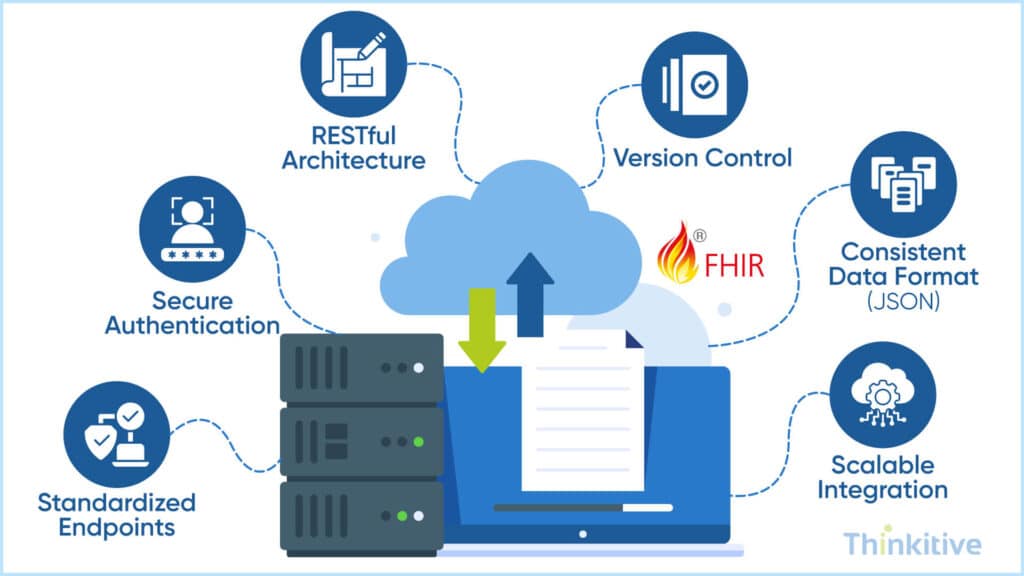
A well-designed EHR API should be predictable, resource-oriented, and resilient enough to handle clinical workflows and integration failures without compromising data integrity.
On that note, here are some of the EHR API design principles that you should follow:
- Design around clinical resources: Build endpoints around concepts such as patients, encounters, medications, appointments, observations, and not internal database tables or schema.
- Standardize search and pagination: Use consistent parameters, response structures, sorting, filtering, and pagination across API endpoints so developers don’t have to learn different patterns for each resource.
- Make write operations idempotent: Ensure retries of requests such as creating appointments, orders, or clinical records don’t accidentally create duplicates.
- Return Actionable Errors: Use meaningful HTTP status codes and structured error responses that tell consuming systems what went wrong and, where possible, how to resolve it.
Curate the API Design that Suits Your EHR System & Pracitce Best –
Get Free ConsultationWhat Belongs in EHR API Documentation
Good healthcare API documentation can turn a technical, functional EHR API into an integration-ready API. It gives the developers everything they need to understand, authenticate, test, and troubleshoot each endpoint.
This is what your EHR API endpoints should clearly document:
- Purpose and resource: What the endpoint does and which clinical or operational resource it acts on.
- Authentication and authorization: Authentication method, required scopes, and access requirements.
- Request and response schemas: Required parameters, data types, response structures, and working example payloads.
- Errors: Every relevant error code, what it means, and how the consuming system can respond.
- Rate limits and pagination: Request limits, pagination parameters, page-size rules, and response metadata.
- Versioning and deprecation: Current API version, backward-compatibility expectation, deprecated endpoints, and sunset timelines.
Keeping APIs Stable as the System Changes
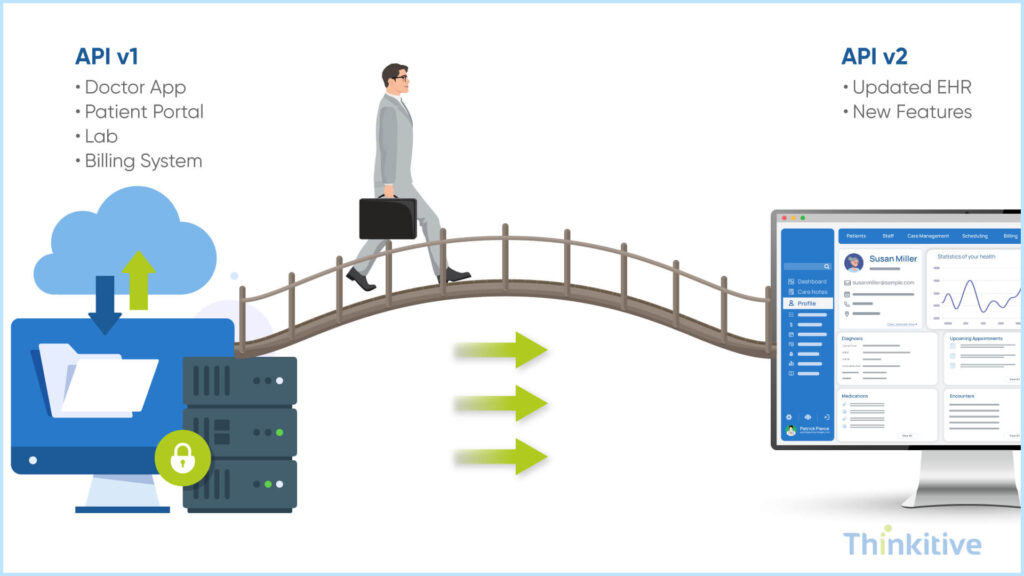
EHR APIs should be designed for change, meaning without forcing existing integrations to break every time the underlying system evolves. That is why EHR APIs should be treated as a long-term contract with their integration partners.
Here are some of the best practices to keep the EHR APIs stable even if the system changes:
- Version before integration: Define the versioning strategy before exposing the first external API. This gives every integration a predictable contract from day one.
- Preserve existing contracts: New EHR releases should avoid breaking existing endpoints, response structures, and data types wherever possible.
- Deprecate, don’t abruptly remove: When an API must change, provide a defined deprecation period and migration path so that your system is intact before you retire the older system.
- Communicate every change: Maintain a changelog that clearly identifies new features, fixes, deprecations, and breaking changes so integration teams can plan their updates accordingly.
One of the best ways to track your APIs and how everything is functioning in your system is by reporting. Read— How to Build EHR That Supports CMS Quality Reporting —for better understanding and building reporting that gives you insights.
Compliance Requirements for Healthcare APIs
Healthcare EHR APIs must support interoperability while meeting requirements for secure access, authorization, privacy, and protection of electronic protected health information (ePHI).
Here are some of the compliance and regulatory requirements that you must know:
| Compliance Area | What It Means for EHR APIs |
| ONC Certification | Certified health IT must support standardized APIs for patient and population services, including access to data through required API capabilities. |
| SMART on FHIR and OAuth 2.0 | Certified API access uses standardized authorization mechanisms, including OAuth 2.0-based authorization and SMART App Launch capabilities where applicable. |
| 21st Century Cures Act | The Cures Act established a framework for interoperability and prohibits information blocking, including practices that interfere with legally permitted access, exchange, or use of electronic health information. |
| HIPAA and HITECH | APIs handling ePHI need appropriate safeguards for authentication, authorization, transmission security, access controls, and auditability. API activity involving PHI should be logged where required by the organization’s compliance and security policies. |
Conclusion
If you have carefully paid attention up to here, then you would know that a well-designed EHR API is the foundation of secure, scalable, and interoperable healthcare data exchange. This includes defining resource-oriented endpoints and consistent API behavior, from implementing FHIR, secure authorization, versioning, and comprehensive documentation.
Each decision to make with respect to your EHR API architecture affects how easily your EHR can integrate with the broader healthcare ecosystem.
So, when you build your own EHR, treat the API as a long-term product and not just a technical layer. Let this EHR API design guide you to design your EHR APIs for interoperability, stability, and developer usability from the start. This will help you make future integrations, compliance efforts, and system expansion significantly easier.
Now that you know how to develop an EHR system along with its API endpoints, get started with its development. Get your first free consultation from our EHR expert.
Frequently Asked Questions
An EHR API design guide explains how to structure, secure, document, version, and maintain APIs used by an electronic health record system. It typically covers EHR API architecture, resource-oriented endpoints, FHIR interoperability, authentication, authorization, error handling, versioning, and documentation.
The APIs an EHR needs to expose depend on its clinical and operational workflows, but common API groups include Patient, Clinical, Orders and Results, Scheduling, Documents, and Billing. These EHR API endpoints allow patient portals, providers, laboratories, payers, analytics platforms, and other healthcare applications to securely access and exchange relevant information.
The key practices for how to design APIs for an EHR system include designing around clinical resources rather than database tables, using consistent search and pagination, supporting standardized healthcare data exchange such as FHIR, making write operations idempotent, implementing strong access controls, and returning structured errors. A well-planned EHR API architecture should also account for scalability, interoperability, security, and backward compatibility.
EHR API documentation best practices include clearly describing each endpoint’s purpose, supported resources, authentication and authorization requirements, request and response schemas, example payloads, error codes, rate limits, pagination behavior, and versioning policies. Good healthcare API documentation should give integration teams enough information to authenticate, test, troubleshoot, and implement an API without relying on undocumented behavior.
Healthcare APIs should establish a versioning strategy before external integrations are launched and maintain backward compatibility wherever possible. When an API must be changed, providers should publish a clear deprecation timeline, provide migration guidance, and communicate changes through a developer-facing changelog. This helps prevent existing EHR API endpoints from unexpectedly breaking partner integrations.
API authentication for healthcare commonly uses OAuth 2.0-based authorization, with SMART App Launch providing standardized patterns for applications accessing FHIR-based EHR systems. Depending on the use case, APIs may also use scopes, tokens, OpenID Connect, and other security mechanisms to ensure that applications and users can access only the data they are authorized to access.
ONC certification requirements include standardized APIs that support access to patient and population data using required interoperability standards and capabilities. Certified health IT also has requirements around API documentation and secure authorization. EHR developers should review the applicable ONC certification criteria and implementation guides when designing APIs for certified health IT.
The 21st Century Cures Act established a federal framework for interoperability and addresses information blocking, including practices that interfere with legally permitted access, exchange, or use of electronic health information. As a result, EHR API architecture should support appropriate, standardized access to health information while avoiding unnecessary technical or contractual barriers to permitted data exchange.
To keep an EHR API stable, define versioning early, preserve backward compatibility, use controlled deprecation periods, and communicate changes clearly. Following EHR API documentation best practices also helps integration partners understand changes and migrate safely as the underlying EHR evolves.


