Integration of Telehealth Features in EMR Software

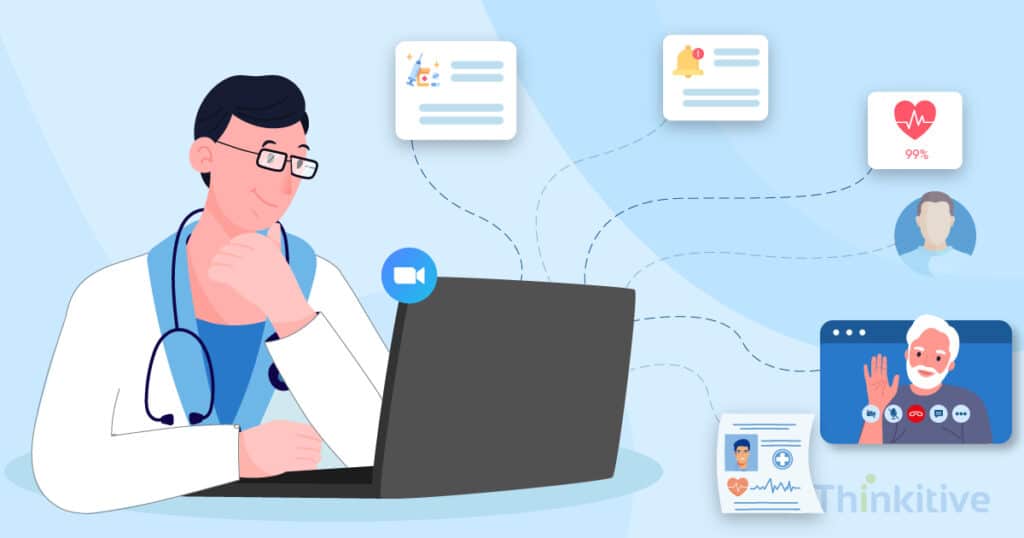
According to a factsheet published by the American Hospital Association, as many as 76% of the hospitals had started using telehealth services to connect with patients remotely. Though these statistics reflect the time before the COVID-19 pandemic, the number has significantly increased since then.
Defying all the odds, telehealth has proved to be a successful venture in healthcare practice, as 96% of telepsychiatry patients reported satisfaction with the virtual mental healthcare experience. As the benefits of telehealth are gaining traction in the healthcare landscape, many healthcare practices are turning to custom healthcare software for telemedicine solutions.
However, this might just add another software to your practice, right?
How about I tell you there is a way you can actually use the telehealth features and contribute to your healthcare delivery optimization? Yes, with EMR software development, you can enable remote patient monitoring through telehealth integration in the EMR.
Sounds confusing? – Let me simplify this for you as you read along.
In this blog, let’s explore the potential benefits of EMR and telemedicine integration and how it can simplify virtual care delivery for you.
Assess Your EHR System for AI Readiness
Get Free AssessmentStreamlined Patient Management & Digital Health Platforms
Let’s begin with the basic functionality of EMR software development with telehealth integration. You see, EMR software has a different purpose, and telehealth is used to provide healthcare. By telehealth integration in EMR, you do not have to manually update the patient’s care journey.
Your EMR software acts as a unified platform for both accessing patient information and communicating. By integrating billing and payment methods, you further extend its functionality and allow your patients to have a complete virtual care experience.
Here are some other benefits of EMR and telemedicine integration in patient management:
- Automated Reminders and Notifications: For your practice, EMR will act as a documented patient care journey; on that basis, follow-ups can be streamlined. Moreover, with the advanced features like reminders and notifications, the chances of no-show can be significantly reduced, and the overall efficiency of your practice can be improved.
- Centralized Data Management: Telehealth integration in EMR allows you to effectively manage data. The collection of video call notes and patient vitals from RPM devices can be directly integrated into the EMR software, ensuring complete and up-to-date medical record keeping.
An easy use case for you to understand this is that, with a unified platform, the patient can use one platform to schedule appointments, follow-up appointments, and consult with the providers.
Other than that, one of the best digital health platforms that you can include in your EMR systems is the patient portal, powered by AI. Now, with AI-assisted self-intake procedures, you can increase patient engagement significantly. For instance, with AI-assisted self-intake processes, patients can self-fill their information, and the system will guide them through the future processes. This way, the routing guide will take the patients to the appropriate telehealth services. This way, you can ensure appropriate and quality care, allowing your care services to be more personalized and holistic.
NOTE: Imbibing digital healthcare services and present many challenges, which have to be overcome during the development stage. However, the problem is most developers aren’t aware of those until they start development. So, to easily overcome them, read our blog – Common Challenges in Custom EHR Development and How to Overcome Them.
Enhanced Clinical Workflows with Intelligent Support
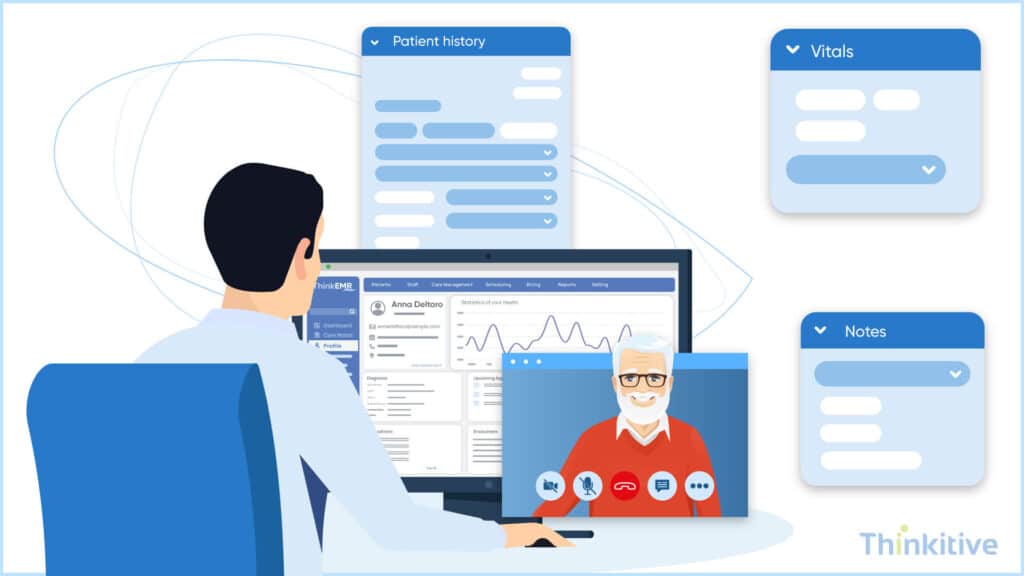
Appointments and consultations are two of the major cornerstones for any practice’s workflow, whether clinical or administrative. Let’s see how EMR and telemedicine integration can benefit your practice in terms of workflows:
- Real-time Data Access: Oftentimes, a lack of access to real-time data delays the consultation. However, with telehealth integration in EMR, the doctor can easily access real-time patient data and accurately diagnose patients and reduce the time to care.
- Integrated Video Conferencing: Telemedicine solutions are crucial for communication in remote monitoring for patients. With its integration, you don’t have to rely on two different software solutions, and your EMR software acts as an all-in-one platform for virtual care delivery.
- Improved Collaboration: Another benefit of EMR and telemedicine integration is bringing the entire care team on the same page and working towards the same goal. For instance, during consultation, your providers can easily share patient data with other providers and consult with patients in real-time without the need for an in-person visit.
- Remote Monitoring Integration: Collection of patient data is another aspect of care delivery, which initially seemed troublesome in virtual care delivery. However, device integration during EMR software development can improve the clinical workflow by allowing continuous monitoring and health tracking.
Talking about intelligent EMR telehealth systems and not talking about AI-driven features is something that you simply can’t do in 2026. The year 2026 is said to be a crucial year for healthcare practice as many providers are said to shift to a custom EMR software as their primary digital health platform.
Moreover, many providers have actively sought ambient clinical documentation support for their telehealth EMR systems. Due to this, most of the documentation aspects of the practice are automated and streamlined. This can reduce the manual note-taking efforts during virtual visits and save the valuable time of providers. Furthermore, providers don’t have to dwell more on documentation, but rather just focus on care delivery, while the system takes care of documentation and note-taking processes.
Other than that, another feature that is said to be seen in most of the remote patient monitoring platforms is that of intelligent alerts. With an intelligent alerting system synchronized and integrated with the telehealth EMR system, the system will be able to directly highlight abnormal RPM data instantly and even during live consultations. This removes the data accessibility gaps and bridges the gap between effective and efficient care delivery.
Complete the Digital Transformation Arc of Your Practice with Telemedicine Integration
Get Free ConsultationTelehealth-Ready EMR Modules: Accessibility & Reach
One of the major benefits of telemedicine solutions has been recognized as improved accessibility and reach. It significantly improves accessibility to care services for patients in rural or underserved areas. Taking it a step further from there, here are some of the benefits of EMR and telemedicine integration:
- Expanding Access to Care: EMR software with telehealth integration allows patients to connect with providers virtually. This way, accessing care for patients with mobility limitations becomes much easier, and if you are opting for RPM device integration, then most of the gaps in virtual care delivery can be bridged.
- Specialist Consultations: People in rural areas often have access to generic care consultations; the lack of specialist care further elongates the recovery process and can lead to mistakes as well. However, with EMR and telemedicine integration, access to specialist consultation can be made possible, which can significantly improve the care delivery process.
- Reduced Travel Time and Cost: EMR software coupled with telehealth can significantly reduce travel time and cost, if not completely eliminate them. It not only becomes a cost-saving venture but also adds a factor of convenience for both patients and providers.
Another type of care delivery that has been made possible by telehealth EMR systems is that of asynchronous care, aka store-and-forward care. In this type of care model, building telehealth-ready EMR systems is crucially important. To give you an idea about how this works, first, the patient signs into the EMR systems and submits data such as symptoms, images, vitals, and questionnaires. This data is then stored securely in the EMR telehealth system, which is later accessed by clinicians to review and respond whenever time permits.
While this use case is not possible for all the specialties, specialties like Dermatology, Behavioral Health, Medication refills, etc., are some of them that have been extremely beneficial.
Furthermore, by building telehealth-ready EMR systems for asynchronous care, you can reduce clinicians’ workload, improve access to care, improve turnaround for simple cases, and lead to better documentation and compliance.
Refer to the table below to know the quick difference between asynchronous and synchronous telehealth:
| Aspect | Asynchronous Care | Live Video Visits |
| Timing | Non-real-time | Real-time |
| Scheduling | Not required | Required |
| Provider efficiency | High | Moderate |
| Best for | Routine, follow-ups | Complex cases |
| EMR value | Strong documentation | Strong interaction |
Increased Revenue & Operational Efficiency

Telehealth integration in EMR gives your practice the potential to expand its reach and treat more patients than in a traditional healthcare landscape. This way, it not only contributes to increasing the practice revenue but also other features that leverage automations also contribute to the increased efficiency of your practice.
- Increased Patient Volume: By increasing your reach, the first thing that you will most likely notice is an increase in patient volume. This is the clear indication that your practice is on the right track of adopting digital technologies, and it is most natural that with increased patients, you will increase practice revenue as well.
- New Revenue Streams: Traditional practices are not going to be replaced; in fact, telehealth integration in EMR opens a new door for adding a new revenue stream to your practice. And since there are different CPT codes for RPM and other services, with EMR and telemedicine integration, you indirectly add another stream of revenue for your practice.
- Optimized Resource Utilization: Telehealth brings convenience in patient-provider consultation for both providers and patients. However, for practice as a whole, it reduces the chances of emergency visits or hospital readmissions. This way, you can optimize the resources and clinical space, leading to more efficiency for your resources.
- Predictive Scheduling Insights: When talking about effective utilization of resources and having an intelligent EMR system, it makes sense to have a predictive insights system. With this system, you can gain meaningful insights from the behavioral patterns of your patients. This can prove to be crucial in reducing telehealth no-shows, which can have a significant impact on your revenue, and you will be able to manage other operational things more efficiently.
- Streamlined Billing and Coding: Telehealth integration in EMR makes your EMR software a unified platform. As your EMR software becomes a centralized data center, billing and coding practices become much easier, and workflow optimization contributes to its accuracy. This leads to accurate billing and coding practices, reducing the chances of claims denials and improving the practice’s revenue cycle.
Step-by-Step HIPAA-Compliance Custom EHR Development Roadmap
Get Free ConsultationData Security, Compliance & Responsible AI
However, with the increasing adoption of technology for data collection, management, and virtual care delivery, the chances of cyberthreats also increase. That is why increasing data security by adhering to the necessary compliance is necessary. Here are some of the major data security and compliance concerns that you must address:
- HIPAA Compliance: HIPAA compliance in telehealth platforms and custom EMR software development is necessary, and achieving it can be a milestone in improving the security of your virtual care delivery practice. It not only acts as a rule book for improving security but also enables you to seamlessly navigate through the legal and regulatory landscape of virtual care delivery.
- Data Encryption: The data you are storing in EMR software is always at risk of being compromised. To avoid that, data encryption practices must be implemented as they add another layer of security to your data, and in case the data is breached, it becomes hard for the other party to make sense of it.
- Access Control: The EMR software and telemedicine will be used by many people in your practice. However, given the sensitive nature of the data, it should be accessed by authorised personnel only. By implementing robust access control features, you limit who can view, access, and make amendments to that information.
Last but not least, if you’re including AI into your telehealth EMR systems, then out of all the other factors like biases, you should also extensively focus on the explainability factor. This is crucial because AI, especially in telehealth EMR systems, is still in developing stages, and it can make mistakes.
However, with an explainability factor, the providers can know how the system came to that particular conclusion, and this can elevate clinical trust and ensure patient safety.
Know the Functions in Your Custom EHR that can be Powered by AI
Get Free ConsultationConclusion
Telehealth integration in EMR software is one of the most anticipated future trends in healthcare technology that has finally started to take shape. From the creation of a unified platform to increase accessibility and reach, it covers all the major aspects of turning the healthcare system into what it should be.
However, the world is far from behind in accepting and embracing telemedicine solutions. Being the frontrunners of using technology for healthcare delivery optimization, let’s take the leap of faith and start your practice’s digital transformation with EMR software development and telehealth integration to give your patients a complete virtual care experience.
Frequently Asked Questions
Integrating telehealth EMR systems allows small and mid-sized practices to expand care delivery without expanding physical infrastructure. Providers can conduct virtual visits, access real-time patient records, and document encounters from a single interface. This reduces administrative overhead, improves care continuity, increases patient access, and enables faster reimbursement—making EMR telehealth adoption both clinically and financially sustainable.
In remote patient monitoring, devices like wearables and home sensors transmit patient vitals through secure APIs or IoT gateways. Custom EMR systems ingest this data in near real time, normalize it, and map it directly to the patient’s longitudinal record. Alerts, trends, and thresholds can be configured so clinicians receive actionable insights instead of raw data—supporting proactive care and early intervention.
AI ambient scribing can automate a significant portion of documentation during virtual visits by transcribing conversations, extracting clinical context, and generating structured notes. However, in most digital health platforms, it works best as a co-pilot—reducing clinician documentation time by 60–80% while still allowing provider review and approval for accuracy, compliance, and medico-legal safety.
By 2026, secure video conferencing within digital health platforms must include end-to-end encryption, role-based access controls, audit logs, secure session storage, and Business Associate Agreements (BAAs) with video service providers. Telehealth-ready EMRs must also ensure that video metadata, chat logs, and shared files are protected under HIPAA safeguards and integrated securely into the patient record.
Telehealth-ready EMR modules support asynchronous care by securely storing images, videos, and documents uploaded by patients or referring providers. These assets are tagged with clinical context, time-stamped, and routed into provider work queues for later review. This model is especially effective for dermatology, radiology, wound care, and specialty consultations—without requiring real-time appointments.
Yes, over time. While off-the-shelf solutions may offer faster initial deployment, custom EMR software development delivers better ROI by eliminating recurring licensing fees, reducing workflow inefficiencies, and enabling deep customization. Practices building telehealth-ready EMR systems can tailor features to their exact clinical and operational needs, resulting in higher provider adoption, better patient outcomes, and long-term cost control.
AI-driven scheduling analyzes historical attendance data, patient behavior, appointment types, and engagement patterns to predict no-show risks. Integrated within EMR telehealth workflows, it can automatically recommend optimal appointment times, trigger smart reminders, or suggest overbooking strategies—helping practices reduce no-shows, maximize clinician availability, and improve virtual care efficiency.


