Custom EHR Development: Complete Cost Breakdown


Electronic Health Record systems have become the epicenter of the healthcare industry over the last few years. You see, all the data that is required for healthcare delivery and administration runs through your EHR system.
This might give you an idea about how important EHR systems are for a healthcare practice. However, when it comes to actually buying an EHR software for your practice, the choice between EHR software licensing vs custom-built software can at times be very dilemmatic.
Let me explain.
You see, with off-the-shelf EHR software, you would have to pay a subscription price, and it would be implemented into your system in almost no time. On the other hand, with EHR system development, you have to design the software, build it, and then implement it into your system.
Now, let me tell you a trend that is revolutionizing the healthcare industry. You see, custom EHR development cost is indeed more than that of a generic EHR. However, many practices are choosing EHR system development, as the one-size-fits-all EHR approach simply doesn’t meet their current and growing needs to not only deliver care but also for effective administration.
Due to this, EHR system development appears to be a suitable choice. However, the question, ‘How much does custom EHR development cost?’ can be quite daunting.
But let me tell you something that I have learned after designing specialty-specific EHRs is that, if you know the right way, you can actually get a custom EHR at an appropriate price.
On that note, let’s see the custom EHR development cost breakdown and what are the things that you need to know with respect to this.
So, without further ado, let’s get started!
Calculate Your Custom EHR Development Cost –
Calculate Development CostWhat Does Custom EHR Development Cost?
Most custom EHR development projects cost between $50,000 and $500,000+, depending on feature complexity, integrations, compliance requirements, and deployment scale.
| EHR Type | Typical Cost |
| MVP | $50K–100K |
| Mid-size | $100K–250K |
| Enterprise | $250K–500K+ |
NOTE: These pricing ranges are based on typical custom EHR development engagements and vary depending on project scope, integrations, compliance requirements, and deployment scale.
What Drives Custom EHR Development Cost?
| Cost Driver | Lower Development Cost | Higher Development Cost |
| Project Scope | Basic MVP with essential workflows | Enterprise platform with multiple clinical and administrative modules |
| Feature Complexity | Scheduling, patient records, ePrescriptions | AI, Telehealth, Patient Portal, Analytics, RPM |
| Integrations | Limited third-party integrations | HL7, FHIR, Labs, Imaging, Billing, Medical Devices |
| HIPAA Compliance & Security | Standard security controls | Advanced encryption, audit logs, role-based access, compliance testing |
| Practice Size | Single-provider or small practice | Multi-provider, multi-location, multi-specialty organization |
| Infrastructure & Scalability | Standard cloud deployment | High-availability architecture with future scalability |
Key Takeaways
- Custom EHR development typically costs between $50,000 and $500,000+, depending on your practice size, feature requirements, integrations, and compliance needs.
- The biggest cost drivers include workflow complexity, HL7/FHIR integrations, HIPAA compliance, AI capabilities, and long-term scalability.
- An MVP-first approach helps reduce upfront investment while allowing you to expand the platform as your practice grows.
- Custom EHRs deliver better long-term value by eliminating recurring licensing fees and supporting practice-specific workflows.
- Careful discovery and planning help avoid costly rework, delays, and budget overruns during development.
Build vs Buy: Understanding the Real Cost Difference
Before actually getting into the details of EHR implementation cost breakdown, let’s first see if EHR software licensing vs custom build, and which one is more suitable for you.
So, first things first, if you’ve chosen to buy an EHR, then you only have to pay recurring licensing fees. Now, while it appears to be an affordable and economical solution, the hidden costs that come with it can run your budget dry.
To give you an idea about the hidden costs, off-the-shelf EHR software limits you in customization, which makes the entire system quite rigid to use. On top of that, it comes with a vendor lock-in period, meaning you can’t switch to another system until the lock-in period is completed.
However, the major drawback comes during scaling. In simple words, the cost comes in the form of per user, so as your users increase, the cost also increases. And due to the lock-in period, your data is not yours completely, and neither is your EHR software that you’re using.
On the other hand, with EHR system development, you have to pay a high cost; however, you not only own the complete software, but you also overcome the other inefficiencies that are present in off-the-shelf EHRs.
So, if you’re looking for an EHR system for a small practice, then go ahead with an off-the-shelf EHR system. Whereas if you’re a large practice or a growing practice, then EHR system development is the way for you to go.
| Factor | Off-the-Shelf EHR (Licensed) | Custom EHR Development |
| Upfront Cost | Lower | Higher |
| Recurring Cost | Monthly/annual subscription fees | Maintenance and support only |
| Customization | Limited | Fully tailored to your workflows |
| Ownership | Vendor-owned platform | Full ownership of the software |
| Scalability | Cost increases as users grow | Designed to scale with your practice |
| Long-Term Cost | Higher total cost due to recurring licensing | Lower total cost of ownership for growing organizations |
For small practices with standard workflows, a licensed EHR may be the most economical option. However, for growing, multi-provider, or specialty healthcare organizations, custom EHR development offers greater flexibility, ownership, and a lower total cost of ownership over the long term despite the higher initial investment.
Phase-by-Phase Custom EHR Development Cost Breakdown
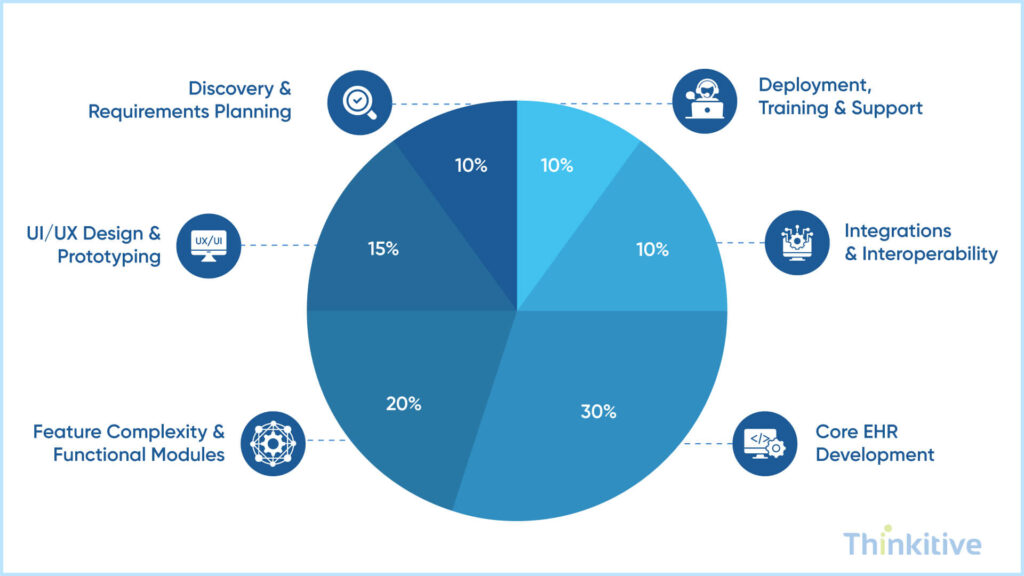
EHR system development moves through different phases, starting from discovery to deployment, and every phase comes with a cost. Let’s have a brief look at the custom EHR development cost breakdown for every phase.
Discovery, Planning & Compliance Foundations
During this stage, every minute detail about your EHR software is discussed and finalized. Some of the core aspects of this include clinical workflows, administration workflows, and their analysis. After this, all these requirements are then validated with respect to the software.
On the basis of this, you have to determine or plan your budget. In this, HIPAA-compliant EHR development cost is something that will make up most of your budget. Now, paying attention in this phase is important because it is on this basis that the foundation of your system can be laid.
You see, weak discovery leads to a lot of rework, delays, and budget overruns when you actually start to develop your EHR.
UX/UI Design for Clinician-Centric Workflows
The next phase is the designing phase. At this stage, you will be designing the User Interface and User Experience of your custom EHR software. A few things that you need to consider in this phase are role-based design. For instance, physicians, nurses, and administrators need different dashboards and even work on different data. So, having a single dashboard will simply make no sense.
This is one of the best practices that you can adopt for EHR usability optimization. You see, the better the design of your software, the better your users can use it. This can reduce the training cost drastically and even the adoption costs.
Also, specialty-specific EHR design is something that you should focus on for EHR workflow optimization. And when making UX decisions, consider the long-term prospects of this. You see, poor usability can lead to rewiring the entire software, which can be a very costly affair, even for a large practice.
One of the most common problems that many practices face is ‘Too Many Clicks’ in their system. And there are many things that can be done to solve this problem. Read our blog – Solving the “Too Many Clicks” Problem in EHR Systems, to know the solution in detail.
Core EHR Development & Customization
After design comes the stage where the developers actually code and develop the software. Some of the major factors that affect the cost at this stage are frontend, backend, and system architecture development. These are not easy processes and require a specialized team for that.
Having said that, the logic for custom development seems easy; however, when it comes to configurable components, this is where things get complicated. Here, you have to find a perfect balance between your development logic and align it with the components that are actually responsible for development.
Now that we’re here, this is something that you need to know. Healthcare software development gives you two choices: either build an MVP product and capitalize on it, or build an enterprise EHR development.
Here, both MVP and enterprise EHR development benefit you, but since we’re trying to break down cost, sit down with your development partner and choose the approach that suits you best. Build an MVP if your software is heavy and complex, or else go for an enterprise EHR.
Feature Complexity & Functional Modules
It is true that features define the functionality of your EHR software. And this can have a huge impact on the development cost. For instance, advanced modules like those of billing, telehealth, patient portals, analytics, etc., are quite complex and require integrations with multiple systems. Due to this, the cost of the development will increase over time.
One of the best ways to overcome this is by avoiding any feature bloating. This can be achieved by the MVP development approach that we discussed earlier. Meaning, build a minimum viable product and release it. Then, as your needs arise, add on new features to that.
This way, you get only the features you need and pay your EHR developers exactly for that.
Download Feature-List for MVP EHR Development –
Download Feature ListIntegrations & Interoperability
Talking about the dependency of your features on different disparate systems, you need to give your EHR system the ability to connect and communicate with other systems. For this, achieving interoperability is crucial. And this is another factor that will massively influence your cost.
Having said that, you need to implement HL7 FHIR standards so that you can integrate your system with disparate systems like labs, pharmacies, billing, and other external systems. Other than that, validating, testing, and maintaining this interoperability or integration bridge with these systems comes bearing a cost.
Now, integrations significantly influence the EHR development cost as most of the clinical and administrative activities depend on other systems. And since it is a complex process, it comes bearing a cost.
Deployment, Data Migration & Ongoing Support
Last but not least comes the go-live phase, and then maintenance starts. The first aspect of this that impacts your development cost here is the secure migration of data from legacy systems. Here, a lot of activities are involved, such as data auditing, deduplication of data, and ensuring compliance with HIPAA.
During deployment, some of the factors that impact the development cost are infrastructure setup, monitoring every activity in your system, and making changes in the system to tune it for optimum performance.
And once the software is deployed into the system, maintenance and support start, which comes with a recurring annual cost.
Custom EHR Development Cost Breakdown
The custom EHR development cost depends on a number of factors like platform complexity, integrations, compliance requirements, specialty-specific workflows, and scalability goals. However, given the requirement of smaller clinics, they may only require a basic EHR MVP; on the other hand, enterprise healthcare organizations require advanced interoperability, analytics, automation, and multi-location support.
Here is a detailed table to help you make the right decision and a near-perfect cost breakdown:
| EHR Type | Estimated Cost | Typical Features | Timeline |
| Basic EHR MVP | $50K–$100K | Patient records, scheduling, billing, ePrescriptions | 3–6 Months |
| Mid-Level Custom EHR | $100K–$250K | Telehealth, patient portal, analytics, HL7/FHIR integrations | 6–10 Months |
| Enterprise EHR Platform | $250K–$500K+ | AI automation, interoperability, RPM, enterprise security | 10–18 Months |
The final EHR development pricing can vary from these numbers based on the regulatory compliance, third-party integrations, mobile accessibility, cloud infrastructure and even custom requirements.
Key Factors That Influence Custom EHR Development Cost
Earlier, we looked at the major cost drivers at a glance. Now let’s explore how each factor affects your development budget in greater detail.
| Cost Factor | What It Includes | How It Impacts Development Cost |
| Scope and clinical complexity | Number of modules, specialties supported, custom workflows, and clinical decision logic. | Broader scope and complex workflows increase design, development, and testing effort. |
| Interoperability depth and ecosystem integrations | FHIR/HL7 integrations, labs, imaging, billing systems, telehealth, and third-party APIs. | Deeper integrations require more engineering, testing, and long-term maintenance. |
| Scalability and performance planning | Multi-location support, concurrent users, data volume, uptime, and response time requirements. | Systems built for growth and high performance require advanced architecture and infrastructure. |
| Security architecture and audit readiness | HIPAA compliance, encryption, access controls, audit logs, and penetration testing. | Strong security and audit readiness add upfront cost but reduce long-term risk and liability. |
| Organizational size and growth roadmap | Number of users, locations, future specialties, and expansion plans. | Larger organizations need flexible, future-proof systems, increasing initial investment. |
Workflow Optimization: The Biggest Cost Lever in Custom EHRs
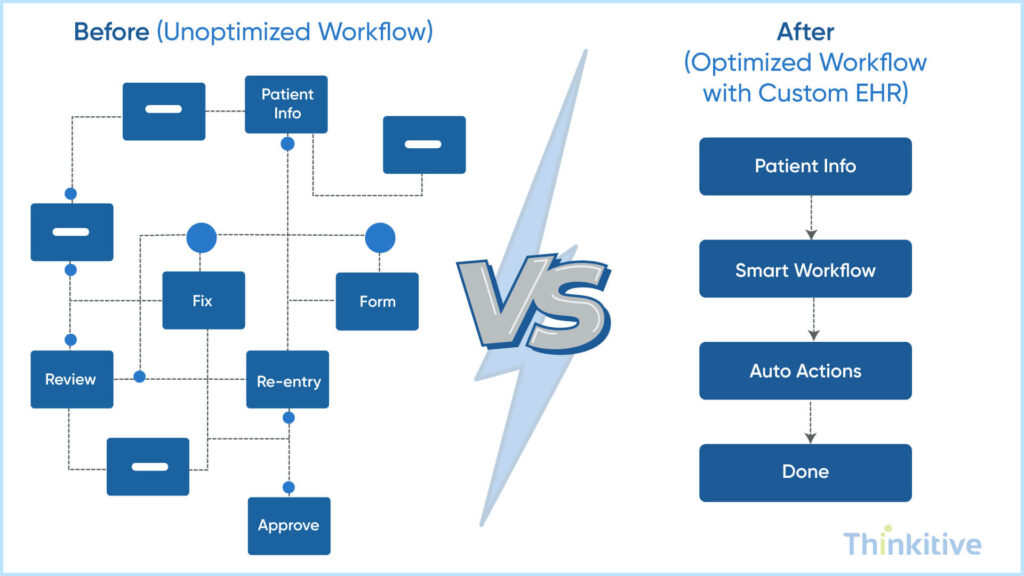
One of the biggest advantages of custom EHR development is the ability to design workflows around your clinical and administrative processes. Efficient workflows reduce documentation time, minimize manual work, and improve provider productivity, which directly lowers long-term operational costs. Planning these workflows during the discovery phase also prevents unnecessary features and costly redevelopment later.
If you’re evaluating workflow-first EHR planning, read our detailed guide on Why the EHR Should Be Specific to Your Workflows.
Specialty-Specific Design: Cost Control Through Precision
Specialty-specific customization influences both development cost and long-term value. While custom workflows and templates increase the initial investment, they eliminate unnecessary modules, reduce staff training, and improve adoption. For specialty practices, this often results in a lower total cost of ownership compared to adapting a generic EHR.
Another interesting thing you need to know about design is that it is a great tool to control the expenditure in the custom EHR software development. On that note, read our blog – How Specialty Clinics Can Design EHR Workflows, to know about the efficiency it brings in workflows and the impact it has on cost.
The AI Advantage: Reducing Long-Term Operational Costs

AI has been associated with taking a lot of jobs. However, that’s not actually true, but it is indeed going to help organizations save a lot of money in the long term. The same is true of the custom EHR development cost.
Here are some aspects where AI can genuinely lower EHR costs for your practice:
- Predictive Analytics & Insights: AI analyzes large volumes of clinical and operational data to identify trends, improve resource planning, and help healthcare organizations make proactive decisions that reduce long-term operational costs.
- Automated Medical Coding & Documentation: AI automates clinical documentation and coding, reducing manual effort, improving billing accuracy, and accelerating reimbursement while lowering administrative expenses.
- Voice-to-Text Clinical Charting: Voice-enabled charting allows providers to document encounters faster, reducing documentation time and administrative workload while improving productivity.
- AI-Driven Workflow Optimization: AI streamlines repetitive clinical and administrative workflows by automating routine tasks, reducing manual errors, and improving overall operational efficiency.
Calculate ROI of Your Custom EHR
Calculate ROICost vs Value: The ROI of Investing in Custom EHR Development
EHR systems have become the epicenter of care delivery for most of the healthcare practices. However, when calculating the ROI of your investments in the EHR system, considering only cost is something very wrong or unfair. You see, these software systems help in documentation, practice management, and care delivery.
When evaluating custom EHR development, cost should never be viewed in isolation. The real value comes from lower licensing expenses, improved productivity, better workflow efficiency, and reduced administrative overhead over the system’s lifetime. While the upfront investment is higher than licensed EHRs, many growing healthcare organizations achieve a lower total cost of ownership over time.
Talking about the other factor than that of the cost, your custom EHR ROI must focus on workflows, usability of the software, and automations. These factors drive ROI and will give you the results that you want to see. To learn about ROI in detail, read our blog – The ROI of Investing in Custom EHR Development.
Hidden Costs Most Healthcare Organizations Overlook
Whether you’re choosing to build your own EHR or buy generic EHR software, there are going to be hidden costs associated with it. And this is exactly what most of the healthcare providers overlook during their custom EHR development.
For instance, if you’re implementing a new system, then there are going to be issues with user adoption, and there are chances that the user might resist that change. In this training, costs add up to the process, and if the usability issues still continue, it disrupts the entire process, forcing you to spend more money on innovation.
Another hidden cost that many healthcare companies play an active role in increasing is late-stage usability fixes and rework. You see, when practices demand changes or additional features at the last stage, it indirectly increases the development cost, and depending on the complexity, it can even turn into a costly venture. That’s the reason I emphasised paying attention to the discovery stage at the start.
Having said that, the regulatory and compliance landscape of EHR systems is constantly evolving. Now, if your EHR software is rigid, then compliance retrofitting and filling the security gaps can be a little overwhelming. The best way to be all over this is to analyze the HIPAA-compliant EHR development cost and stick to it.
Also, one of the major factors that appears to be hidden is scalability. You see, when your EHR software can’t be scaled due to early architectural shortcuts, it can only add more rework and influence the cost by a significant margin.
Planning for Enterprise Scale & Long-Term ROI

If you are looking for a custom EHR solution for your multilocation practice and choose enterprise deployment, then you need to plan for it in advance. You see, enterprise EHR development benefits are lucrative in nature. However, if not planned properly, it can fail your entire project.
Some of the core considerations in enterprise EHR development are interoperability expansion and ecosystem growth. As your practice grows, the interoperability also needs to grow, and it needs to fit in the ecosystem. That is why knowing what you’re developing in enterprise development is important.
Thinkitive’s Approach to EHR Development Pricing
At Thinkitive, we have curated a method that follows a scalable and modular development approach that helps healthcare clinics and hospitals optimize their EHR build cost without compromising compliance, interoperability, or future scalability options.
A sneak peek into our development approach would be our MVP-first strategy, which allows your practice to use the software as soon as it is developed, reducing launch time, reducing the upfront investment, and scaling the platform once developed depending on your operational, clinical, and administrative needs.
Every estimate begins with a structured discovery workshop that defines workflows, integrations, compliance requirements, and delivery phases before development begins. This allows us to provide transparent pricing while minimizing scope changes later in the project.
Refer to this table for a better understanding:
| Thinkitive Approach | Business Benefit |
| MVP-First Development Strategy | Launch faster with reduced upfront investment |
| Reusable Healthcare Components | Minimize development time for core healthcare modules |
| Agile Sprint-Based Delivery | Improve budget visibility and iterative product refinement |
| FHIR-Ready Architecture | Simplify future interoperability and integration expansion |
| Cloud-Native Infrastructure | Reduce infrastructure overhead and improve scalability |
| Compliance-Driven Development | Avoid costly security and compliance rework later |
| Scalable Product Architecture | Support future expansion without rebuilding the platform |
Conclusion: Is Custom EHR Development Worth the Cost?
If you’ve made it this far, then you must have got a brief idea about what aspects of the custom EHR development cost are going to cost you the most. Having said that, there is no doubt that EHR system development is a costly venture, but you might ask – is it even worth it?
Well, it is worth every dime you spend. You see, with custom development, you pay a huge first cost, and with time, the cost gradually reduces to only maintenance and support. However, the situation is quite contrary with off-the-shelf EHR, where the cost becomes a compounding factor that grows as your organization grows.
On that note, take a strategic decision on your EHR system development venture, and let this blog be your guide to build a future-ready healthcare system. And if you don’t know where to get started, then book your free consultation with an EHR software development company and get a personalized quotation for your EHR software.
Frequently Asked Questions
On average, custom EHR development cost ranges from $120,000 to $500,000+, depending on scope and complexity.
- MVP EHR systems typically start around $50K–$100K
- Mid-sized, specialty-focused systems range from $200K–$350K
- Enterprise EHR development with advanced integrations, analytics, and AI can exceed $500K
The final cost depends heavily on features, integrations, compliance requirements, and scalability needs.
The biggest cost drivers include:
- Scope of clinical and administrative workflows
- Number and complexity of integrations (HL7, FHIR, labs, billing)
- Specialty-specific EHR design
- HIPAA compliance and security architecture
- UI/UX and EHR usability optimization
- Data migration from legacy systems
- AI and automation features
Each added layer of complexity increases both development and long-term maintenance costs.
A full EHR implementation cost breakdown typically includes:
- Discovery & workflow analysis
- UX/UI design and usability testing
- Core EHR development
- Integrations (labs, billing, devices, APIs)
- HIPAA-compliant security setup
- Testing & validation
- Deployment & staff training
- Post-launch support and optimization
Many organizations underestimate non-development costs like training, testing, and change management.
EHR software licensing vs custom build differs mainly in long-term economics:
- Off-the-shelf EHRs have lower upfront costs but recurring per-provider fees
- Custom EHRs require higher initial investment but eliminate licensing fees
Over 5–7 years, custom systems often become more cost-effective for growing or multi-location organizations.
Yes — especially for scaling organizations. Custom systems:
- Avoid recurring licensing costs
- Reduce workflow inefficiencies
- Improve clinician productivity through EHR workflow optimization
- Lower customization and integration expenses over time
This leads to a lower total cost of ownership (TCO) compared to rigid commercial EHR platforms.
- MVP EHR: $50K–$100K (core workflows, basic compliance)
- Enterprise EHR development: $350K–$600K+ (advanced security, AI, analytics, scalability)
Enterprise EHR development benefits include long-term scalability, multi-specialty support, and deeper interoperability.
HIPAA-compliant EHR development cost is higher due to:
- Encryption (data at rest & in transit)
- Role-based access control
- Audit logs and monitoring
- Secure hosting infrastructure
- Compliance documentation and testing
Security and compliance can account for 15–25% of total development cost, but skipping them creates massive legal and financial risk.
Commonly overlooked costs include:
- Staff training and onboarding
- Workflow re-engineering
- Data migration complexity
- Ongoing usability improvements
- Regulatory updates
- Performance optimization as usage grows
Ignoring these can lead to budget overruns and delayed ROI.
Integrations typically add 20–40% to the base custom EHR development cost:
- HL7/FHIR interoperability
- Lab and imaging systems
- Medical billing and clearinghouses
- Third-party APIs and devices
However, strong interoperability significantly reduces long-term operational friction.
Absolutely. EHR workflow optimization:
- Reduces documentation time
- Minimizes manual errors
- Improves staff efficiency
- Lowers training and support costs
Well-optimized workflows directly impact long-term ROI and clinician satisfaction.
Specialty-specific EHR design increases upfront cost but delivers better outcomes:
- Custom templates and clinical logic
- Specialty workflows and reporting
- Reduced customization post-launch
Specialty-focused systems often outperform generic EHRs in efficiency and adoption.
Post-deployment costs typically include:
- Hosting and infrastructure
- Maintenance and updates
- Security monitoring
- Feature enhancements
- Compliance updates
- Support and performance tuning
These costs are predictable and usually 15–20% of initial development annually.
AI increases initial cost due to:
- Model development and training
- Data infrastructure
- Compliance and explainability requirements
However, AI reduces long-term costs by automating documentation, coding, alerts, and decision support — improving ROI over time.
Most organizations see ROI within 18–36 months, driven by:
- Reduced licensing fees
- Improved productivity
- Lower operational inefficiencies
- Better data-driven decisions
The ROI timeline shortens significantly with strong usability and workflow optimization.
Budget planning should:
- Start with an MVP and scale incrementally
- Allocate funds for integrations and compliance early
- Include post-launch optimization costs
- Plan infrastructure for growth from day one
A scalable approach prevents costly rebuilds and protects long-term investment.


