Admin & Billing Features to Build Into Your EHR


If you dissect your EHR software, then it is majorly divided into clinical and administrative features. While most of the EHR software systems are provided with basic clinical features, some of the major inefficiencies that are faced on a daily basis are caused by admin features and, to some extent, billing features.
An effective EHR billing module connects documentation, coding, claims, and payments into a unified workflow, improving operational efficiency and financial performance.
Have a look at this stat: nearly 75% of physicians who experience burnout identify administrative tasks as a major source of strain. Upon looking deeper into the problem, it was quite clear that the EHR software systems in use are quite old. The same boxy screens, too much text, and multiple clicks still consume most of our time.
On the other hand, this stat tells a different story and justifies one of the major trends in the industry. You see, the time spent on managing charts, data, processing claims, and other billing activities can be cut short by 20-30% when the software aligns with the workflows and is well integrated.
This is why the trend of practices building their own EHR with EHR billing features is gaining traction across the industry. On top of that, with this approach, practices can also satisfy the growing demands of having a connected EHR platform for both clinical and financial activities.
However, building an EHR system is a collaborative process that requires contributions from clinicians, IT professionals, and other stakeholders. But the main question where everything becomes a mess is ‘ How to create EHR software and what medical billing software features for EHR to choose?’
Well, after developing over 50+ custom EHRs across different specialties, we have tried to answer your question through this blog. On that note, in this blog, let’s have a look at some of the essential billing features in electronic health record systems and how to build a billing module into your EHR.
So, without further ado, let’s get started!
Essential EHR Billing Modules You Need
Every billing module plays a specific role in the healthcare revenue cycle. The table below summarizes the core EHR billing capabilities, their primary function, and the value they bring to your practice’s financial operations.
| Billing Module | What It Does | Revenue Impact |
| Insurance Eligibility Verification | Verifies patient coverage before care | Reduces claim rejections |
| Charge Capture | Records billable services accurately | Prevents revenue leakage |
| Medical Coding (ICD-10/CPT) | Assigns standardized billing codes | Improves claim accuracy |
| Claims Scrubbing | Detects claim errors before submission | Reduces denials |
| Claims Submission | Sends claims electronically to payers | Speeds reimbursements |
| Denial Management | Tracks and resolves rejected claims | Improves payment recovery |
| Payment Posting | Records insurance and patient payments | Keeps financial records accurate |
| Revenue Cycle Reporting | Monitors billing and reimbursement performance | Supports financial decision-making |
Core EHR Billing Features Required for Healthcare Operations
Let’s start with the basic or core EHR billing features that a healthcare practice would require.
Starting with the very first process, the billing and invoice management workflows. Understanding the intricacies of this is important because, when patients are billed, they are billed for all the services that are being provided to them.
However, here’s the catch: they are not billed for all the services provided to them, but rather they are billed for the documented services provided to them. This makes documentation very important and necessary for accurate billing. And since this requires a workflow that aligns with its different steps, it becomes crucially important.
Another core feature that is a must-have feature to build an EHR for billing and admin workflows is insurance eligibility verification. The eligibility verification process takes time, and it enables payment tracking processes as well.
This is the reason why you must have an AI-powered or automated feature of insurance eligibility verification. If this is done, then the follow-up processes of payment tracking also become much easier and kind of sophisticated.
EHR Claims Management Features for Faster Reimbursements
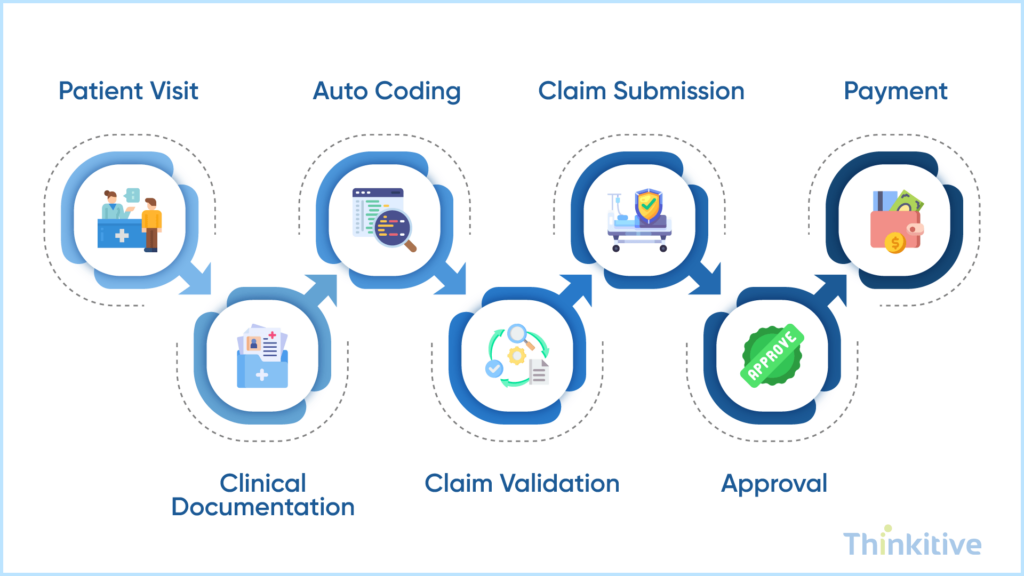
Getting reimbursement from the insurance companies for the services you have provided is also a long process. It requires submitting the claims to clearing houses, and then the verification process starts, which is approved by the insurance companies, after which you get paid.
The most troublesome part of this is that this process takes a lot of time for almost every process. This is why healthcare providers are actively looking to integrate automated claims submission and denial management workflows in their EHR billing module. These integrated EHR claims management features can alone take off a significant burden from your staff.
However, just having these two features is not enough; features like claims scrubbing and coding validation can elevate the performance of the software significantly. For instance, with claims scrubbing, they don’t have to worry about the mistakes in the documentation process, and coding validation capabilities allow you to use accurate code for every service you provide.
Due to these claims, the process can not only be fastened but also be made more accurate and timely. To make the process even faster, you need to integrate your EHR system with clearinghouses and payer systems.
This integration allows your system to exchange and share information with these systems directly in real-time.
Now, take a step back and look at this entire scenario from a broader perspective; every process is saving a significant amount of time in the billing process. Due to this, the time usually taken for reimbursement is reduced by a significant margin, and the EHR claims management feature is at the center of it.
Building an Integrated EHR Billing Module
As we are going deeper into the EHR billing features, you are slowly realizing that just having these features is not enough. You kind of need the entire ecosystem to support it, and in short, you have to build that EHR billing module.
On that note, let’s see some of the intricacies of how to build a milling module into EHR:
The first thing that you need to do is connect the billing workflows with clinical documentation and coding systems. For instance, the services you provide are documented in the clinical features. This is why you need to connect your documentation processes with those of the billing workflows.
This makes data sharing within the system much simpler, and with this, the next step becomes much simpler.
On top of that, your system also needs to support coding capabilities like ICD-10, CPT codes, and encounter-based billing workflows. This way, coding becomes simpler, and staff members don’t have to spend much time on coding processes.
Now, when you are building your own EHR, you need to understand how to build a billing module into an EHR system. This is necessary because many of the processes involved in this are intertwined with one another. For instance, clinical processes must be aligned with documentation workflows, which should be integrated into the billing system for claims generation, submission, coding, etc.
In this way, by building an integrated EHR billing module, you can not only improve operational efficiency with simple connected and integrated workflows.
Compliance, Security & Automation Features
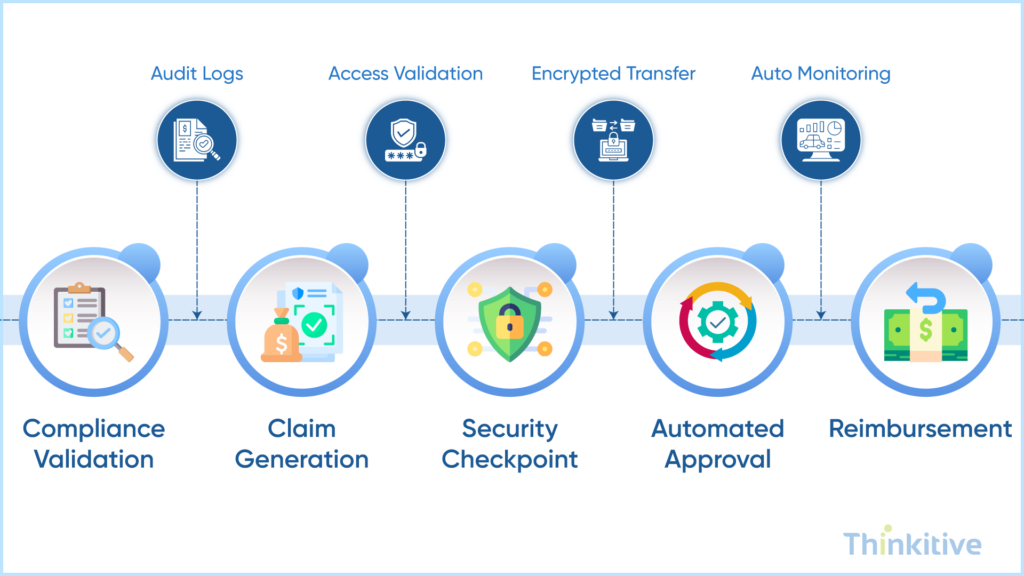
Since EHR billing modules process sensitive financial and patient information, security and regulatory compliance must be built into every billing workflow from the beginning.
For instance, with HIPAA-compliant billing and patient data handling, you basically cover all the important aspects of securing your data. This way, you can easily navigate through the regulatory landscapes and save yourself from hefty fines and other penalties.
Along with being compliant with regulations like HIPAA and HITECH, you also need to get ONC certification for billing data access and audit integration. This is not only important for getting the certification, but also ensures that the billing data you are using is accurate and clean, which reduces the chances of rejection by a huge margin. And with auditing capabilities, it ensures that everything can be covered easily and effectively.
Reporting & Revenue Cycle Visibility Features
These sets of features are contributing to the usability, look, and feel of the EHR software with respect to the billing and admin features. The best example of this can be seen in financial dashboards and reimbursement tracking features.
While one allows you to have a comprehensive overview of both practices’ and patients’ finances. The other makes it easy to track payments and make necessary plans with respect to that. Due to these features, much of the decision-making process becomes data-backed and quite easy.
For instance, with reporting monitoring, the performance of each payer can be known before, and in some cases, can be tracked and maintained easily. And in case of any missed payments or trouble, the bottlenecks can be easily identified and addressed.
And last but not least, reporting and visibility features support your practice’s growth and give you clear data to draw the roadmap of your practice’s growth.
How to Prioritize Billing Features During EHR Development
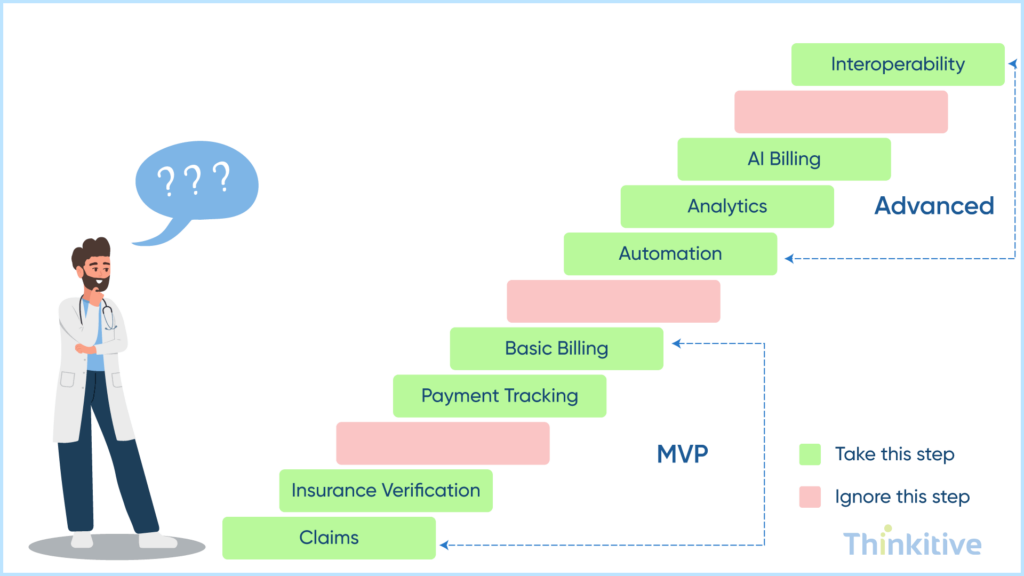
If you have made it this far, then you know almost all the features that you need for EHR billing modules. Now, there is a high chance that you might not require all these features, right? And the question that troubles now is how to prioritize billing features, well, let’s try to find out below:
First things first, identify the MVP features, and this solves almost all the problems that are related to the basic functioning of your system. Coming to the next advanced features, make note of these features and plan their development at the same time or after the development of MVP features.
Due to this, the functioning of your practice remains uninterrupted, and further processes become easier. Furthermore, prioritize features that promote automation and have interoperability capabilities. It makes becoming part of the connected ecosystem easier and processes faster.
EHR Billing Module Implementation Checklist
Use this checklist to ensure your custom EHR includes the essential billing capabilities required for efficient claims processing, reimbursement, and revenue cycle management.
| ✓ | Billing Capability | Included? |
| ☐ | Billing & Invoice Management | |
| ☐ | Insurance Eligibility Verification | |
| ☐ | Charge Capture | |
| ☐ | ICD-10 & CPT Coding Support | |
| ☐ | Claims Scrubbing | |
| ☐ | Claims Submission | |
| ☐ | Denial Management | |
| ☐ | Clearinghouse & Payer Integration | |
| ☐ | Payment Tracking & Posting | |
| ☐ | Revenue Cycle Reporting | |
| ☐ | HIPAA-Compliant Billing Workflows | |
| ☐ | Audit Logs & Billing Security Controls |
Conclusion
EHR billing features for healthcare systems form the financial backbone of their digital practice. Moreover, with automation, interoperability, and compliance becoming some of the most critical aspects of these features, you need to move away from the traditional approach and be part of the connected ecosystem for faster and more effective billing.
Moreover, the best way to do that is to build your own EHR with an EHR billing module that also supports admin features. On top of that, with integrated billing workflows directly into clinical operations, every process in accordance with billing becomes streamlined and sophisticated.
So, what are you waiting for? Identify where your system lacks with our expert consultation and start building a custom EHR with billing features that can solve it for your practice.
Frequently Asked Questions
The most important EHR billing features include charge capture, insurance eligibility verification, claim generation, claim scrubbing, payment posting, denial management, patient billing, and revenue cycle analytics. These capabilities help healthcare organizations streamline billing workflows, improve reimbursement rates, reduce administrative burden, and maintain healthy cash flow.
A comprehensive EHR billing module should include patient invoicing, insurance verification, coding support, charge capture, claim submission, payment processing, denial management, accounts receivable tracking, and financial reporting. Integrating these functions within the EHR helps providers manage clinical and financial workflows from a single platform.
Effective EHR claims management features include automated eligibility checks, claim scrubbing, coding validation, payer rule enforcement, denial tracking, and claim status monitoring. These features help identify errors before submission, improve first-pass claim acceptance rates, and reduce costly reimbursement delays.
Integrated billing workflows eliminate data silos between clinical and financial systems by connecting patient encounters, documentation, coding, and claims processing. Strong EHR billing and revenue cycle features help reduce manual data entry, improve billing accuracy, accelerate reimbursements, and enhance operational efficiency across healthcare organizations.
When considering how to build a billing module into EHR systems, organizations should focus on integrating scheduling, patient registration, charge capture, coding, claims processing, payment collection, and reporting capabilities. The billing module should also support interoperability with clearinghouses, payer systems, and accounting platforms to ensure seamless revenue cycle management.
The essential billing features in electronic health record systems include insurance verification, charge capture, medical coding support, claims management, denial management, patient payment processing, accounts receivable tracking, and revenue reporting. These features enable healthcare organizations to manage billing efficiently while improving financial performance.
AI enhances medical billing software features for EHR platforms by automating coding assistance, identifying claim errors, predicting denials, prioritizing follow-ups, and providing revenue cycle insights. These capabilities help healthcare organizations improve billing accuracy, reduce administrative workload, and optimize reimbursement outcomes.
EHR billing systems must comply with healthcare regulations and standards such as HIPAA, ICD-10, CPT, HCPCS, and payer-specific billing requirements. Security measures, including role-based access controls, audit logs, data encryption, and secure claims transmission, are also essential to ensure compliance and protect patient information.
Analytics and reporting provide visibility into claim acceptance rates, denial trends, reimbursement timelines, collections performance, and overall financial health. As one of the must-have features to build an EHR, advanced reporting helps healthcare organizations identify bottlenecks, improve decision-making, and optimize revenue cycle performance over time.


