Navigating EMR Regulatory Compliance


There are two factors that are shaping the future of the healthcare industry, one is the technological progression, and the other is the healthcare transformation. And the interesting part in this is that they are very closely interlinked and support each other for their growth.
As healthcare delivery is evolving, the regulatory landscape is also evolving, which is shaping the healthcare laws, data privacy mandates, and even interoperability standards. If you have been involved in the discussions related to EMRs and their EMR software regulatory landscape, then you must have heard the terms such as HIPAA, the 21st Century Cures Act, and ONC requirements.
Now, this regulatory compliance is necessary because it ensures that the data that you use for care delivery is protected and is clinically accurate. This way, you can operate the healthcare software system safely and ethically.
However, given the ever-evolving nature of EMR compliance requirements, custom EMR development has been seen as the most reliable and feasible solution for practices. You see, non-compliance with these regulatory standards is complex and can lead to significant financial penalties, regulatory audits, and even legal consequences. All this because these compliances ensure secure use of data, whereas non-compliance can increase the risk of data breaches and information misuse.
For independent practices and specialty clinics building or modernizing a custom EMR, navigating these regulatory requirements is essential to protect patient data, maintain audit readiness, and comply with both federal and state healthcare regulations.
On that note, let this blog act as a EMR regulatory compliance guide and help you build a secure and compliant EMR software.
Step-by-Step Guide to Navigate EMR Regulatory Landscape
Download Free GuideWhat Are the Core EMR Compliance Requirements?
To build a compliant custom EMR system, healthcare practices should address these regulatory requirements:
- HIPAA: Protect patient health information (PHI) through access controls, encryption, audit logs, and breach notification procedures.
- HITECH Act: Strengthens HIPAA by promoting certified EMR technology, improving security requirements, and enforcing breach reporting.
- ONC Certification Requirements: Support interoperability, standardized data exchange, and certified health IT capabilities where applicable.
- 21st Century Cures Act: Prevent information blocking and enable patients to securely access their health information.
- State Privacy Laws: Comply with state-specific consent, privacy, retention, and breach notification requirements that may extend beyond federal regulations.
HIPAA compliance is clearly a cornerstone that you have to achieve in EMR software development. HIPAA stands for the Health Insurance Portability and Accountability Act of 1996, which sets the national guidelines for protecting sensitive patient health information (PHI). It mainly deals with the disclosure of patients’ information without their consent and its ethical use. Understanding HIPAA EMR requirements is the foundation of any compliant system — covering everything from access controls to encryption and breach notification.
Other than HIPAA EMR requirements, one of the major compliance requirements that you need to adhere to is the HITECH Act. An interesting thing about the HITECH Act is that it strengthens HIPAA and plays a crucial role in its adoption. Along with that, it enforces security, data privacy policies, and even breach notification.
In simple terms, adhering to the HITECH Act will not only get you a HIPAA-compliant EMR system, but you’ll also use certified EMR technology.
Some of the key provisions relevant to your EMR software that you know are:
- Privacy Rule: This rule helps in protecting the privacy and security of PHI held by covered entities and practices. This rule also gives you the guidelines for the usage of PHI and its disclosure.
- Security Rule: This rule sets the standards for safeguarding electronic PHI to ensure the sensitive information of patients remains confidential and is ethically used with their consent. This is majorly applicable for most of your processes, which vary from administration to clinical care delivery and technical safeguards.
- Breach Notification Rule: The last key provision in EMR software is breach notification, which requires informing the individual and the Secretary of Health and Human Services (HHS) of breaches of unsecured PHI.
To achieve these key provisions, you need to design your EMR software in compliance with these rules, and some of the essential features that help you in achieving this are:
- Access Controls: This only allows authorized personnel to access PHI based on their roles and responsibilities. This is in place to prevent unauthorized access.
- Audit Trails: Audit trails help you in tracking user activity in your EMR system, which becomes necessary to identify and address any security concerns in the system.
- Encryption: This feature helps you to protect the PHI both when it is transmitted and when it is at rest in your EMR software.
The regulatory landscape of HIPAA compliance is also constantly changing; that is why you need to curate and implement a HIPAA compliance plan so that you’re always up-to-date with the developments and ensure the privacy and security of your EMR software system.
One of the most essential aspects of compliance that many practices ignore is risk assessment. For instance, almost all the clinics that develop a custom EMR conduct a risk assessment. However, what they fail at is that they just conduct it once during deployment, and then it is felt untouched.
Only when you continuously assess your system for risk can you flag any gaps. And since the regulatory landscape is always evolving, it helps you always stay ahead of the curve and use safe and secure software at all times.
| Regulation | Purpose | Why It Matters |
| HIPAA | Protect PHI | Patient privacy |
| HITECH | Strengthens HIPAA | Security & breach reporting |
| ONC | Certified health IT | Interoperability |
| 21st Century Cures | Prevent information blocking | Patient access |
| State Laws | Local compliance | Audit readiness |
NOTE: Read our blog – A Deep Dive into Custom EHR Software Architecture, Compliance & Scalability, for better understanding about the regulatory landscape and the role compliances play in it.
When Does Custom EMR Software Require FDA Compliance?
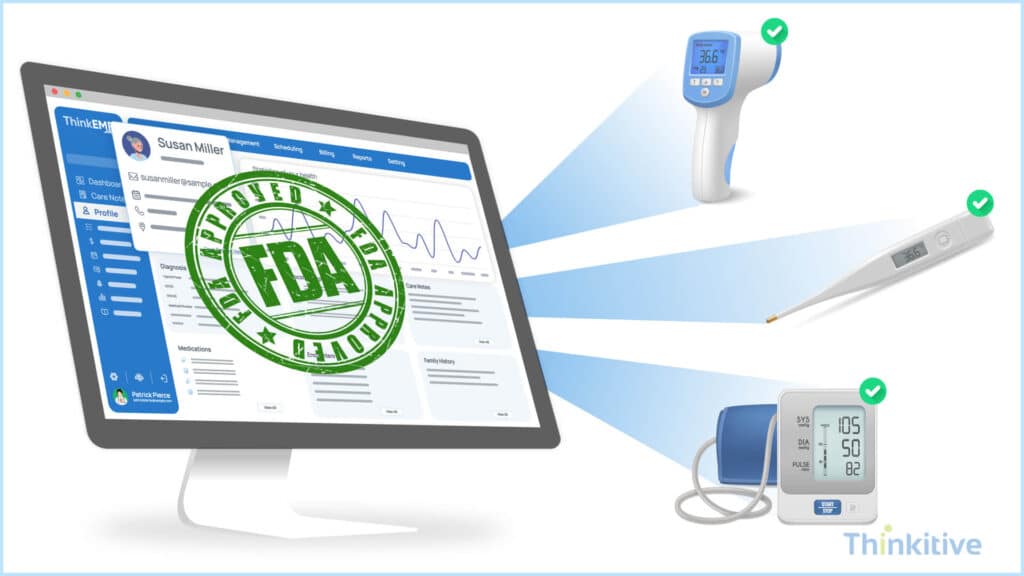
In some way or another, your custom EMR software is also said to be a medical device. This, along with other healthcare devices such as a pulse oximeter and a Holter monitor, requires FDA clearance for safe and effective use.
Furthermore, if you plan to provide virtual care with remote monitoring of patients, then you should be able to navigate the FDA premarket notification (510(k)) process. This is not only a regulatory pathway for medical device manufacturers to obtain clearance to market the devices, but also gives patients the assurance that the device is safe to use and effective as the predicate device.
Compliance with FDA quality system regulations can ensure that you’re delivering quality care with the use of high-quality devices. However, to seamlessly navigate the steps involved in the 510(k) process can sometimes be complex. That is why it is recommended that you have dedicated professionals who can help you easily navigate through the crucial steps, like pre-submission, data collection, and submission review.
One of the best ways to ensure that during the entire development process you comply with the FDA regulations is by establishing and maintaining a robust quality management system.
FDA Regulations & HIPAA Compliant EMR Development Guide
Download FreeInteroperability Standards
Interoperability is now considered both a technical capability and a regulatory expectation for modern EMR systems.
Care delivery is a highly collaborative process, and being a healthcare provider, nobody knows this better than you. For sharing information from one system to another, the system needs to understand and make sense of the information that is being shared. To ensure that there are no leaves unturned in this, you need to comply with the interoperability standards such as HL7 and FHIR.
HL7 FHIR standards are industry-standard guidelines that ensure seamless data exchange with other healthcare systems and devices. Though there are certain challenges of achieving interoperability, these can be easily overcome if you have a strong team of EMR software developers who specialize in developing robust APIs and develop the software with adherence to the data exchange protocols.
However, just like the landscape of healthcare technology is changing, it will clearly have an impact on the interoperability standards as well. To ensure that the information shared by your systems is accurate and helps your patients in care improve their condition, it is important for you to stay updated with the latest developments in the interoperability standards. Read this exclusive guide on interoperability, security, and compliance of custom EMR to have a broader picture of the healthcare regulatory landscape specific to EMRs.
Interoperability is one of the major regulatory requirements in EMR software development. It is crucial to share data in a safe environment and for your systems to communicate with other systems. Now, during development, if you position interoperability as a regulatory requirement and compliance enabler, it goes beyond its usual function and gives you a functional advantage.
Challenges in Meeting EMR Regulatory Requirements
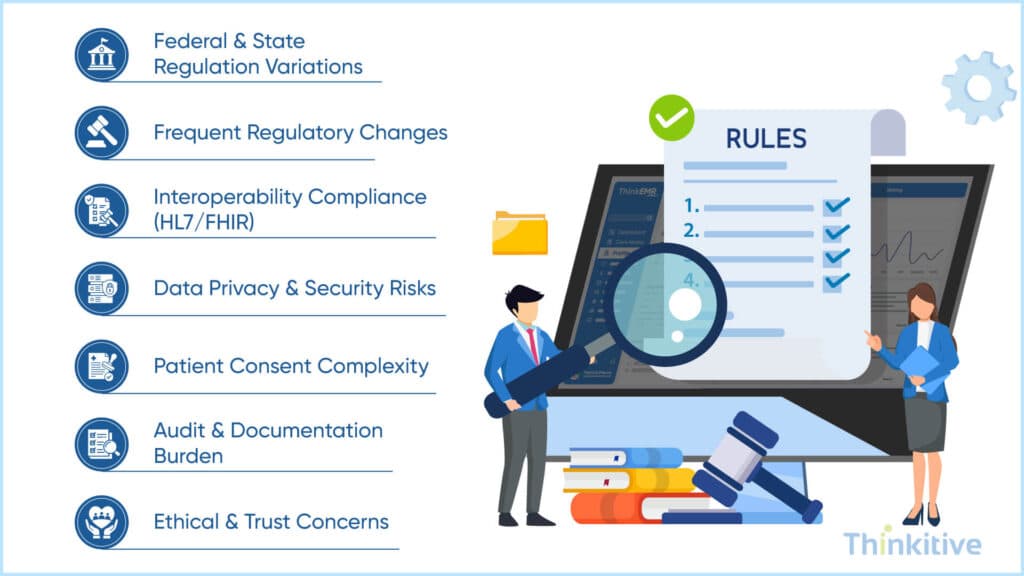
While there are certain federal rules and regulations that you need to adhere to during EMR software development, the geopolitical landscape can also impact the regulatory landscape. Depending on the state you are practicing and operating in, certain laws and regulations might change, which is why it is very important for you to understand and comply with these state and local regulations related to healthcare data privacy and security.
When dealing with this, you need to identify and address the specific requirements for the law and curate your entire software workflow in compliance with it. For instance, certain states have different data breach notification rules, and some states even have their own consent form that allows you to use the patient data effectively and efficiently.
One of the best ways to seamlessly navigate through these state and local regulations is by conducting thorough research and always staying up to date with any changes in the regulations and guidelines.
- Ethical Considerations
Independent practices are increasingly adopting AI-powered documentation, clinical decision support, and workflow automation, making the ethical use of patient data an increasingly important aspect of EMR regulatory compliance.
Beyond meeting legal requirements, healthcare providers must ensure that patient information is collected, stored, and used responsibly while maintaining transparency throughout the care journey.
Some of the key ethical considerations in custom EMR development include:
- Protecting patient privacy by limiting access to sensitive health information and following HIPAA requirements.
- Obtaining informed patient consent before collecting, sharing, or using health data for clinical, operational, or AI-driven purposes.
- Reducing algorithmic bias by validating AI-powered features and ensuring they support fair clinical decision-making.
- Maintaining transparency and accountability through audit trails that record who accessed or modified patient information.
- Training healthcare staff on responsible data handling, security best practices, and ethical use of EMR systems.
By embedding these ethical principles into custom EMR development, healthcare practices can strengthen patient trust, improve regulatory compliance, and build a secure foundation for adopting emerging healthcare technologies.
Compliance Audits & Documentation
One of the most ignored aspects of EMR regulatory compliance is auditing and documentation. You see, only when you regularly conduct audits and document every change that you make can you actually make any progress with respect to navigating EMR regulatory requirements.
Furthermore, rather than just relying on internal compliance audits, you can even conduct external compliance audits to validate regulatory adherence. This ensures that your system is truly fully compliant and adheres to the regulatory compliance in EMR.
On top of that, maintaining documentation for security controls, privacy practices, and audit readiness of your system also becomes much easier when you regularly conduct your audits. And when you have everything documented, managing compliance across state regulation, national regulation, and even international regulations becomes easy.
While many ignore this, the importance of audits and documentation simply cannot be ignored. It helps you with updates, compliance monitoring, and most importantly, navigating through the changes much more easily. Following an EMR compliance checklist during audits can help practices systematically verify that all regulatory requirements are being met.
Assess Your System Compliance Readiness
Get Free ConsultationKey Takeaways
- HIPAA and HITECH form the foundation of EMR regulatory compliance for healthcare practices.
- State-specific privacy laws and consent requirements may impose additional obligations beyond federal regulations.
- Regular risk assessments, audit trails, and documentation help practices maintain ongoing compliance and prepare for regulatory audits.
- Interoperability standards like HL7 and FHIR support secure data exchange while meeting modern regulatory expectations.
- Building compliance into custom EMR development from the start is more effective and cost-efficient than retrofitting security and compliance later.
Conclusion
HIPAA, GDPR, HITECH Act, ONC, HITRUST, FDA, etc, are some of the many healthcare regulations that you need to adhere to while building your own EMR software. Adherence to these key regulations and guidelines will not only help you seamlessly navigate through the legal landscape but also help build trust with patients and the stakeholders in your practice.
Though I’ve tried my best to simplify the navigation process, technically it is a lot more difficult than it appears on the screen you’re reading this on. To help you with that, book your first free consultation and let’s take your custom EMR development journey forward.
Frequently Asked Questions
EMR regulatory compliance refers to ensuring that electronic medical record systems meet all applicable healthcare regulations governing patient privacy, data security, interoperability, audit readiness, and clinical safety. For most healthcare practices, this includes complying with HIPAA, HITECH, ONC requirements, applicable state privacy laws, and, when necessary, FDA regulations for Software as a Medical Device (SaMD).
In 2026, EMR regulatory compliance means ensuring that EMR systems not only protect patient data but also support secure data exchange, transparency, and audit readiness. Compliance now spans privacy, security, interoperability, certification, and information-blocking rules—making it an ongoing operational responsibility rather than a one-time checkbox exercise.
Custom EMR software must comply with healthcare privacy and security laws, interoperability mandates, and data exchange regulations. This includes safeguards for patient data, standardized data formats, secure APIs, and alignment with national health IT frameworks. Developers share responsibility alongside providers for meeting these regulatory requirements.
HIPAA directly influences EMR architecture and design choices. It requires strong access controls, encryption, audit logs, and breach response mechanisms. These HIPAA EMR requirements shape everything from database design to user roles and third-party integrations, making security-by-design a core development principle.
EMR software may fall under FDA oversight when it performs clinical decision-making functions that influence diagnosis or treatment, rather than just storing or displaying data. In such cases, the EMR may be classified as Software as a Medical Device (SaMD), triggering additional validation, documentation, and risk-management requirements.
HL7 and FHIR standards are central to modern EMR compliance. They enable structured, API-based data exchange and are closely tied to national interoperability mandates. EMRs that do not properly implement these standards risk non-compliance, data-sharing limitations, and potential information-blocking violations.
The most common risks include inadequate security controls, improper third-party integrations, poor auditability, and failure to keep up with evolving interoperability rules. Non-compliance can result in regulatory penalties, audits, data breaches, and erosion of patient trust—making proactive compliance management essential.


