Measurement-Based Care in Mental Health: Why Off-the-Shelf EHRs Fail at Outcome Tracking

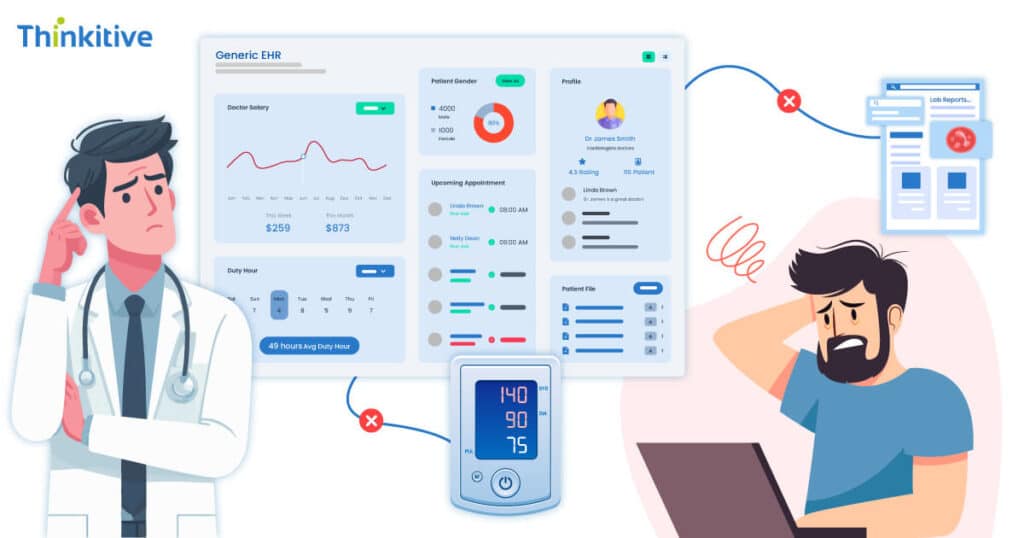
When you see a patient in any other area of healthcare, their progress is visible. It can be seen through stabilizing blood sugar, reducing calories, or lowering blood pressure. In mental health, progress also exists, but it’s scattered in observations, patient-reported symptoms, and clinical assessments. This makes accurately tracking patient progress and quantifying outcomes more challenging.
That’s exactly what measurement-based care in mental health aims to do, which is to turn mental health progress into measurable, data-backed outcomes.
However, to make this possible, one thing is necessary: tools tailored to understand mental health data. Yet, many behavioral health practices use generic or off-the-shelf EHRs that lack the needed tools or dashboards to visualize the mental health data.
These off-the-shelf EHR limitations become the biggest hurdle for providers like you in tracking the progress the patient has made. However, this can change quickly with custom behavioral health software solutions built for behavioral health workflows.
In this blog, we are going to explore how, along with the reasons why off-the-shelf EHRs fail in mental health outcome tracking.
Ready to understand the why and how? Let’s dive in!
Why Generic EHRs Aren’t Built for Behavioral Health
Now, before we dive into the core issue, which is outcome tracking, let’s first understand why the off-the-shelf EHRs are not an ideal choice for behavioral health. Here are the biggest reasons that make off-the-shelf EHRs unfit for recording mental health care:
- Mental vs. Mental Paradigm
We can say that this is the fundamental reason. These EHRs were always meant for physical health and to track numbers. However, when they are used in mental health, they need to track emotions and behavioral changes.
For a physician, progress is not low blood pressure but fewer panic attacks, better emotional regulation, and improved daily functioning. However, these are all qualitative shifts and not quantitative ones, and off-the-shelf solutions fall short when it comes to tracking them.
So, although the generic systems work seamlessly for physical conditions, they typically become unfit for mental health care documentation and tracking.
- Workflow Misalignment
Another reason that generic EHRs are not built for behavioral health care is that they function completely differently from physical care. Therapy does not end with a single encounter. It always connects the last session to the next one.
Basically, mental health care needs longitudinal data tracking over weeks, months, or sometimes even years. Meanwhile, most of the off-the-shelf EHRs are built around short, encounter-based workflows for primary care or specialty visits. But therapy doesn’t fit in with these criteria; it’s continuous and highly individualized and needs to be flexible.
The result is clinicians spending more time clicking through irrelevant screens than focusing on patient progress.
- Rigid Templates
If you are using a generic EHR for your behavioral health, you may have seen tabs for lab results, imaging studies, or vaccination records. These fields make complete sense when they are in physical care, but add no value in therapy documentation.
These rigid templates hinder clinicians’ workflow and make progress tracking unnecessarily complicated. Important behavioral data, mood fluctuations, coping strategies, session goals, or PHQ-9 scores often get lost in free-text notes.
So, what behavioral health needs instead are flexible, context-aware templates that capture the nuances of patient interactions, without forcing them into irrelevant medical boxes.
Now that we have looked at why mental health practices can’t use off-the-shelf EHRs, let’s understand how this impacts outcome tracking.
The Core Issue: Inadequate Outcome Tracking
As mentioned in the introduction, while there are ways to track progress in mental health, measuring it consistently over time can be difficult. What makes it even harder are the limitations of off-the-shelf EHRs. Here are the key limitations:
- No Standardized Assessment
In behavioral, although there are no lab tests or readings, assessments like PHQ-5 (Patient Health Questionnaire-9) and GAD-7 (Generalized Anxiety Disorder-7) can help measure the progress. Moreover, patient-reported outcomes (PROMs) are also a vital source of information.
Yet, many generic EHRs lack built-in support for these assessments or record the patient’s given insights properly. That’s why clinicians are often forced to record scores manually or use external systems, which adds to complexity and increases the chances of errors. This limitation directly impacts effective measurement-based care in mental health.
- Missing Longitudinal Tracking
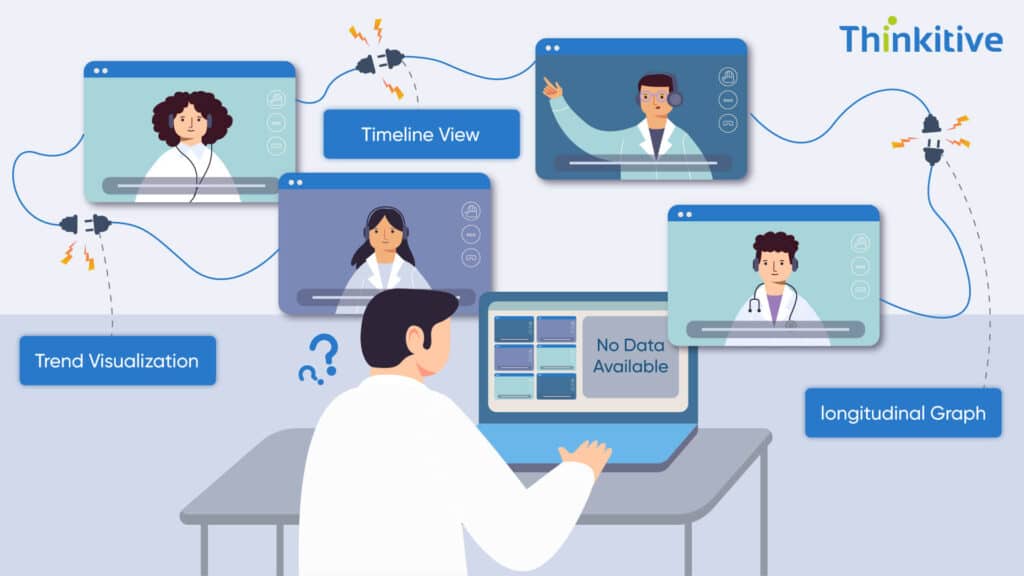
Behavioral changes happen over time and subtly, so it’s important to track these changes for weeks or even months. But generic EHRs designed for isolated medical encounters rarely support longitudinal data tracking.
Without trend visualization or timeline views, clinicians can’t easily see whether a patient is improving, plateauing, or regressing. This gap undermines the ability to make informed, data-driven decisions over the course of therapy.
- Data Buried in Notes
The final limitation of the off-the-shelf EHR system is its lack of proper documentation of mental health data. Much of the rich, qualitative information about a patient, such as mood shifts, coping strategies, and session goals, is captured in free-text fields. While this works for that time, later, when clinicians need to find this information, it gets buried.
Generic EHRs are not built to analyze or visualize this behavioral health EHR outcome tracking; the data exists, but remains invisible. The outcome: off-the-shelf EHR limitations prevent clinicians from fully implementing measurement-based care in mental health.
Mental Health EHR Dashboard Blueprint: Track, Visualize, and Prove Patient Progress
Get NowThe Impact on Clinicians & Patients
What many healthcare practices think while choosing an off-the-shelf EHR is that it is only about short-term savings. However, they overlook a crucial factor, and that is how it will impact clinicians and patients in the long term if it fails to match behavioral health needs. Here is how it impacts them:
- Wasted Time
Clinicians spend hours on manual data entry, juggling spreadsheets, and duplicating documentation across systems. This administrative burden takes time away from what matters most — direct patient care. Without seamless behavioral health EHR outcome tracking, valuable clinician hours are lost every day.
- Reduced Care Quality
Critical patient insights often get buried in unstructured notes or scattered across disconnected files. When mood changes, coping strategies, or progress on PHQ-9 and GAD-7 assessments aren’t easily accessible, treatment decisions rely on incomplete information, reducing the overall quality of care.
- Integrated Care Failure
Behavioral health doesn’t exist in a vacuum. Patients often receive care from multiple providers, including primary care physicians, specialists, and therapists. Off-the-shelf EHRs frequently create data silos, making it difficult to share patient-reported outcomes (PROMs) and longitudinal data across the care team. The lack of interoperability, even with FHIR or HL7 standards, hampers coordinated care and slows progress tracking.
- Compliance Risks
Standard EHRs rarely offer built-in audit trails or standardized reports required by payers and regulatory agencies. Practices struggle to demonstrate outcomes, prove the quality of care, and remain compliant with reporting requirements. This not only increases administrative stress but also exposes providers to potential reimbursement or legal challenges.
The takeaway is clear: limitations in generic EHRs ripple across the system. Clinicians face inefficiency and frustration, while patients risk suboptimal care. The next step is exploring how measurement-based care, supported by purpose-built mental health EHR solutions, can address these challenges.
The Path Forward: What Specialized or Custom EHRs Do Differently
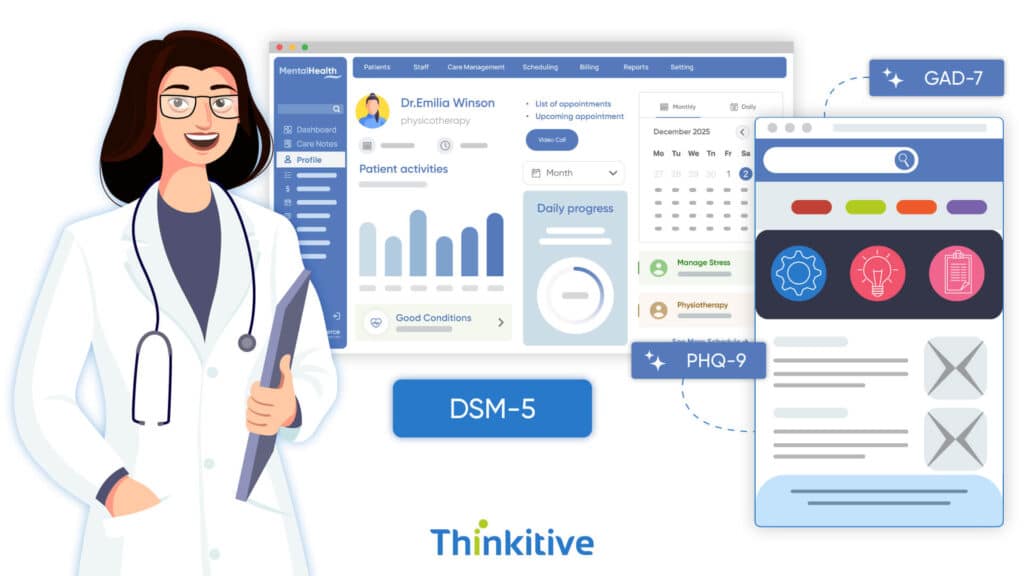
A custom mental health EHR solution fills all the gaps that an off-the-shelf solution brings in mental health care. These systems are built with the needs of behavioral health in mind and make care delivery easier, bringing true measurement-based care in mental health.
- Behavioral Health-Centric Design
When custom EHRs are designed, they are always built around what behavioral health needs are. This means that from templates to tracking, everything follows the rules and regulations of mental health care and is not a generic one. For instance, the templates are designed with DSM-5 diagnostic criteria.
This approach ensures that clinicians can record accurate patient data, including emotional, cognitive, and social factors, without clicking through unnecessary fields.
- Outcomes Tools Built-In
Unlike off-the-shelf EHR solutions, specialized behavioral health EHRs have all the outcome tracking tools built in. Most importantly, it has PHQ-9 and GAD-7 integration along with BDI assessment forms. Moreover, these tools can automatically calculate scores, plot results, and generate reports over time, making outcome tracking easier and effortless.
In addition, these systems can be equipped with features like patient-reported outcomes (PROMs), allowing clinicians to collect data between visits and enabling more evidence-based decision-making.
- Data Visualization
Another change that a custom mental health EHR solution brings is behavioral health data visualization with the help of dashboards. These dashboards collect all the data and visualize it for better measurement-based care in mental health. With these behavioral health dashboards for progress monitoring, clinicians can view trends in mood scores, symptom severity, and engagement levels over time. This means they can easily adjust the care plan accordingly to each progress or relapse. Moreover, what makes it such a good feature is that it motivates both clinicians and patients to continue the care.
- FHIR & HL7 Integration
One of the biggest advantages of having a custom mental health EHR solution is that they are built with EHR interoperability with FHIR HL7 integration. With this integration, a seamless data exchange across care services such as mental health, primary care, and hospital systems becomes easily possible.
This ensures coordinated care across the patient’s entire care network, eliminating data silos and supporting integrated care delivery.
- Automation & AI
Finally, what gives the custom EHRs an edge over the off-the-shelf EHRs and saves clinicians the most time is automation and AI. With predictive analytics, clinicians are always ready for a possible relapse or a breakdown, taking out the uncertainty from patient care.
Furthermore, it also helps them identify at-risk patients before the situation worsens, allowing for timely interventions. In addition, automated reminders, progress summaries, and smart charting save providers the hours of manual work and extended work time, while ensuring accuracy.
In short, when a mental health care practice adopts an EHR built for their workflows, they can seamlessly shift care from reactive to proactive approaches. Additionally, these systems track and measure outcomes accurately, making them the best EHR for behavioral health measurement-based care.
Want to Learn How to Integrate PHQ-9 and GAD-7 in EHR Systems? Read this Guide
Read HereKey Takeaway: Measurement-Based Care is the Future
For mental health progress to be visible is a very rare occurrence; that’s why measurement-based care (MBC) becomes quite crucial. So, rather than using your intuition as a guide, shifting to an EHR that can track and present solid data is much better and accurate for effective care delivery.
Moreover, with MBC, clinicians can quantify emotional and behavioral changes just like a report on an increase in blood pressure. When behavioral health clinics implement EHRs that support outcome tracking, the care moves from subjective progress to more data-based improvements.
Here’s how the change happens:
| Aspect | Traditional Note-Based Care | Measurement-Based Care (MBC) |
| Data Type | Narrative notes and qualitative observations | Quantitative, standardized assessments (e.g., PHQ-9, GAD-7, PROMs) |
| Tracking | Manual or inconsistent | Longitudinal, automated tracking over time |
| Decision-Making | Based on memory or perception | Driven by objective data and visualized outcomes |
| Patient Engagement | Limited visibility into their own progress | Patients actively track improvement through reports and dashboards |
| EHR Role | Documentation storage | Outcome engine that drives clinical insight |
| Care Coordination | Data silos between behavioral and primary care | Interoperable through FHIR/HL7 integration |
That’s why the future of behavioral health is smart documentation and measurement-based care. With both of these pillars, making behavioral health improvements and proving treatment effectiveness visible becomes accurate and effortless. This boosts both patient engagement and clinics’ ROI easily with increased claim approvals.
5 Red Flags That Tell Insurers You’re Not Tracking Mental Health Outcomes
Read Mental Health InsightsConclusion
In a nutshell, in healthcare, outcome tracking is crucial to know the effectiveness of treatment and any needed changes for further improvements. While it’s easy for generic or physical conditions, it’s nearly impossible.
That’s where measurement-based care steps in. It helps clinicians quantify the improvements. However, with a generic EHR, successfully doing this is quite challenging, increasing the chances of failure. So, behavioral health clinics need to adopt specialized or custom mental health EHR solutions that are built around behavioral health workflows.
Want to see how this changes the whole process? Book a demo right away to see the custom mental health EHR solution in action and transform your outcome tracking.
Frequently Asked Questions
Measurement-Based Care (MBC) is data-based care that helps clinicians quantify the subjective improvements in mental health. This uses tools such as PHQ-9 and GAD-7 to measure patient progress over time. With this, clinicians can effectively adjust treatment plans based on actual outcome trends rather than clinical intuition alone.
The factor for the failure of those EHRs is that they are not built for behavioral health workflows. They lack integrated assessment tools, longitudinal tracking, and visualization dashboards, making measurement-based care in mental health inefficient and nearly impossible.
Common outcome measures include PHQ-9 for depression, GAD-7 for anxiety, BDI for mood disorders, and PROMIS for patient-reported outcomes. These standardized assessments provide quantifiable data on symptom severity and improvement, allowing clinicians to objectively monitor behavioral health progress over time.
In theory, yes. However, it’s often costly and complex. Off-the-shelf EHRs aren’t designed for therapy workflows or nuanced progress tracking. Customization requires building behavioral templates, integrating assessments, and enabling outcome dashboards, features that specialized behavioral health EHRs already provide out of the box.
A behavioral health EHR embeds standardized assessments, automates scoring, and visualizes patient progress longitudinally. It supports collaborative care with FHIR/HL7 integration and predictive analytics for relapse prevention. By transforming raw data into actionable insight, it empowers clinicians to deliver measurable, personalized, and outcome-driven care.


