NextGen EHR Integration: Connecting NextGen with Modern Clinical Systems

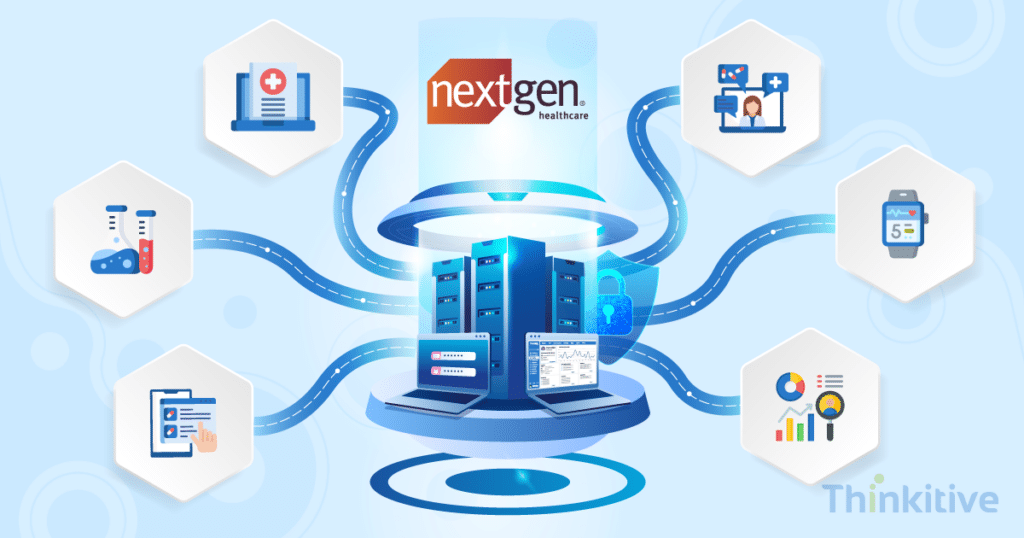
Over the years, seamless interoperability has become the top priority for healthcare organizations, and they have been pushing this into the EHR functionality. In fact, being a part of connected health infrastructure is what the healthcare practices are demanding across the landscape.
For instance, one of the most prominent and well-connected health infrastructure is that of NextGen connecting over 60,000 healthcare connections across clinics, hospitals, and care settings. So, with NextGen EHR integration, you get to be a part of a large connected healthcare network.
Furthermore, with FHIR adoption continuing to grow, reaching almost 64% in 2024, it is basically reshaping the healthcare connectivity landscape.
Driven by these trends, providers are actively choosing NextGen EHR integrations to connect telehealth, remote patient monitoring, AI documentation, patient engagement, and care coordination platforms to unify their clinical ecosystem.
Moreover, NextGen interoperability is everything that you need to achieve modern interoperability, but how to integrate with NextGen EHR using FHIR is still a task for many healthcare providers.
On that note, in this blog, let’s see exactly that, along with other intricacies of NextGen’s hybrid ecosystem of APIs and Mirth Connect workflows, and see how NextGen EHR integration can modernize ambulatory care connectivity.
So, without further ado, let’s get started!
Assess Your System for NextGen EHR Integration –
Get Free Assessment
The Architectural Choice: NextGen Mirth Connect vs NextGen API
When you are doing NextGen EHR integration, you would have to make the choice between NextGen Mirth Connect vs NextGen API. So, basically, by choosing one of these choices, you make the decision for the interoperability approach.
Now, NextGen supports both traditional interface-engine integrations and modern API-driven connectivity as well. Here, each approach serves different business and technical requirements. This makes it clear when to use Mirth Connect and APIs that might impact integration performance, scalability, and long-term maintainability.
NextGen Mirth Connect Integration
Mirth Connect EHR integration is commonly used for healthcare practices that rely on traditional HL7 messaging workflows. So, if you have the traditional HL7 messaging workflows, then it would be best suited for:
- HL7 v2 message exchange
- Laboratory and diagnostic integrations
- Billing and revenue cycle workflows
- Legacy healthcare applications
- Multi-system data routing and transformation
NextGen API Integration
On the other hand, NextGen APIs enable modern interoperability through REST services and FHIR standards. Due to this, real-time data exchange between applications. And this would be best suited for:
- Telehealth platforms
- Patient engagement solutions
- RPM systems
- AI-powered clinical applications
- Mobile and cloud-based healthcare platforms
NextGen Mirth Connect vs NextGen API: Key Differences
Here are some of the key differences between Mirth Connect and APIs, which would help you make the right choice:
| Mirth Connect | NextGen API |
| Message-based communication | Request-response communication |
| Primarily HL7 focused | Primarily REST and FHIR focused |
| Ideal for legacy systems | Ideal for modern applications |
| Complex workflow orchestration | Real-time data access |
| Interface engine dependent | API-first architecture |
Which Approach Should You Choose?
Your NextGen EHR integration strategy spends on various factors. Some of the factors that you need to consider are real-time data requirements, existing technology infrastructure, scalability, number of systems, and regulatory and interoperability requirements.
However, in a real-world scenario, many healthcare practices adopt a hybrid approach that uses Mirth Connect for established HL7 workflows and APIs for modern FHIR-based interoperability. And the best part about this is that not only does it align with ONC certification and USCDI standards, but also the interoperability goals in the 21st Century Cures Act.
Implementing NextGen EHR Integration with Third-Party Applications
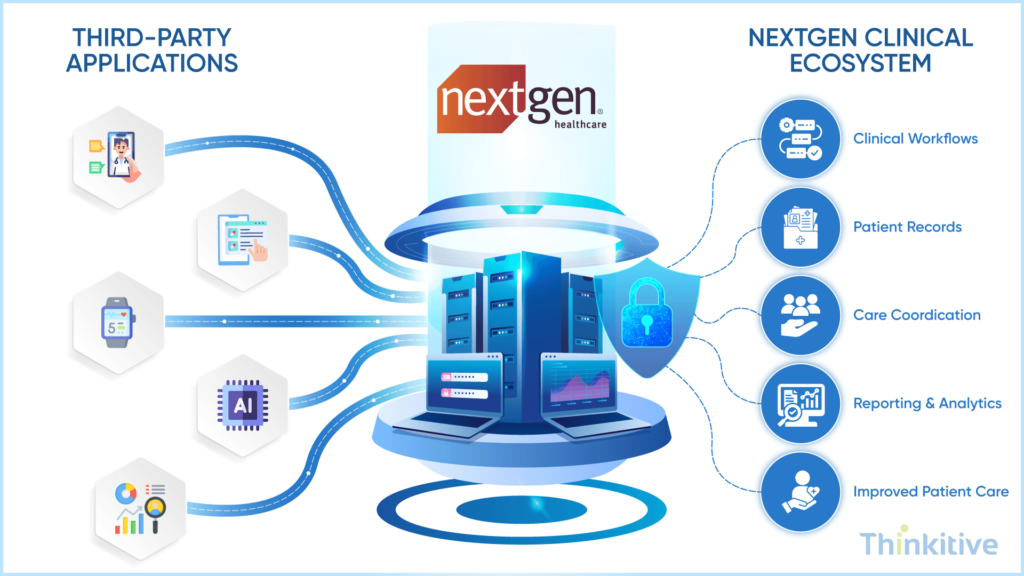
Healthcare practices often have to rely on third-party applications for seamless sharing of data, even in real-time. Now, this requires more than just a simple system-to-system connection for successfully integrating third-party applications with NextGen EHR integration.
For this, healthcare organizations must ensure secure authentication, controlled data access, and seamless interoperability across clinical systems. NextGen provides a structured iteration framework that supports modern healthcare connectivity through APIs and industry-standard security protocols.
The first step is to get started with the NextGen API ecosystem with the NextGen API Developers Hub. This basically serves as a central resource for developers and healthcare practices to build and deploy integrations. Some of the key onboarding activities in this include:
- Registering third-party applications
- Accessing API documentation and specifications
- Configuring application credentials
- Testing integration workflows
- Managing deployment and product access
NextGen EHR integration with third-party applications relies on secure authentication and authorization standards. You need to secure these integrations with OAuth 2.0 and OpenID Connect.
OAuth 2.0 helps in controlling application access to EHR data, protecting patient information, managing user permissions, and enabling token-based authentication. On the other hand, OpenID Connect supports secure user identity verification, Single sign-on capabilities, and maintains consistent authentication across applications.
Furthermore, different integrations require different levels of access. This is why managing these access scopes effectively is crucially important. The table below will help you understand this better:
| Integration Type | Typical Requirements |
| Provider-facing applications | Patient chart access, clinical documentation access, scheduling information, and care coordination workflows |
| System-to-system integrations | Automated data exchange, background processing workflows, population health data access, and reporting and analytics connectivity |
Best Practices for Scalable NextGen Interoperability
Some of the best practices for achieving scalable NextGen interoperability that healthcare practices can adopt are:
- Prioritize FHIR-based integrations
- Implement role-based access controls
- Standardize healthcare data exchange workflows
- Design integrations for future scalability
- Continuously monitor security and compliance requirements
These best practices allow providers to achieve and support seamless interoperability across specialty-care platforms, patient engagement solutions, telehealth systems, and other clinical applications while maintaining a scalable ambulatory care ecosystem.
Know the Best Approach for NextGen EHR Integration –
Get Free ConsultationHow to Integrate with NextGen EHR Using FHIR
Given the constant advancements in healthcare and the healthcare technological landscape, healthcare interoperability is constantly evolving. In this, FHIR has become the preferred standard for modern EHR integrations, and NextGen supports FHIR R4-based APIs, enabling healthcare organizations to securely access, exchange, and manage clinical data across various applications.
On the other hand, the API-first approach simplifies connectivity while supporting compliance with today’s interoperability requirements.
Accessing Clinical Data Through FHIR APIs
NextGen FHIR endpoints only allow authorized applications to retrieve and exchange critical healthcare information like patient demographics, allergies, medications, prescriptions, procedures, clinical interventions, observations, vital signs, encounters, and appointments.
Supporting SMART on FHIR Applications
The next step in this process is to support third-party applications to launch securely within clinical workflows and access authorized patient data. This is done with the help of SMART on FHIR.
Some of the most common use cases for which this is used are:
- Clinical decision support tools
- AI-powered documentation solutions
- Patient engagement applications
- Care coordination platforms
- Population health management systems
Modern integrations require more than just data retrieval. You need to manage read, write-back and workflow automation for seamless integration by achieving complete interoperability. Some of the FHIR-based integrations will support certain aspects like:
- Read access to clinical records
- Write-back capabilities for approved workflows
- Automated care coordination processes
- Real-time clinical data synchronization
- Trigger-based workflow automation
Along with that, to ensure consistent interoperability, you must normalize data using industry-standard terminologies, which are standardized in healthcare data exchange. Have a look at the table of the common standards and what they are used for:
| Standards | Purpose |
| SNOMED CT | Clinical concepts |
| LOINC | Laboratory observations |
| RxNorm | Medications |
| ICD-10 | Diagnoses and billing workflows |
Building Future-Ready Interoperability
FHIR-based NextGen EHR integrations have helped organizations align with the evolving interoperability initiatives, which also include ONC certification requirements, USCDI standards, and the 21st Century Cures Act.
Now, by adopting API-first clinical workflows, healthcare providers can support scalable data exchange, help in improving care coordination, and simply integrate with third-party clinical applications across ambulatory care environments.
Testing, Validation, & Production Go-Live
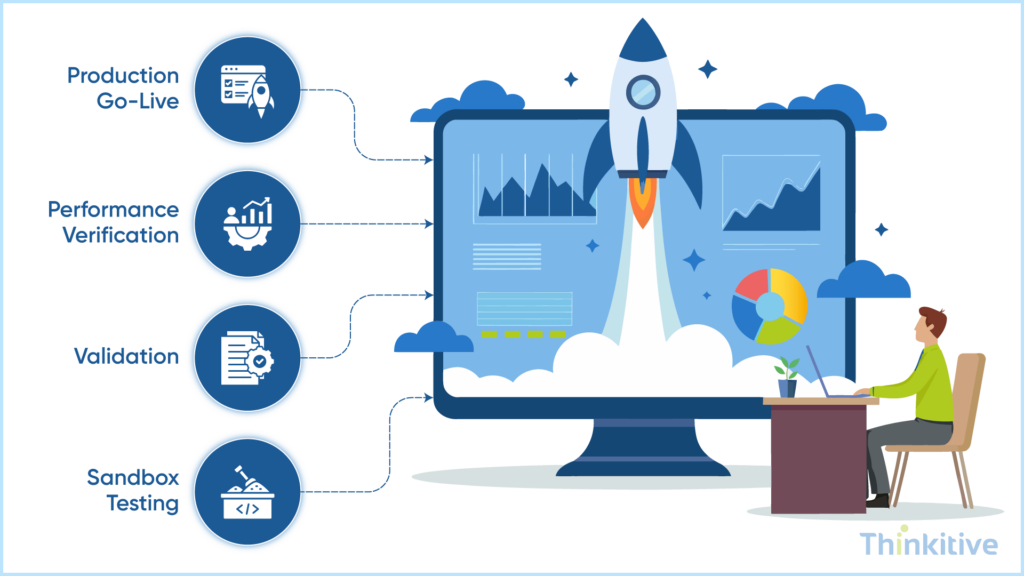
You might successfully develop the NextGen EHR integration. However, without thorough testing and validation, its reliability cannot be ensured. It can bring in inefficiencies like inconsistency in data exchange and even disrupt your clinical workflows in some instances.
That is why, before moving to production, practice must validate integrations in controlled environments and establish a long-term monitoring strategy.
The first step in this is to validate the integrations in sandbox environments. Since NextGen Share and sandbox environments allow you to test interoperability workflows before deployments, you can use this for verifying API connectivity and authentication, testing FHIR resource retrieval and updates, validating data mapping and transformation logic, and identifying potential integration failures, too, in simulated real-world clinical workflows.
Test Performance & Synchronization Reliability
The healthcare system needs accurate and timely data exchange to support patient care activities. That is why performance testing is a must. In this, you should focus on improving API response time, data synchronization accuracy, throughput under peak workflows, error handling, and recovery mechanisms, etc.
And it doesn’t end here. Once the integrations are live after performance Testing,you need to continuously monitor and maintain the integration for its operational stability. Here are some of the key metrics that you should be monitoring:
- API availability and uptime
- Latency and response time
- Transaction success rates
- Authentication failures
- Integration error logs
Furthermore, since the healthcare landscape is constantly evolving, you need to plan for long-term interoperability maintenance. Some of the best practices in this involve tracking API version updates, reviewing security and compliance requirements, monitoring rate-limited thresholds, detecting workflow disruptions early, and regularly validating integration performance.
By combining comprehensive testing with proactive monitoring, healthcare organizations can ensure that their NextGen EHR integrations remain scalable, reliable, and aligned with evolving interoperability demands long after production go-live.
Do You Really Need NextGen EHR Integration –
Learn MoreConclusion: Building a Scalable Specialty-Care Connectivity Strategy
NextGen interoperability still remains critical for ambulatory healthcare modernization as it helps you connect with over 60,000 healthcare practices across the nation. So, if you are planning for NextGen EHR integration, then you must balance legacy HL7 workflows with API-first interoperability strategies as explained earlier.
On top of that, focus on FHIR-based interoperability, SMART on FHIR standards, TEFCA, and ambulatory EHR integration in connected healthcare ecosystems so that your integration is reliable and relevant for a long time.
Planning an EHR integration project?
Also, you know the complete guide about EHR vendor integration. Read this detailed blog here — EHR Vendor Integration: How to Choose the Right Approach by System.
Get a vendor-by-vendor breakdown of integration requirements, approval processes, available APIs, interoperability standards, and best practices to ensure a smooth implementation.
On that note, let this blog be your guide to NextGen EHR integration, and if you want to know where your system stands, then talk to our integration expert to learn more.
Frequently Asked Questions
The first step in a NextGen EHR integration project is identifying your interoperability requirements, including the systems you want to connect, the data you need to exchange, and the workflows you want to automate. Once requirements are defined, organizations can access the NextGen Developer Hub, review API documentation, and determine whether an API-based or interface-engine approach is most appropriate.
Mirth Connect EHR integration is often the preferred option when connecting legacy healthcare systems that rely on HL7 messaging workflows. Organizations typically use Mirth Connect for laboratory integrations, billing systems, imaging platforms, and complex multi-system data routing, while modern applications often benefit more from API-based connectivity.
To begin NextGen API integration, developers typically register their application through the NextGen Developer Hub, configure authentication credentials, define access permissions, and test API connectivity within sandbox environments before moving to production deployment.
Yes. NextGen supports SMART on FHIR capabilities, allowing third-party applications to securely launch within clinical workflows. This makes it easier to support patient engagement solutions, clinical decision support tools, and other applications commonly used in ambulatory EHR integration environments.
When evaluating NextGen Mirth Connect vs NextGen API, the primary difference lies in the integration approach. Mirth Connect focuses on HL7 message routing, transformation, and workflow orchestration, while APIs leverage REST and FHIR standards to support real-time data access, scalability, and modern healthcare application connectivity.
NextGen supports ambulatory EHR integration through APIs, FHIR resources, workflow automation capabilities, and specialty-specific clinical data exchange. This enables healthcare organizations to connect telehealth platforms, care coordination solutions, patient engagement tools, and specialty-care applications within a unified workflow.
Common challenges include data mapping complexities, authentication and security requirements, workflow alignment, API version management, and interoperability between legacy and modern systems. Successful NextGen interoperability initiatives typically require careful planning, testing, and ongoing maintenance.
Yes. Depending on permissions and supported endpoints, NextGen EHR integration with third-party applications can support both read and write-back functionality. This allows authorized applications to update clinical records, automate workflows, and synchronize healthcare data across connected systems.
Security is a critical component of how to integrate with NextGen EHR using FHIR. Organizations typically implement OAuth 2.0, OpenID Connect, role-based access controls, secure API authentication, encryption protocols, and audit logging to protect patient information while maintaining compliance with healthcare interoperability and privacy requirements.


