Off-the-shelf Vs. Custom EMR Software

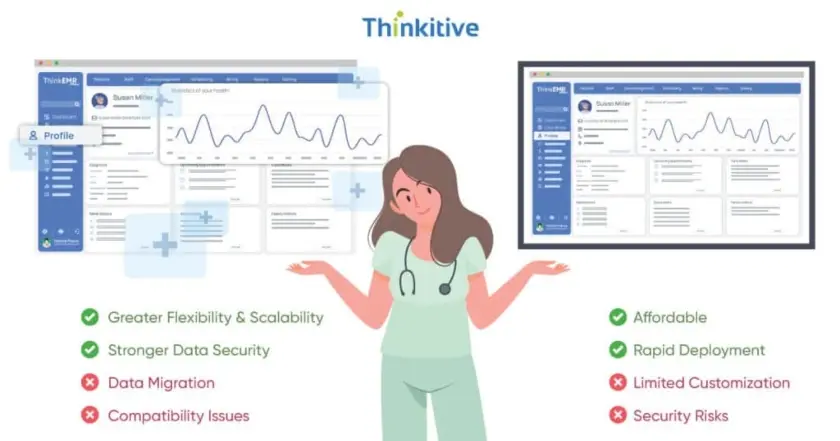
Technology is becoming a trendsetter in the healthcare industry. Looking at the graph of technological adoption in healthcare, in the last decade, the adoption rate of healthcare software has been the highest.
With healthcare software development, practices have become more focused and streamlined, and administrative tasks have been streamlined for better practice management. And in an attempt to streamline care delivery processes many healthcare practices have started to adopt electronic medical records software systems.
These systems have not only replaced paper-backed records with digital records in a quick span of time they have become the epicenter for care delivery and even patient-related administrative processes.
Moreover, riding the wave of digital transformation in the healthcare industry, many healthcare practices are actively looking for EMR developers to build their own EMR with EMR system customization features.
If you’re one of them, then you might ask, ‘Aren’t custom EMR software development costly?’
Well, compared to off-the-shelf EMR software, yes! However, what choice do you have? When you scratch the surface of the healthcare IT landscape for robust healthcare solutions for record-keeping, off-the-shelf and custom EHR development are the two choices that you get.
And interestingly, out of all the healthcare organizations who have failed in their venture of digital transformation, they have made a wrong choice, and they’re not to be blamed completely. The choice between off-the-shelf and custom EMR software can be daunting.
But worry not! In this blog, let’s briefly discuss the difference between custom EMR software development and off-the-shelf EMR software. And by the end of this blog, you will have enough information to make the right decision.
Cost Considerations
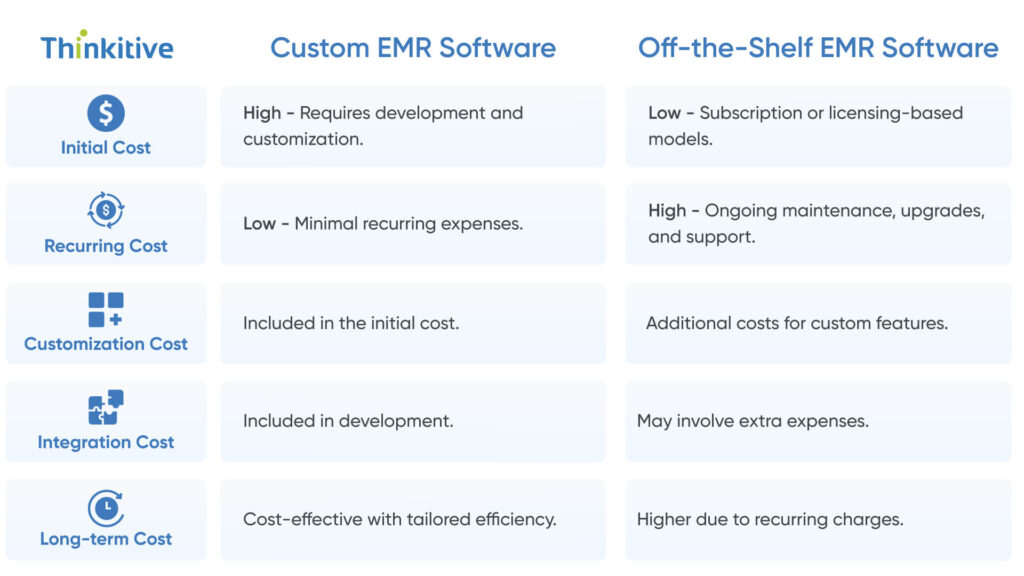
Well, as mentioned earlier, custom EMR software development requires a higher initial investment. This is because you have to build your own EMR from scratch, in this, the development and customization along with the EMR developers requires a significant investment.
However, the long-term cost-effectiveness that it brings to your practice can be transforming with EMR customization services. Furthermore, EMR implementation services can lead to improved efficiency, reduced clinical and documentation errors, and better data utilization.
On the other hand, off-the-shelf EMR requires very little investment, and since most of the software comes in subscriptions or licensing pricing models, they have a significantly less initial investment but are recurring in nature.
These recurring costs include ongoing maintenance, upgrades, and support. Moreover, if you want to customize a few aspects of the off-the-shelf software, then it might require additional costs for customization and integrating the software into the existing systems.
Flexibility & Customization
Since you will be building your own EMR software, you get the freedom to customize and develop the software as per your specific needs and requirements especially when it comes to aligning the software with the clinical and administrative needs.
As your clinic must be working in a way that is unique and works best for you to deliver the best possible. A tailored EMR software can offer you enough flexibility and customization abilities to cater to specific patient populations, specialties, and practice sizes.
Moreover, with seamless integration capabilities with other healthcare systems and devices, your custom EMR software can be easily customized to be the one-stop solution for all your needs.
However, in terms of flexibility and customization, off-the-shelf EMR software offers near-to-zero or very limited customization options. Since they are restricted to pre-defined configurations, they offer very little customization.
Also, one of the major reasons why many healthcare practices have shifted to custom EMR software development is due to the non-alignment nature of off-the-shelf software systems. On top of that, the EMR software is limited to adapting to future changes in regulation and practice requirements, making it further difficult for you to make any changes in your system.
Last but not least, many use mobile devices to access healthcare, with mobile EMR application development and patient portal development, you can improve access and provide access on the go. However, this can be a little tricky with off-the-shelf solutions as it may or may not provide mHealth app, and API integration for EMR with off-the-shelf mobile software can be difficult.
Data Security & Integrations
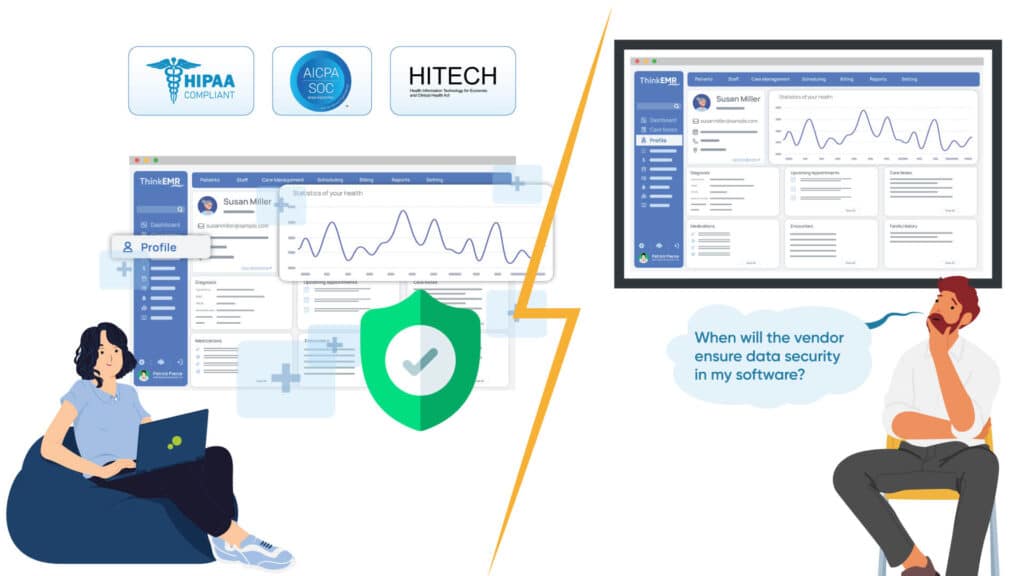
When you are building your own EMR software, you get complete control over the security and integrations of your software system. Meaning with EMR software development, you get enhanced control over data security and privacy measures. This way, you can protect your patient data efficiently and effectively and easily align the software with the necessary regulatory guidelines of HIPAA, GDPR, HITECT, FDA, etc.
Apart from the security aspects, custom EMR offers greater flexibility in data integration and exchange with other systems. Meaning that it is easier to achieve interoperability with custom EMR software development and seamlessly share data to make the most out of it by adhering to HL7/FHIR standards.
When it comes to off-the-shelf EMR software, you have to rely on vendors for data security and HIPAA compliance, which can be dicey at times. On top of that, due to the pre-defined configuration, very limited data integration offerings are available, especially with legacy systems, which most of the healthcare systems use.
Moreover, a data security breach at one practice can impact multiple practices using the same software, as it is a part of one chain.
Scalability & Growth
It is natural that with time, your practice will grow and to adapt to the evolving changes, you will have to enhance your software’s capabilities to adapt to that growth.
The custom EMR software is highly scalable in nature and can easily accommodate future growth in terms of patient volume and practice complexity. Along with that, with technological changes and evolving healthcare trends, custom EMR software acts as a long-term solution due to its highly customizable and flexible nature.
Long story short, as your practice grows, your custom EMR software will also grow with you and with medical billing integration, you can make it a one software solution for your entire practice.
On the other hand, off-the-shelf EMR software can offer limited scalability options, but it all depends on the vendor’s platform, pricing models and offerings. Moreover, upgrades and changes in the software may require significant cost and downtime, which can disrupt the day-to-day operations and activities of your practice.
In short, off-the-shelf software’s pre-defined nature does not allow it to offer scalability features, and keeping up with the rapid technological advancements in healthcare can be tough.
Support & Maintenance
Last but not least, the support and maintenance aspects of software are something that every technological user needs.
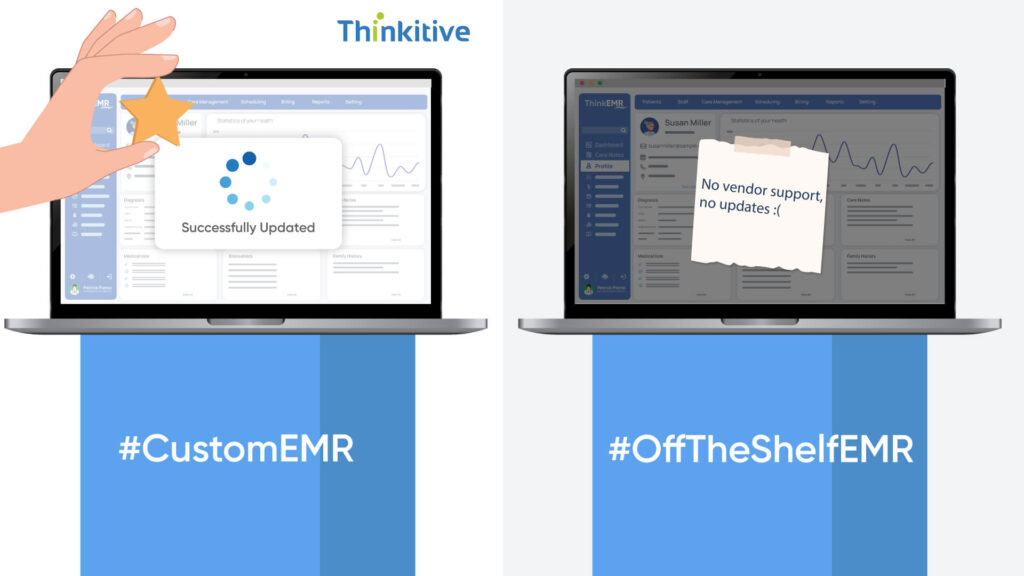
When you opt for custom EMR software development, you get a dedicated team to provide you with around-the-clock support and software maintenance. With personalized assistance and faster response times, it becomes easy to maintain the software and carry out day-to-day activities without disruptions.
Furthermore, ongoing updates and improvements based on the specific needs and feedback is easier to handle with customizable EMR.
On the contrary, off-the-shelf EMR software’s support is completely vendor oriented and varies in quality as well as in responsiveness. On top of that, the limited customization options within the vendor’s support framework makes it difficult to accommodate all your needs and requirements effectively.
In short, for all your support and maintenance needs, you have to rely on your vendor.
Conclusion
Custom EMR software development and off-the-shelf EMR software, both come with their own benefits and drawbacks. Except for the cost factor, the choice in the end comes down to needs and requirements. That is why evaluate your needs and priorities and consult with experienced EMR developers before making a final decision.
On that note, let’s take the first step to build your own EMR software. Click here to get your first free consultation.
Frequently Asked Questions
Custom EMR solutions offer tailored features and scalability but require significant development and maintenance costs. Off-the-shelf solutions provide pre-built functionalities and faster implementation but may have limited customization and potentially higher long-term costs due to vendor lock-in.
Custom EMR systems are significantly more expensive than off-the-shelf options due to development, maintenance, and specialized IT expertise.
Choosing an EMR system involves considering factors like functionality, interoperability, usability, security, cost, vendor support, scalability, compliance, integration, and patient experience. These factors ensure the system meets your practice’s specific needs and improves patient care.
Yes, custom EMR systems can be integrated with your existing software. This allows for a seamless flow of information and improves efficiency.
Custom EMR solutions can be more secure than off-the-shelf systems because they can be designed with specific security features and tailored to the organization’s unique needs. However, both types of systems can be made to meet strict security and legal requirements. The choice between custom and off-the-shelf depends on the organization’s size, specific needs, and long-term scalability requirements.
Implementing a custom EMR solution typically takes 6–18 months, depending on factors like the size of the healthcare organization, the complexity of the project, and the extent of customization required. Smaller organizations may be able to implement an EMR system in under a year, while larger organizations may take longer.
Off-the-shelf EMR systems face compliance challenges like ensuring HIPAA, GDPR, and other regulations are met, seamlessly exchanging data with other systems, and protecting sensitive patient information from breaches.
Yes, most off-the-shelf EMR systems offer some degree of customization. This can include configuring workflows, adding custom fields, integrating with other software, and even some degree of interface personalization. However, the extent of customization varies significantly between vendors.
Yes, custom EMR systems absolutely require ongoing maintenance and support.
- Software Updates: Regular updates are crucial to address bugs, enhance security, and incorporate new features or regulatory changes.
- Technical Support: A dedicated team is needed to troubleshoot issues, provide user training, and ensure system uptime.
- Data Backups and Recovery: Robust backup and disaster recovery plans are essential to prevent data loss and ensure business continuity.
- System Upgrades: As technology evolves, upgrades may be necessary to maintain performance, compatibility, and integration with other systems.
Yes, it’s definitely possible to migrate data from an old EMR system to a new custom solution. Here’s why:
- Data portability: Modern EMR systems often have features or APIs that allow you to export data in a structured format like CSV or XML.
- Data mapping: You can create a mapping document that defines how data fields from the old system should be translated into the new system’s format.
- Data transformation tools: There are various tools and techniques available to clean, transform, and load data into the new system.
Important Considerations:
- Data security and privacy: Ensure the migration process complies with all relevant regulations and safeguards patient data.
- Data validation: Thoroughly validate the migrated data to ensure accuracy and completeness.
- Testing: Conduct extensive testing before and after the migration to identify and resolve any issues.


