EHR Integration for Specialty Practices: Unique Challenges by Practice Type

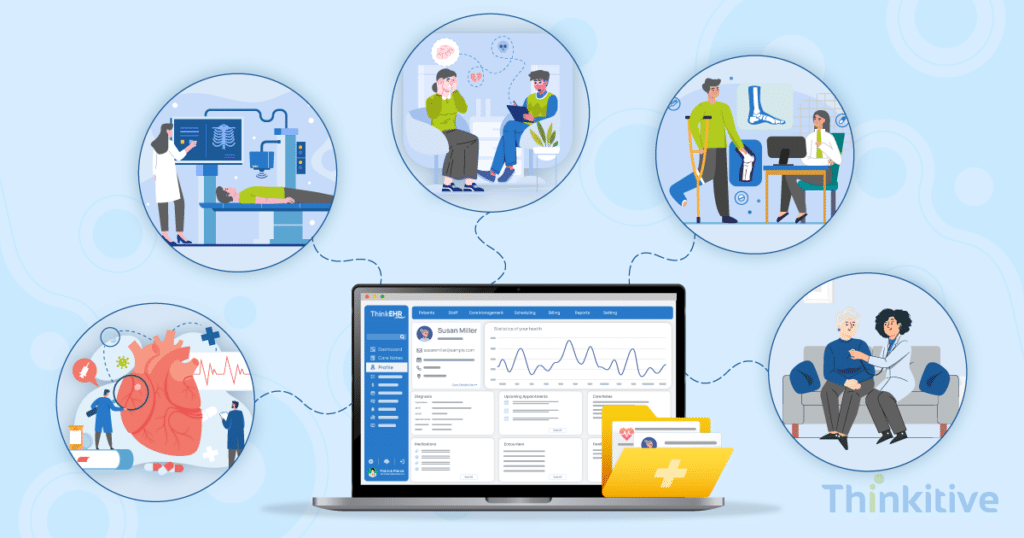
Whenever things get intrinsic, the generic technology fails!
And the phenomenon is seen very commonly in the healthcare industry. You see, after a point, care delivery becomes very specific to a specialty.
You see, EHR software systems have replaced most of the paperwork, and today, it has become the epicenter of care. However, as soon as the care delivery shifts to specialty, all things go haywire.
It is not the infrastructure that has to be blamed completely. I mean, the variations in clinical workflows, tools used to gather data, and the different types of data that you gather, the software simply can’t focus on one particular thing.
This is why there has been a striking demand for EHR integration for specialty practices. And it was bound to happen sooner or later. As your system needs the ability ingrained in them to be able to communicate with the system on the other side.
To better understand how foundational EHR systems connect and support interoperability across healthcare environments, you can refer to EHR Integration Guide: Complete Overview for Healthcare Organizations.
However, while doing so, things can be a little different than how they appear. You see, healthcare system integration for specialty practices needs to be uniquely curated to support your specialized care delivery.
On that note, let’s try to understand the EHR integration challenges for specialty clinics and how you can solve them. So, without further ado, let’s get started!
What Makes EHR Integration Different Across Specialties
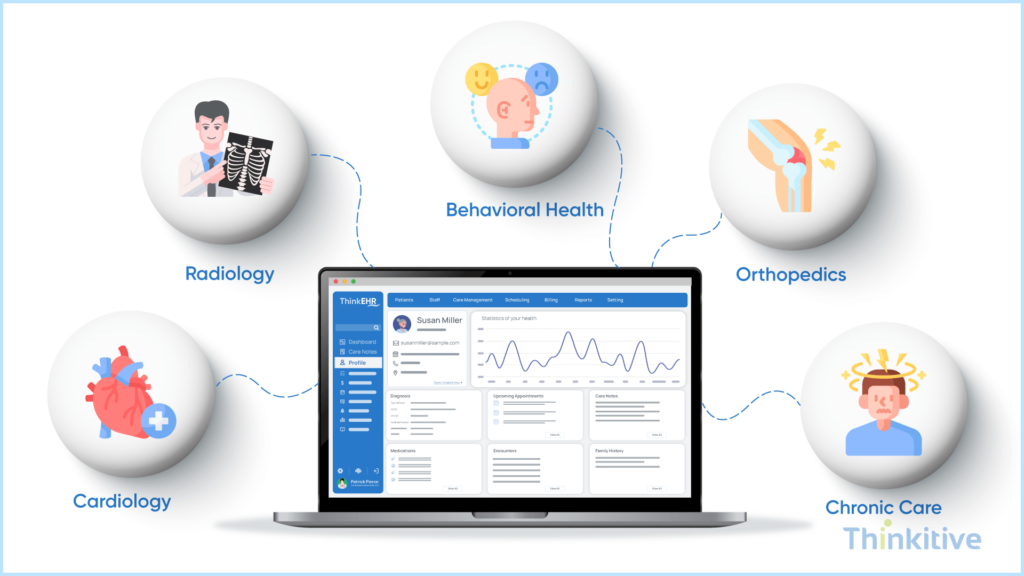
Before getting into the challenges section, let’s first try to understand some of the intricacies of specialty EHR integration.
While you might think that a particular specialty EHR must work in a specific way. However, on the ground, it is not just the specialty that you have to be specific about; you can be specific to the practices as well.
It is true that specific specialties have certain care goals and care episode lengths, and this brings in variations in their core workflows. For instance, routine check-up for pregnancy, or continuous care for a Type 2 Diabetes patient, or home care for Alzheimer’s.
Things differ when it comes to care, and every practice has a different approach to addressing and tackling that. This makes things even more complicated.
While everything till now is just talking about infrastructure, the data that the system collects even makes it a lagging process. You see, from devices you might get different data, which your system has to convert. Other than that, from all the systems that it collects data from, the problem with its structure has to be solved.
That is why in the current landscape, there is a huge dependency on specialty-specific applications and systems. Moreover, the impact of these differences makes the specialty EHR integration process driven by complexities or uniqueness, for that matter, and data flow. How the data flows, from which system to where, and whatnot.
Assess Your System Readiness for Specialty EHR Integration –
Free Assessment
Specialties with High Imaging & Device-Generated Data
Every specialty has a unique need, especially with those who rely on high imaging or device-generated data. So, here’s the table of some of the most in-demand specialties, EHR integration, and the challenges it poses:
| Specialty | Data Characteristics | Integration Requirements | Key Challenges |
| Cardiology | High-frequency, real-time data from ECG, telemetry, echocardiography, and monitoring devices | Low-latency, real-time integration with EHR systems; seamless device-to-EHR data flow | Fragmented systems, delayed data availability, continuous monitoring complexity |
| Radiology | Large-volume imaging data (CT, MRI, X-rays) stored in PACS; standardized via DICOM | Efficient handling of large files; fast retrieval and synchronization with EHR systems | Data size, storage complexity, PACS integration challenges |
| Orthopedics | Imaging-heavy workflows (X-rays, MRIs) + surgical planning tools | Integration between imaging systems, EHR, and surgical planning software | Disconnected imaging and surgical workflows |
| Ophthalmology | High-resolution imaging (OCT scans, fundus photography) from specialized diagnostic devices | Device-level integration with EHR; support for image storage and retrieval | Proprietary device formats, limited APIs |
| Neurology | Continuous monitoring data (EEG) + brain imaging (MRI, CT) and neurodiagnostic outputs | Real-time integration for monitoring systems + imaging synchronization | High data complexity, need for precise time-aligned data |
To measure the impact of care, here is how solving each of these challenges impacts the care delivery process:
- Cardiology: Enables faster diagnostics and earlier detection of clinical issues.
- Radiology: Improves real-time clinical decision-making and responsiveness.
- Orthopedics: Reduces delays caused by fragmented systems and manual data access.
- Ophthalmology: Enhances coordination between specialists, imaging systems, and care teams.
- Neurology: Supports more accurate, data-driven treatment planning.
Specialties with Complex, Longitudinal Treatment Workflows
While some practices depend on imaging and labs, some of the specialties have to deal with complex and longitudinal treatment workflows. Due to these, the intricacies in EHR customization for practices with respect to EHR integration also change. Here is a brief table about specialties that depend on complex and longitudinal treatment workflows:
| Specialty | Data Characteristics | Integration Requirements | Key Challenges |
| Oncology | Multi-step treatment journeys (diagnosis, staging, therapy, follow-ups) with continuous data updates | Integration across EHR, imaging, lab systems, and oncology-specific tools for longitudinal tracking | Data spread across systems, care coordination complexity, maintaining complete patient timelines |
| Chronic Care (e.g., diabetes, cardiovascular diseases) | Long-term patient data including vitals, medications, lifestyle data, and remote monitoring inputs | Continuous data synchronization across EHR, RPM devices, and care management platforms | Managing large volumes of longitudinal data, inconsistent data sources, patient adherence tracking |
| Nephrology | Ongoing dialysis treatments, lab monitoring, and medication adjustments over extended periods | Integration between dialysis systems, lab systems, and EHR for continuous tracking | Frequent data updates, coordination between treatment centers, fragmented data flows |
| Endocrinology | Long-term hormone level monitoring, lab data, and medication adjustments | Integration with lab systems, EHR, and patient monitoring tools | Delayed data updates, dependency on lab integrations, maintaining longitudinal accuracy |
| Behavioral Health | Continuous therapy sessions, progress notes, and patient-reported outcomes over time | Integration of EHR with therapy notes, patient engagement tools, and remote care platforms | Unstructured data, privacy constraints, difficulty in standardizing longitudinal records |
And here is how curating your EHR integration structure with these aspects impacts your care delivery:
- Oncology: Improves care continuity across long-term treatment journeys.
- Chronic Care: Enables more personalized, data-driven treatment plans.
- Nephrology: Enhances tracking of patient progress over time.
- Endocrinology: Reduces care gaps and missed interventions.
- Behavioral Health: Supports better coordination across multiple providers and systems.
Specialties with Unstructured & Sensitive Clinical Data
Till here, we have discussed the specialties of workflows and types of care delivery. However, some specialties deal with sensitive data, too, in an unstructured manner. For such aspects, the intricacies of EHR integration become even more specific. Here is a brief table to help you understand the specialty-specific EHR integration challenges better:
| Specialty | Data Characteristics | Integration Requirements | Key Challenges |
| Behavioral Health | Narrative-heavy therapy notes, patient-reported outcomes, and session-based documentation | Integration of EHR with therapy platforms, patient engagement tools, and secure data exchange systems | Unstructured data formats, difficulty in standardization, strict privacy requirements |
| Psychiatry | Sensitive mental health records, medication histories, and longitudinal behavioral data | Secure, privacy-first integration with EHR and prescribing systems | Data segmentation needs, regulatory constraints, limited interoperability |
| Psychology | Qualitative assessments, counseling notes, and non-standardized clinical inputs | Integration with documentation tools and EHR systems that support unstructured data | Lack of structured formats, challenges in data exchange and analysis |
| Substance Abuse Treatment | Highly sensitive patient data, treatment plans, and progress tracking | Secure integration with EHR, care coordination platforms, and reporting systems | Strict confidentiality regulations, restricted data sharing, fragmented systems |
| Social Work / Care Coordination | Social determinants of health (SDoH), case notes, and community-based data | Integration across EHR, social services platforms, and care coordination tools | Data variability, lack of standardization, cross-system interoperability challenges |
While these challenges seem to be very specific and complex, the impact of solving them can revolutionize your care delivery process. Here are some of its intricacies that you need to know:
- Behavioral Health: Improves documentation quality and consistency for narrative-driven care.
- Psychiatry: Enables secure and compliant handling of sensitive patient information.
- Psychology: Enhances care coordination across providers and support systems.
- Substance Abuse Treatment: Supports better clinical insights despite unstructured data formats.
- Social Work: Reduces information gaps in long-term and behavioral care journeys.
Book Free Call for Aligning Data Flow with System Workflows
Book 30-Min CallSpecialties with Continuous Monitoring & External Data Inputs
Some specialties go even more specific. You see, their care delivery process depends on continuous monitoring and data collected from external systems. One of the finest examples of this can be seen in orthopedic practices and practices that have remote monitoring scenarios. The table below will give you an accurate overview of the challenges it poses in EHR integration:
| Specialty | Data Characteristics | Integration Requirements | Key Challenges |
| Orthopedics | Post-surgical recovery data, mobility tracking, and rehabilitation progress from wearable devices | Integration with wearable devices, rehab platforms, and EHR systems for continuous data flow | Data fragmentation across devices, inconsistent data formats, integration with rehab tools |
| Rehabilitation (Physical Therapy) | Continuous patient activity data, exercise tracking, and remote progress monitoring | Integration with patient engagement apps, wearable devices, and EHR systems | Ensuring data accuracy, patient compliance, and syncing real-time data |
| Cardiology (Remote Monitoring) | Continuous cardiac data from wearable monitors and remote patient monitoring (RPM) devices | Real-time integration with EHR and monitoring platforms | High-frequency data handling, alert management, device interoperability |
| Pulmonology | Respiratory data from spirometers, sleep studies, and home monitoring devices | Integration with diagnostic devices and remote monitoring systems | Variability in device data, lack of standardization, delayed data transmission |
| Chronic Care Management | Long-term health data from wearables, home devices, and patient-reported inputs | Integration across EHR, RPM platforms, and care management systems | Managing large volumes of continuous data, ensuring data reliability, system scalability |
And here is how solving these EHR integration challenges will help you make your specialty practice better:
- Orthopedics: Enables proactive care through continuous patient monitoring.
- Rehabilitation: Supports early detection of health issues and timely intervention.
- Cardiology: Reduces hospital readmissions and emergency visits.
- Pulmonology: Enhances patient engagement and adherence to treatment plans.
- Chronic Care Management: Improves overall care outcomes with real-time data insights.
Specialties with Multi-Entity & Long-Term Patient Tracking
A few unique specialties depend on multi-entry and long-term tracking of vital data. Here are some of the challenges that you might face with EHR integration in these:
| Specialty | Data Characteristics | Integration Requirements | Key Challenges |
| Pediatrics | Family-linked records, growth tracking, immunization history, and developmental milestones over time | Integration with EHR, immunization registries, and family-linked record systems | Managing linked patient records, long-term data accuracy, coordination across caregivers |
| Family Medicine | Multi-patient (family-level) records, longitudinal health histories, and preventive care data | Integration across EHR, lab systems, and external registries for comprehensive tracking | Handling interconnected records, maintaining continuity across generations, data consistency |
| Obstetrics & Gynecology | Maternal and fetal records, pregnancy timelines, and postpartum tracking | Integration between EHR, lab systems, imaging, and maternal health registries | Linking maternal-fetal data, time-sensitive updates, fragmented data across systems |
| Geriatrics | Long-term health records, comorbidities, medication history, and caregiver inputs | Integration with EHR, care coordination platforms, and external care facilities | Managing complex longitudinal data, coordination across multiple providers, polypharmacy tracking |
| Home Healthcare | Continuous patient data from home care settings, caregiver notes, and remote monitoring inputs | Integration with EHR, remote monitoring tools, and care coordination systems | Data variability, coordination between home and clinical settings, delayed or incomplete data |
Here is the impact that solving these can have on care delivery:
- Pediatrics: Improves continuity of care across long-term and family-linked health journeys.
- Family Medicine: Enables holistic, patient-centric care by connecting related records and data sources.
- Gynecology: Enhances coordination between multiple providers, caregivers, and care settings.
- Geriatrics: Supports more accurate long-term health tracking and preventive care.
- Home Healthcare: Reduces gaps in care across transitions and life stages.
Key Considerations for Specialty-Based Integration
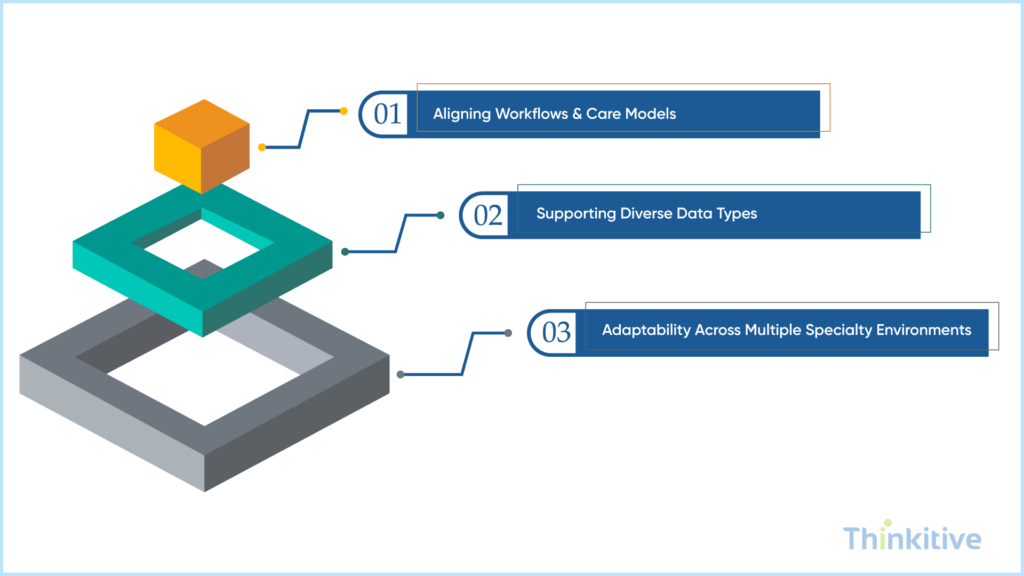
If you have made it this far, then you must have addressed that many practices come under every other category. Well, this is where our expertise comes into action. On that note, here are a few things that you need to consider for specialty-based integration:
- Aligning Workflows & Care Models: The first and foremost consideration is to align your integration strategy with respect to that of your practice workflows and the care model you are following. If you are crystal clear on that, most of the intricacies will be solved.
- Supporting Diverse Data Types: Depending on the specialty, you will be dealing with a lot of different types of data. For that, your integration bridge needs to support diverse data types and adhere to different system interoperability needs. This way, many of the issues related to data will be solved.
- Adaptability Across Multiple Specialty Environments: While customizing these healthcare system integrations for specialty clinics, you need to ensure that your integration bridge is flexible enough to adapt across multiple specialty environments.
Know Where Your Specialty EHR Integration System Lack –
Get Free AssessmentConclusion: Why Specialty-Driven Integration is Critical
So, this is how specialty-driven integration has become so critical in healthcare practices. In fact, given the nature of data collection and workflow patterns, the integration needs may vary. That is why your custom EHR integration approach should be flexible yet strategically aligned with the clinical context of your practice.
That is why working with experienced and trustworthy partners becomes so essential. On that note, just to get a second opinion on your EHR integration approach for your specialty from experts at Thinkitive. Get your first free consultation here.
Frequently Asked Questions
General-purpose EHRs are typically designed for broad use cases, focusing on standardized workflows common in primary care. However, specialty practices require highly tailored workflows involving unique data types, devices, and treatment protocols.
This mismatch leads to inefficiencies such as excessive manual data entry and workflow disruptions. Specialty EHR integration and EHR customization for specialty practices address this gap by aligning the system with specialty-specific processes, improving usability and clinical efficiency.
EHR integration challenges for specialty clinics are more complex due to:
- Diverse data types (imaging, device-generated, unstructured data)
- Dependence on multiple third-party systems and devices
- Specialty-specific workflows and treatment protocols
- Limited interoperability between niche systems
Unlike primary care, EHR integration for different medical specialties requires deeper customization and workflow alignment, making integration more resource-intensive and technically demanding.
Imaging integration using PACS and DICOM standards enables seamless access to diagnostic images directly within the EHR. This eliminates the need to switch between systems or manually retrieve files.
In specialties like cardiology and radiology, this form of healthcare system integration for specialty practices ensures:
- Faster image retrieval
- Real-time access to diagnostic data
- Improved collaboration between clinicians
As a result, specialty EHR integration significantly accelerates diagnostic workflows and reduces delays in clinical decision-making.
Yes, AI-driven data mapping can streamline the digitization of legacy and paper-based records by automatically extracting, structuring, and mapping data into EHR-compatible formats.
This approach helps overcome specialty-specific EHR integration challenges such as:
- Unstructured and narrative-heavy data
- Inconsistent record formats
- Manual data entry errors
By reducing migration time and improving data accuracy, AI enhances healthcare system integration for specialty practices transitioning to digital systems.
The most effective approach involves a combination of API-based integration, interoperability standards, and middleware solutions.
When integrating specialty applications with EHR systems, organizations should:
- Use standards like FHIR for data exchange.
- Implement middleware to bridge legacy systems.
- Ensure workflow alignment between systems.
- Prioritize scalability and future integrations.
This enables seamless specialty EHR integration while maintaining consistency across the broader healthcare ecosystem.
Specialists often deal with complex workflows that generic EHR interfaces fail to support efficiently. This results in excessive clicks, redundant documentation, and clinician frustration.
EHR customization for specialty practices addresses this by:
- Streamlining workflows
- Reducing unnecessary steps
- Automating repetitive tasks
- Tailoring templates to specialty needs
As a result, clinicians experience reduced administrative burden and improved productivity, making EHR integration for different medical specialties more effective.
Behavioral health data is highly sensitive and subject to stricter privacy regulations compared to other specialties.
Specialty-specific EHR integration challenges in this domain require:
- Role-based and segmented data access
- Enhanced consent management
- Secure data exchange protocols
- Compliance with regulations like HIPAA and additional behavioral health protections
These measures ensure that healthcare system integration for specialty practices maintains both data security and patient trust.
Chronic disease management relies on continuous monitoring, longitudinal data tracking, and coordinated care across providers.
Specialty EHR integration enables:
- Real-time access to patient data
- Integration with remote monitoring devices
- Better tracking of treatment progress over time
- Improved coordination between care teams
By addressing EHR integration challenges for specialty clinics, healthcare providers can deliver more proactive, personalized care—ultimately improving long-term patient outcomes.


