HIPAA-Compliant EHR Development: Build a Secure Custom EHR

Let me tell you an interesting stat, you see, in 2018, Stanford Medicine polled doctors about EHRs, suggesting that 67% of physicians cited problems in solving their interoperability problems. Cut to 2024, the number has surprisingly increased to 69% with critical issues in interoperability disrupting their coordination and care delivery.
Coordination in healthcare has always been a problem. In fact, a study suggests that almost 80% of medical errors are caused by miscommunication, which directly or indirectly implies inefficiencies of their EHR interoperability software.
Upon close inspection of some of the systems of our clients, it was clear that EHR interoperability security is one of the major concerns for them. You see, as instructed by HIPAA, your EHR systems need to be interoperable. And amongst all the healthcare software systems that say they are HIPAA compliant, more than 50% of them are not fully HIPAA compliant, according to Becker’s Hospital Review.
This non-HIPAA compliance is the reason why more than 124-133 million health records were compromised in 2024-2025 alone, according to HIPAA Journal.
This is why healthcare organizations are increasingly investing in HIPAA-compliant EHR development that prioritizes security from the ground up. Instead of treating security as an afterthought, modern custom EHR systems are designed with encryption, access controls, secure APIs, continuous monitoring, and regulatory safeguards built into every layer of the application.
While interoperability and regulatory compliance are important, security is the foundation that makes both possible. Every integration, API, user login, and patient record introduces potential risks, making secure EHR development essential for protecting sensitive health information and maintaining patient trust.
In this guide, you’ll learn the security best practices for HIPAA-compliant EHR development, including data encryption, access control, API security, audit logging, risk management, and practical steps to build a secure custom EHR system. We’ll also briefly discuss how security supports interoperability and compliance, with links to dedicated guides covering those topics in detail.
Top 5 Benefits of Custom EHR Solution
Download Free eBookHow Do You Build a Secure Custom EHR System?
Building a secure custom EHR system requires a security-first approach throughout the software development lifecycle. Follow these key steps to protect patient data while building a reliable and HIPAA-compliant EHR system:
- Assess security risks: Identify security requirements, potential vulnerabilities, and regulatory obligations before development begins.
- Design a secure architecture: Build a scalable architecture that protects patient data and minimizes security risks.
- Encrypt data and control access: Protect data at rest and in transit while implementing role-based access control (RBAC) and multi-factor authentication (MFA).
- Secure APIs and integrations: Protect connected healthcare systems using secure APIs, authentication protocols, and encrypted data exchange.
- Monitor and audit continuously: Maintain audit logs, monitor system activity, and conduct regular security assessments to detect threats early.
- Build compliance into development: Implement security controls that support HIPAA, HITECH, and other applicable healthcare regulations.
- Test and improve regularly: Perform vulnerability assessments, penetration testing, and security updates to strengthen your EHR over time.
Why Security Matters in Connected EHR Systems
Modern healthcare is built on connected systems rather than standalone applications. A custom EHR rarely works in isolation, you see it continuously exchanges patient information with laboratories, pharmacies, imaging centers, billing platforms, payer systems, telehealth solutions, and other healthcare providers. This seamless exchange of information improves care coordination, eliminates duplicate data entry, and helps clinicians make faster, more informed decisions.
However, every new integration also creates another potential entry point for cyber threats. A single unsecured API, weak authentication mechanism, or poorly protected third-party integration can expose sensitive patient information and compromise the security of your entire healthcare ecosystem. As healthcare organizations continue to adopt connected technologies, securing these data exchange channels becomes just as important as enabling them.
This is why security should never be treated as an afterthought during custom EHR development. Instead, it should be embedded into every layer of the system—from data encryption and user authentication to API protection, access controls, continuous monitoring, and audit logging. A security-first approach not only protects patient information but also creates a strong foundation for secure interoperability and regulatory compliance.
For a detailed understanding of architecture, compliance, and scalability of custom EHR, read our blog – A Deep Dive into Custom EHR Software Architecture, Compliance & Scalability.
Secure Healthcare Data Exchange in Custom EHR Systems
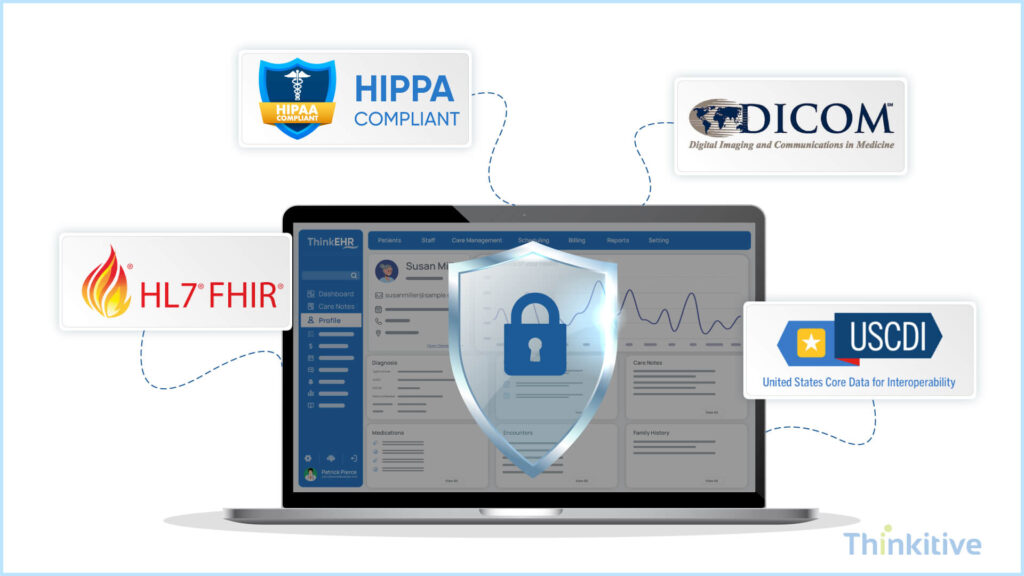
While the connected ecosystem improves care coordination and clinical efficiency, it also expands the attack surface for cyber threats. Every interface, API, and third-party integration must therefore be secured to protect sensitive patient information throughout its journey.
Rather than viewing security as a separate layer added after development, healthcare organizations should build secure data exchange capabilities into the architecture of their custom EHR from day one. This ensures that patient information remains confidential, accurate, and accessible only to authorized users while moving between connected healthcare systems.
- Securing FHIR & HL7-Based Integrations: FHIR and HL7 enable healthcare systems to exchange clinical and administrative information efficiently, but they also expose sensitive patient data through APIs and connected services. To secure these integrations, organizations should implement OAuth 2.0 and OpenID Connect for authentication, encrypt all data transmissions using TLS, and strengthen APIs with token validation, rate limiting, API gateways, and continuous monitoring to prevent unauthorized access and malicious attacks.
- Protecting Medical Imaging Data with DICOM: Medical imaging data exchanged through DICOM often contains highly sensitive patient information and therefore requires the same level of protection as clinical records. Encrypting imaging data during transmission, enforcing role-based access controls, maintaining comprehensive audit logs, and securing connected PACS and imaging devices help prevent unauthorized access while preserving the confidentiality and integrity of diagnostic information.
Best Practices for Secure Healthcare Data Exchange
Regardless of the interoperability standard being used, every custom EHR should follow a consistent set of security best practices for healthcare data exchange:
- Encrypt data both in transit and at rest.
- Implement role-based access control (RBAC) and multi-factor authentication (MFA).
- Secure APIs with OAuth 2.0, token validation, and API gateways.
- Validate all incoming and outgoing data to prevent manipulation and injection attacks.
- Monitor system activity through continuous logging and real-time threat detection.
- Regularly assess third-party integrations for security vulnerabilities and compliance risks.
Secure healthcare data exchange is not only about protecting information from cyber threats—it also creates the trusted foundation required for interoperability, regulatory compliance, and safe collaboration across the healthcare ecosystem.
Note: Understand your practice needs and requirements for data sharing and collection. This is important because it makes it easier for you to choose the right interoperability standard for your practice. Know the role of interoperability for your custom EHR software system in detail before finalizing on the interoperability standard for your software system.
Meeting USCDI Requirements
The USCDI stands for United States Core Data for Interoperability. defines the standardized health data that should be exchanged across healthcare systems; securely handling that data is equally important. A custom EHR should protect USCDI data elements using encryption, role-based access controls, secure APIs, and comprehensive audit trails to ensure they remain confidential, accurate, and accessible only to authorized users. If you’d like to understand USCDI, the 21st Century Cures Act, and interoperability requirements in detail, read our dedicated guide on Custom EHR Interoperability.
How to Achieve Seamless Data Exchange with Interoperable EHR Systems
Join Free WebinarSecurity in Custom EHR Development – Protecting Data in Motion
As a healthcare professional, you already understand the importance of protecting sensitive patient health information. When you build a custom EHR system, safeguarding that information becomes one of your biggest responsibilities.
After all, every patient record contains confidential data, and a single security breach can compromise patient privacy, disrupt clinical operations, damage your practice’s reputation, and even result in significant financial penalties.
This is why HIPAA-compliant EHR development should never treat security as an afterthought. Instead, security should be embedded into every stage of development, from system architecture and data storage to user access and third-party integrations.
EHR Data Encryption & Access Control
Protecting patient information starts with ensuring that only authorized users can access it and that intercepted data remains unreadable. Combining strong encryption with access control significantly reduces the risk of unauthorized access and data breaches.
- Encrypt data at rest and in transit: Use strong encryption standards to protect patient information whether it is stored in databases or exchanged between connected healthcare systems.
- Implement role-based access control (RBAC): Grant users access only to the information required for their responsibilities, reducing unnecessary exposure to sensitive data.
- Enable multi-factor authentication (MFA): Add an extra layer of identity verification to prevent unauthorized logins, even if user credentials are compromised.
- Follow the principle of least privilege: Regularly review and restrict permissions so users only have the minimum access needed to perform their tasks.
Continuous Monitoring & Security Audits
Security is an ongoing process rather than a one-time implementation. Continuous monitoring and regular assessments help identify vulnerabilities before they impact patient care or expose sensitive information.
- Conduct regular security audits: Periodically review your system to identify security gaps, configuration issues, and compliance risks.
- Maintain detailed audit logs: Record every login, data modification, and access event to improve accountability and simplify investigations.
- Monitor system activity continuously: Detect unusual behavior, failed login attempts, or suspicious API requests before they become security incidents.
- Perform vulnerability assessments: Test your system regularly to identify and resolve weaknesses before attackers can exploit them.
Securing APIs & Third-Party Integrations
Modern custom EHR systems rely on APIs and third-party integrations to exchange healthcare data. Every connected application becomes a potential entry point for attackers if appropriate security measures are not implemented.
- Secure APIs with strong authentication: Protect integrations using standards such as OAuth 2.0 and secure token-based authentication.
- Validate all incoming and outgoing data: Prevent malicious payloads and maintain data integrity during every transaction.
- Assess third-party vendors: Ensure external applications follow the same security standards before exchanging patient information.
- Protect against API abuse: Implement rate limiting, continuous monitoring, and threat detection to reduce risks such as denial-of-service attacks and unauthorized access.
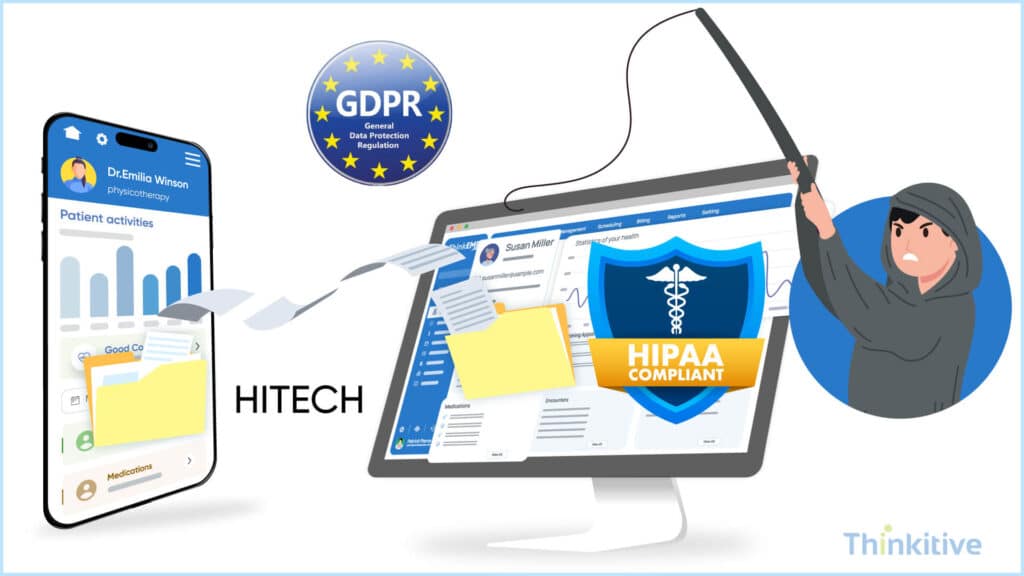
Last but not least, one of the best practices to strengthen the security of your custom EHR software is by adhering to the regulatory HIPAA EHR requirements, such as HIPAA, GDPR, HITECH Act, etc. With your EMR software developers complying with these guidelines, you can ensure all the security measures are taken and help you seamlessly navigate through the healthcare IT security ecosystem and the legal landscape. Know everything you need to know about the regulatory landscape for your custom EHR software here.
Essential Security Measures for Your EHR System
Download Free ChecklistSecurity & Compliance in Custom EHR Systems
Security and compliance go hand in hand in custom EHR development. While regulations such as HIPAA, HITECH, and GDPR define how patient information should be protected, achieving compliance starts with implementing strong security practices. Features such as data encryption, role-based access control, secure APIs, audit logging, and continuous monitoring help safeguard sensitive health information while supporting regulatory requirements.
To maintain a secure and compliant custom EHR, healthcare organizations should:
- Conduct regular risk assessments to identify and address emerging security vulnerabilities.
- Keep security policies and employee training up to date as regulations and cyber threats evolve.
- Maintain detailed audit logs to improve accountability and simplify compliance reporting.
- Review and update security controls periodically to protect patient data and support long-term regulatory compliance.
Get Your Free Consultation with a Healthcare IT Compliance Expert –
Get Free ConsultationThe Future of Custom EHR Development
As discussed earlier, the technological landscape is constantly changing, and while the emerging trends like Artificial Intelligence, Machine Learning, and IoT dictate the terms, it is most likely to impact the healthcare IT landscape. Moreover, the application of these technologies in healthcare can be seen in use and has made a significant impact as well. Keeping updated with technological advancements is one of the best ways to future-proof EHR development.
As cyber threats continue to evolve, the future of custom EHR development will focus on building intelligent, resilient, and proactive security systems rather than simply responding to attacks. Emerging technologies are enabling healthcare organizations to identify threats faster, automate security operations, and continuously strengthen the protection of sensitive patient data.
Some of the key security trends shaping the future of custom EHR development include:
- AI-powered threat detection to identify unusual user behavior and potential cyberattacks in real time.
- Zero Trust Architecture that verifies every user, device, and application before granting access.
- Cloud-native security with automated encryption, backup, disaster recovery, and continuous monitoring.
- Automated compliance monitoring to simplify adherence to evolving healthcare regulations.
- Advanced identity management using adaptive authentication and passwordless login technologies.
Healthcare organizations that incorporate these security capabilities into their custom EHR development strategy will be better equipped to protect patient information, reduce cybersecurity risks, and maintain compliance as the healthcare technology landscape continues to evolve.
Secure EHR Development Checklist
- Encrypt patient data both at rest and in transit.
- Implement role-based access control (RBAC) and multi-factor authentication (MFA).
- Secure APIs and third-party integrations with industry-standard authentication.
- Maintain comprehensive audit logs for all user and system activities.
- Perform regular vulnerability assessments and penetration testing.
- Continuously monitor and update security controls to address emerging cyber threats.
Conclusion
You see, healthcare delivery works in collaborative frameworks where everything is dependent on other healthcare service providers. Here, as the healthcare landscape is slowly transforming into a digital ecosystem, achieving interoperability is crucial, and while achieving interoperability, ensuring security is an additional responsibility that comes with it.
Having said that, to ensure the security of the system, adhering to compliance such as HIPAA, GDPR, HITECH Act, and other relevant regulations is one of the best practices to adopt to easily navigate through the security infrastructure and also the legal landscape.
On that note, you’ve probably made the right decision by choosing a custom EHR development approach. And if you’re still looking for a healthcare software development vendor, then you might have just come to the right place. Get your free consultation about custom EHR development from our custom EHR business expert.

Frequently Asked Questions
Building a secure custom EHR system starts with adopting a security-by-design approach throughout the software development lifecycle. This includes encrypting patient data at rest and in transit, implementing role-based access control (RBAC) and multi-factor authentication (MFA), securing APIs and third-party integrations, maintaining detailed audit logs, and performing regular security assessments. By embedding these security measures from the beginning, healthcare organizations can protect sensitive patient information while supporting HIPAA-compliant EHR development.
Every custom EHR should include essential security features such as data encryption, role-based access control, multi-factor authentication, secure API authentication, audit logging, automated session management, and continuous security monitoring. These features help prevent unauthorized access, protect patient health information, and strengthen the overall security posture of the EHR system.
Protecting patient data in a custom EHR requires multiple layers of security. Healthcare organizations should encrypt sensitive information, restrict data access based on user roles, authenticate users through secure login mechanisms, monitor system activity with audit logs, and secure all data exchanged through APIs and external integrations. Regular vulnerability assessments and security updates further reduce the risk of data breaches and cyberattacks.
Some of the biggest security risks in custom EHR development include unauthorized access, weak authentication mechanisms, insecure APIs, ransomware attacks, insider threats, third-party integration vulnerabilities, and outdated software components. These risks can be minimized by following secure development practices, implementing continuous monitoring, and regularly testing the system for vulnerabilities.
Secure EHR development provides the technical foundation required to support HIPAA compliance. Security measures such as encryption, access controls, audit logging, secure data transmission, and ongoing risk assessments help protect electronic protected health information (ePHI) and align the system with HIPAA Security Rule requirements. While compliance also involves administrative and organizational policies, implementing strong security controls is an essential step toward achieving and maintaining HIPAA compliance.


