Building Dashboards in Mental Health EHRs That Prove Treatment Effectiveness

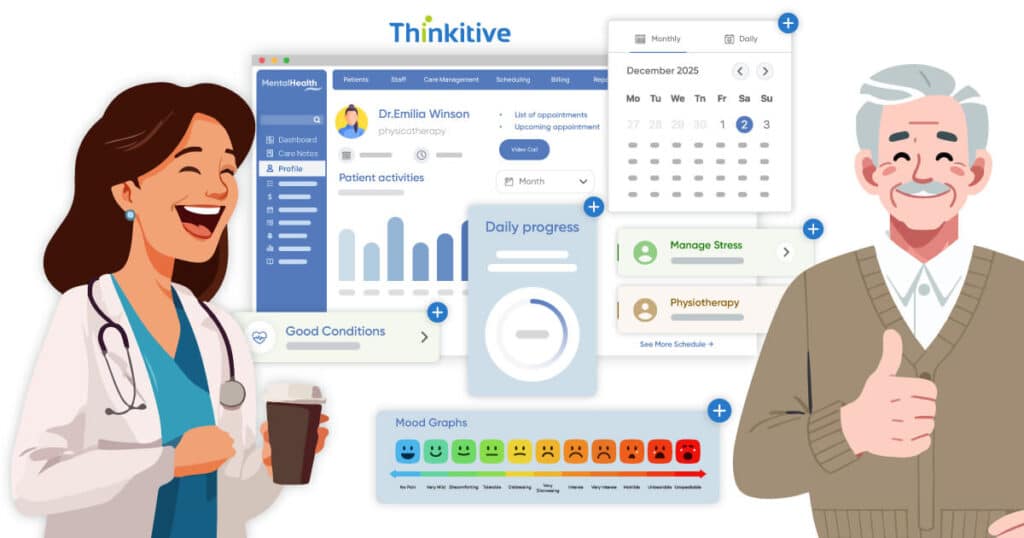
If I ask you how important visibility is for any provider, I am sure your answer will be: very important. Without it, no clinician can understand how their treatment is working and whether or not it needs any adjustments.
This is for physical conditions. For behavioral health, it is far more crucial as the progress can’t be confirmed with the naked eye. So, providers need a tool that makes observing and following these changes easier, and that tool is mental health EHR dashboards.
However, many clinics can’t use this tool effectively because the generic EHRs fail to properly visualize patient progress. Additionally, they also lack the functionality needed for treatment effectiveness tracking, creating gaps in insurance-compliant reports.
Now, when a generic EHR falls short, you need to build a specialised EHR through custom mental health software development. With these EHR that understand behavioural health workflows, you can easily build EHR reporting tools for mental health that include behavioral health outcome tracking and mental health EHR dashboards for patient progress visualization.
In this blog, we are going to dive into how to build dashboards in mental health EHRs as well as features for visualizing PHQ-9, GAD-7, and BDI outcomes, and make dashboards more effective in EHRs.
Let’s get started without further ado!
Why Dashboards Are Critical for Mental Health Practices
As I said in the introduction, in mental health, most of the time, the progress is not quickly visible, and it’s also true for decline. This one reason alone makes mental health EHR dashboards essential for behavioral health practices.
However, there are many other reasons why mental health dashboards are important. One of those reasons is that these dashboards help clinicians in proving treatment effectiveness in behavioral health practices and track their progress in real time. With this, it becomes much easier for the clinics to increase their chances of claim approvals.
In addition, these dashboards also act as measurement-based care dashboards, enabling providers to make informed decisions. It also makes it easy for clinicians to optimize the care plans, ensuring timely interventions and increasing final patient outcomes.
Finally, the features like automated score visualization, trend tracking, and behavioral health outcome dashboards provide accurate data on patient progress. This leads to higher claim approval, fewer patient readmissions, and better patient outcomes.
In short, mental health EHR dashboards not only visualize patient data but also impact clinic ROI and improve patient safety.
Challenges with Generic EHRs
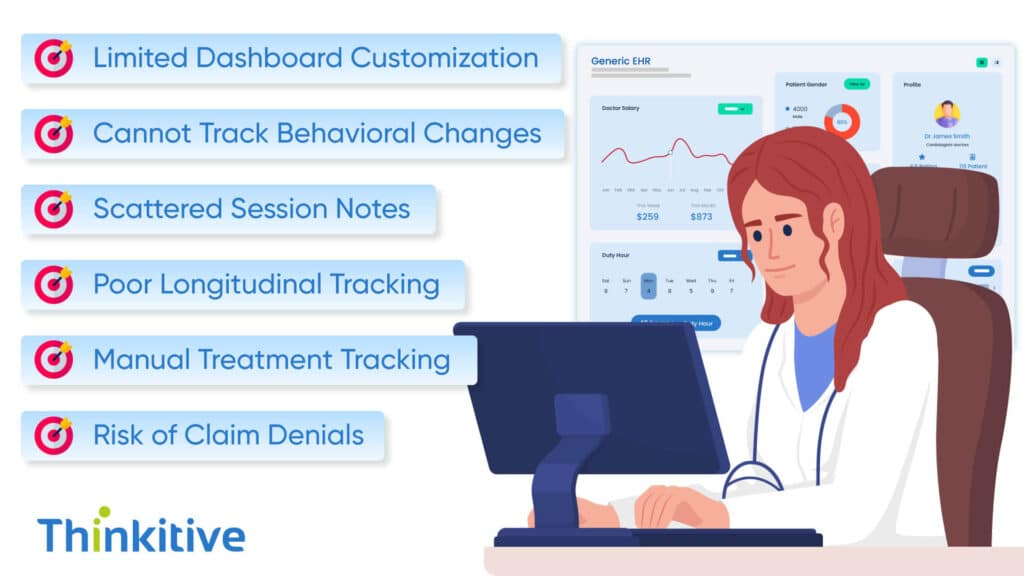
When it comes to mental health care, the generic EHRs always fall short and bring multiple challenges for many aspects of behavioral health. For instance, they lack dashboards that can be easily customized for mental health.
In generic EHRs, the dashboards are designed to visualize labs, vital signs, and medications. However, mental health needs to track emotional and behavioral changes. This is where the first challenge comes while using the generic EHRs.
Another issue with these systems is that they don’t have the templates to fit narrative notes of mental health sessions. This leads to providers writing the notes in free-text fields, scattering them, and making it difficult to find them later. It prevents EHRs from visualizing a complete patient profile and effectively tracking the changes.
Furthermore, generic EHRs fail in longitudinal tracking. Mental health needs data from previous weeks, months, or even years; however, the silos in EHRs make it challenging to keep track of all these records. Without this, the clinicians can’t have a holistic view of the patient profile, risking delayed care and reduced treatment effectiveness.
Most importantly, with these systems, it’s nearly impossible to track treatment effectiveness for reimbursement. Because of this, the providers have to manually track patient progress, increasing the chances of gaps, risks, inconsistencies, and more claim denials.
Features of Effective Mental Health Dashboards
For any mental health EHR dashboard to work properly and be effective, it needs to show more than just numbers. It needs to turn the patient data into actionable insights for clinicians to make informed decisions.
The first feature that clinicians need is for visualizing PHQ-9, GAD-7, and BDI outcomes in EHRs. The dashboards need to track the assessment scores in real-time and update them in EHR so that clinicians can quickly assess and make adjustments to the care plan. This feature is the foundation for accurate treatment effectiveness tracking.
In addition, it must track the longitudinal progress of patients. With these behavioral health outcome dashboards, providers are able to identify patterns and track trends in patient health, making the care both proactive and data-driven.
Then the next essential feature is automated alerts on critical changes in patient health. It becomes crucial to provide on-time care and intervention, ensuring nothing goes unnoticed and improving patient progress visualization.
The final feature is important for ensuring compliant reports for insurers. Insurance companies require measurable outcomes, so you need custom EHR dashboards for insurance reporting that generate exportable, structured reports. Simplifying this process and reducing administrative burden on providers.
In short, the outcome tracking dashboards for mental health clinics must have all the EHR reporting tools for mental health that make care delivery efficient and insurance submission accurate.
How to Build Dashboards in Mental Health EHRs
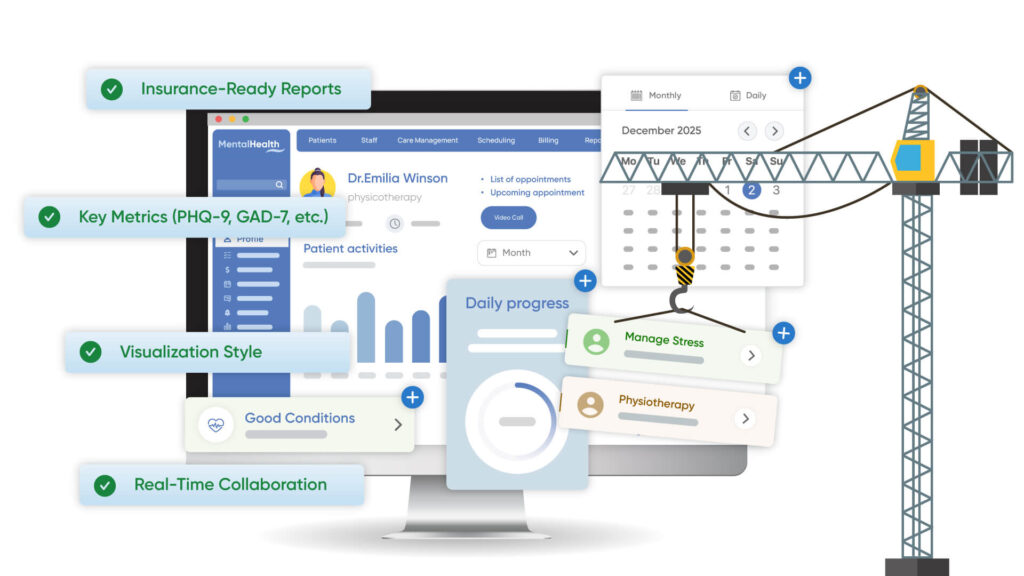
Building a powerful mental health EHR dashboard isn’t just about adding graphs and charts; it’s about designing a tool that supports clinical insight, insurance compliance, and measurable outcomes.
Start by identifying what you want to measure. Common metrics include PHQ-9, GAD-7, and BDI scores, along with therapy session notes, medication adherence, and patient engagement levels. Defining these outcomes early ensures your dashboard truly supports proving treatment effectiveness in behavioral health practices.
Then comes selecting the visualization style, as not every metric needs a bar graph. So, select visualization styles that make data meaningful, trend lines for progress over time, pie charts for symptom distribution, or heat maps to identify high-risk patients. The goal is to make patient progress visualization effortless and intuitive.
Dashboards should do more than display data; they should help with reporting. Build exportable reports that align with payer requirements and compliance standards. This transforms your dashboard into a dual-purpose tool: one for care improvement and another for insurance-ready documentation.
Behavioral health care is rarely a solo effort. Add secure sharing features so therapists, psychiatrists, and care coordinators can view and update outcomes in real-time. This ensures care teams stay aligned and that everyone has access to the same measurement-based care dashboards.
With these steps, you can build custom EHR dashboards that go beyond data display; they empower clinicians, enhance reporting accuracy, and elevate overall care quality in mental health settings.
Implementation Strategies for Mental Health EHR Dashboards
It’s not enough to just plan out the steps you need to properly implement them. However, this is the real challenge, and that’s why these implementation strategies are so important. The first thing you need to do is select a platform that aligns with your practice workflows.
The selection criteria for this are that the platform should support behavioral health metrics, integrate seamlessly with EHR, and be flexible for future upgrades, after this comes the linking of standardized assessments, including PHQ-9, GAD-7, and BDI, to your EHR for tracking patient progress and treatment effectiveness.
Finally, the most important part is the training and adoption of the dashboard. Because even the best dashboard fails if the teams don’t know how to use it properly. You need to conduct training sessions and set measurable goals while monitoring the adoption rate.
This encourages clinicians to use measurement-based care dashboards more quickly, and the adoption rate is high.
Benefits of Dashboards Integration
Integrating behavioral health outcome dashboards is not just for efficiency; it brings multiple benefits for clinics, patients, and clinicians. From better decision-making to easier insurance submissions, every stakeholder benefits from unified data visibility.
| Stakeholder | Key Benefits |
| Clinicians | Gain quick access to actionable, real-time data. Reduce manual work with automated treatment effectiveness tracking and visual progress charts. |
| Practice Managers | Track overall clinical performance and patient outcomes efficiently through measurement-based care dashboards. Simplify reporting for audits and compliance. |
| Patients | Experience more personalized, transparent care. Dashboards enhance patient progress visualization and help patients stay engaged in their treatment plans. |
| Insurers | Receive clear, exportable reports that provide proof of treatment effectiveness for faster claim approvals and fewer denials. |
With these dashboards, mental health practices develop an ecosystem that is driven by data and supports better outcomes, operational efficiency, and financial transparency.
Conclusion
In today’s data-driven mental health landscape, dashboards are no longer optional; they’re essential for proving treatment effectiveness and ensuring consistent, evidence-based care. With real-time visibility, automated assessments, and insurance-ready reporting, these tools empower clinicians to make smarter decisions and deliver measurable results. By adopting custom mental health EHR dashboards, practices can enhance clinical outcomes, strengthen compliance, and simplify documentation workflows.
Talk to our healthcare software experts to discover how your practice can transform care with custom mental health dashboards.
Frequently Asked Questions
A mental health EHR dashboard is a visual interface within an electronic health record system that organizes patient data, tracks symptom scores, therapy progress, and outcomes, allowing clinicians to monitor behavioral health metrics, identify trends, and make informed, measurement-based treatment decisions efficiently.
Dashboards improve treatment effectiveness by providing real-time visibility into patient progress, highlighting trends in symptom severity, and enabling timely adjustments to therapy. Clinicians can track outcomes systematically, use measurement-based care, and intervene proactively, ensuring treatments are personalized, data-driven, and aligned with patient goals.
Generic EHRs often fall short in behavioral health. They typically lack customizable dashboards, struggle to visualize longitudinal trends, and don’t integrate mental health assessments effectively. As a result, outcome tracking, treatment monitoring, and insurance-compliant reporting are limited or require significant manual work.
Key metrics include standardized assessment scores like PHQ-9, GAD-7, and BDI, therapy session progress notes, medication adherence, functional improvements, and patient engagement indicators. Including both individual and population-level data allows clinicians to monitor trends, measure treatment effectiveness, and make evidence-based care decisions.
Dashboards streamline insurance reporting by generating structured, exportable outcome data aligned with payer requirements. They provide documentation of measurable progress, symptom trends, and treatment interventions, reducing administrative burden, ensuring compliance, and supporting faster approvals and fewer claim denials.
Yes, effective mental health EHR dashboards can integrate multiple standardized assessments. By aggregating PHQ-9, GAD-7, BDI, and other tools into a single visual interface, clinicians can track outcomes in real-time, compare trends, and make more informed, measurement-based decisions for each patient.


