Athenahealth Integration: API-Driven EHR Connectivity for Practices


The healthcare landscape is changing, and cloud-first platforms are the new demands of healthcare providers seeking greater scalability. One name that is quite prominent in this is Athenahealth.
Athenahealth stands out as a cloud-based platform that plays a major role in the platform’s scalability and other aspects. That is why Athenahealth EHR integration is something that every healthcare provider is looking for as a way to integrate with third-party applications.
And one of the major advantages of Athenahealth API integration is that it provides 800+ API endpoints, which are available for integration across clinical, financial, and operational workflows. In fact, 400+ customers and partner applications are already leveraging Athenahealth APIs across their vast provider network, consisting of almost 160,000+ healthcare providers, connected through Athenahealth integration.
This network of healthcare providers consists of large hospitals and clinics, but there are some strong adoption interests across independent practices, urgent care clinics, and multi-specialty healthcare groups.
Moreover, Athenahealth is a lightweight cloud EHR integration allowing you to deploy faster, lower costs, and easy scaling. This is done with APIs and cloud-based connectivity. While most of the practices use legacy on-premise systems, which require less maintenance, they support real-time data exchange and simplify ongoing updates and interoperability.
Given this scenario, it is natural that healthcare providers are demanding API-driven interoperability across modern ambulatory healthcare environments.
On that note, let’s have a comprehensive overview of Athenahealth interoperability and athenaOne API connectivity. So, without further ado, let’s get started!
Assess Your System for Athenahealth EHR Integration –
Get Free Assessment
Onboarding & Sandbox Setup via the Athenahealth Developer Portal
The first step into the Athenahealth ecosystem is the onboarding process. Through the Athenahealth Developer Portal, the platform serves as the central hub for application registration, API access management, testing, and integration development. Let’s discuss its intricacies below:
Register Application & Generate Test Credentials
First things first, you must register your application within the Athenahealth developer ecosystem. This is basically done to collect application details and request access to the APIs that you’ll be needing. Once the requests are approved, the platform generates developer credentials, which include client IDs and authentication credentials, giving you access to Athenahealth APIs.
Access Sandbox Environments for Safe Testing
Athenahealth provides sandbox access, which allows you to build and test your integrations in a safe and secure environment without impacting live patient data or workflows. This sandbox environment contains synthetic datasets that simulate real-world healthcare settings while maintaining compliance and security.
Sandbox access enables development teams to perform the following tasks:
- Validate API requests and responses before production deployment
- Test patient, provider, appointment, and encounter workflows
- Simulate integration scenarios using synthetic healthcare data
- Identify and resolve issues early in the development cycle
Manage API Onboarding & Authentication Workflows
A successful Athenahealth EHR integration requires you to carefully manage API onboarding and authentication processes. This is the reason why developers must configure authentication mechanisms, establish secure access controls, and verify that applications can seamlessly integrate, interact, and communicate with authorized API endpoints.
Some of the key activities involved in this are:
- Configuring developer and application authentication
- Managing API permissions and access scopes
- Testing authorization workflows
- Validating connectivity between external applications and Athenahealth systems
Navigate API Documentation & Endpoint Discovery
You need to document your Athenahealth API integrations. This is a standard process that provides comprehensive API documentation that helps developers understand available endpoints, request formats, response structures, authentication requirements, and implement integration best practices. This is provided in the Athenahealth developer portal. These documentations are important because they accelerate development timelines and reduce integration complexity and deployment risks.
Here are some of the top use cases of documentation:
- Discover relevant API endpoints for specific workflows
- Understand supported clinical and administrative data models
- Review request and response specifications
- Troubleshoot integration issues and implementation challenges
Architectural Mechanics: Athenahealth API Integration & FHIR Connectivity

Athenahealth’s interoperability framework is quite eccentric in nature, given that they are built around a modern API-driven architecture that allows secure and efficient healthcare data exchange.
Now, through athenaOne APIs connectivity, healthcare practices can integrate EHR data with other third-party applications, patient engagement platforms, analytics solutions, and clinical workflow tools.
Athenahealth API integration is a REST-based architecture at its core, which makes it lightweight using HTTP protocols for communication between systems. Due to this, the Athenahealth EHR integration becomes quite simplified and enables you to have real-time access to clinical, administrative, and operational data.
On top of that, if you are looking for standards-based interoperability, then Athenahealth supports FHIR APIs that enable access to healthcare data using widely adopted HL7 FHIR resources. With the help of this, developers can retrieve and exchange information like:
- Patient demographics and clinical records
- Practitioner and provider information
- Appointment and scheduling data
- Document Reference resources and clinical documents
- Additional healthcare data required for coordinated care workflows
Athenahealth also supports SMART on FHIR workflows, which allow you to build integration that allows you to operate directly within provider workflows. SMART on FHIR enables seamless access to EHR data and maintains secure authentication and authorization standards.
The major advantage of Athenahealth interoperability comes in the form of its alignment with healthcare regulation and data-sharing initiatives. For instance, FHIR-based connectivity supports compliance efforts that are related to ONC certification requirements, USCDI standards, and provisions of the 21st Century Cures Act that promote patient access and healthcare interoperability.
When designing these integrations, you must also distinguish between provider-facing applications and system-to-system integrations. This is important because provider-facing solutions support clinical users through embedded workflows, decision support, and patient care applications. On the other hand, system-to-system integration focuses on secure data exchange between healthcare platforms, revenue cycle systems, analytics tools, and external healthcare services.
Athenahealth interoperability provides a flexible framework that supports modern healthcare connectivity across various environments. It is able to do that by combining REST APIs, FHIR standards, SMART on FHIR capabilities, and cloud-native architecture.
Know the Best Approach for Athenahelath EHR Integration –
Get Free ConsultationPractical Deployment: How to Integrate Third-Party Apps with Athenahealth
Now that your architecture is in place, you start integrating third-party applications with Athenahealth to extend clinical, administrative, and patient engagement capabilities.
Furthermore, a successful deployment starts with secure authentication and follows industry-standard interoperability practices. As you know, Athenahealth EHR integration typically uses OAuth 2.0 authentication to establish secure access between applications and EHR data.
Through access tokens and authorization workflows, you can control permissions, protect sensitive healthcare information, and manage secure communication throughout the application lifecycle.
Furthermore, to support real-time interoperability, Athenahealth cloud EHR integration also provides webhook capabilities that notify external systems whenever a specific event occurs. You see, rather than continuously polling APIs, applications can easily receive immediate updates related to appointments, chart activity, patient workflows, and other operational events.
Now, some of the common third-party integrations include:
- Telehealth and virtual care platforms
- Patient portals and engagement applications
- Revenue cycle and billing systems
- Clinical decision support solutions
- Analytics and reporting platforms
- AI-powered healthcare applications
So, depending on business requirements, integrations can support read-only access, bidirectional data exchange or workflow automation scenarios. For instance, applications may retrieve patient data, write information back into the EHR, trigger appointment workflows, or automate administrative tasks across medical practices.
To ensure scalability, organizations should adopt best practices such as using standardized APIs, implementing robust error handling, monitoring API performance, and maintaining secure authentication controls. Cloud-native deployment models further improve reliability and simplify long-term maintenance.
Terminology normalization is also a core consideration that you must understand. You see, much healthcare data originates in different and multiple systems. For such data, your integrations should align with industry-standard vocabularies like SNOMED CT for clinical concepts, LOINC for laboratory data, RxNorm for medication, and ICD-10 for diagnoses. Standardized terminology improves data consistency, interoperability, analytics accuracy, and cross-platform communication.
Security, Compliance & Production Go-Live
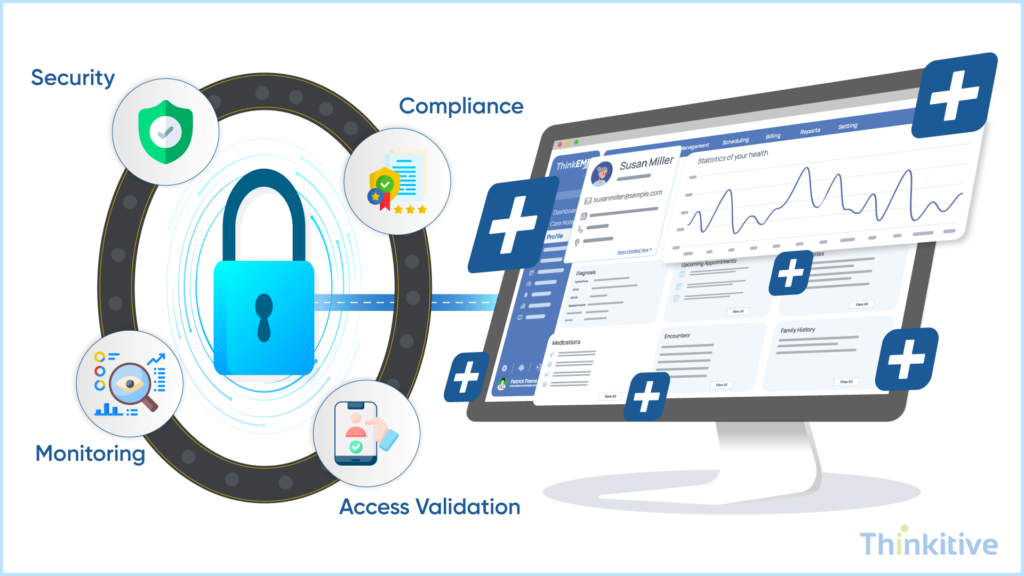
Before pushing your Athenahealth EHR integration into production, you must ensure that the security, compliance, and operational requirements are aligned with the necessary regulations. Since integrations often handle protected health information (PHI), HIPAA compliance remains a critical consideration throughout the deployment lifecycle.
You must implement robust security controls, including role-based access controls (RABC), audit logging, data encryption, and user activity monitoring. These safeguards help in protecting sensitive healthcare data while maintaining accountability and regulatory compliance.
Along with that, you also need to meet requirements associated with Athenahealth’s Marketplace Development Program (MDP), which evaluates integrations for security, performance, reliability, and overall interoperability readiness before approval.
Once testing and compliance reviews are complete, applications can be provisioned into live clinical environments. However, deployment is only the beginning. Healthcare organizations must continuously monitor integration performance to ensure reliable operation across connected systems. Key metrics typically include API latency, throughput, synchronization accuracy, error rates, and overall system availability.
Long-term success also depends on proactive interoperability maintenance. As APIs evolve and healthcare standards change, organizations must manage version updates, validate compatibility, and monitor connected applications for potential disruptions. A structured maintenance strategy helps preserve integration stability, security, and performance while ensuring uninterrupted access to critical healthcare data and workflows.
Want to understand how integration approaches differ across EHR vendors?
Also, you know the complete guide about EHR vendor integration. Read this detailed blog here — EHR Vendor Integration: How to Choose the Right Approach by System.
Learn how integration strategies vary for Epic, Oracle Health (Cerner), Athenahealth, NextGen, eClinicalWorks, and other EHR systems, along with the technical, compliance, and implementation factors you should evaluate before starting your project.
Do You Really Need EPIC EHR Integration –
Learn MoreConclusion: Driving High-Velocity Cloud Interoperability
Athenahealth interoperability remains ideal for the modern digital health ecosystem for its ability to give you cloud EHR integration, to be a part of the digital ecosystem of 160,000 healthcare practices across the country.
On top of the Athenahealth EHR integration, it uses API-first and cloud-native interoperability that allows you to share data in real-time and almost instantly. And this is the reason why most healthcare practices are actively looking for Athenahealth integration for medical practices.
However, if you are looking for a long-term Athenahealth EHR integration, then you must keenly focus on FHIR, SMART standards, TEFCA, and cloud EHR integration through connected environments.
On that note, get a free assessment of your system for Athenahealth EHR integration from our EHR integration expert, and I hope this blog will serve its purpose.
Frequently Asked Questions
The first step in an Athenahealth EHR integration is registering your application through the Athenahealth Developer Portal. This process provides access to developer credentials, sandbox environments, and the APIs needed to build and test integrations before moving into production.
To begin an Athenahealth API integration, developers must create an application within the Athenahealth Developer Portal, submit the required application details, and request access to relevant APIs. Once approved, the platform issues authentication credentials and sandbox access for development and testing.
An Athenahealth FHIR API implementation typically involves connecting to HL7 FHIR resources such as Patient, Practitioner, Appointment, and DocumentReference. Developers use these standardized resources to support secure healthcare data exchange and interoperability between Athenahealth and external healthcare applications.
AthenaOne API connectivity supports webhooks that send event-driven notifications whenever specific actions occur within the system. This allows external applications to receive real-time updates related to appointments, chart activity, and workflow events without continuously polling APIs.
Organizations looking for how to integrate third-party apps with Athenahealth typically start by establishing OAuth-based authentication, connecting to relevant APIs, configuring webhook notifications, and mapping clinical or operational workflows. Common integrations include telehealth platforms, billing systems, patient portals, and analytics solutions.
Yes. Athenahealth supports SMART on FHIR implementation, allowing developers to build embedded clinical applications that securely access EHR data within provider workflows. This approach strengthens Athenahealth interoperability while maintaining industry-standard authentication and authorization controls.
Common challenges in Athenahealth API integration projects include authentication management, API version compatibility, data mapping, terminology normalization, workflow synchronization, and maintaining compliance with healthcare regulations. Proper planning and testing can help minimize these implementation risks.
Cloud EHR integration improves interoperability by enabling secure, real-time data exchange between healthcare systems, third-party applications, and clinical workflows. Compared to traditional on-premise environments, cloud-based architectures are typically easier to scale, maintain, and update across medical practices.
Successful Athenahealth interoperability requires strong security controls, including HIPAA compliance, role-based access control (RBAC), audit logging, data encryption, secure authentication, and continuous monitoring. These safeguards help protect patient data while supporting reliable communication between connected healthcare systems.
Athenahealth integration for medical practices enables providers to connect EHR systems with telehealth platforms, patient engagement tools, billing solutions, analytics platforms, and clinical applications. This improves workflow efficiency, enhances care coordination, and supports a more connected healthcare ecosystem.


