How Generic EHR Templates Force Mental Health Providers into the Medical Model Documentation

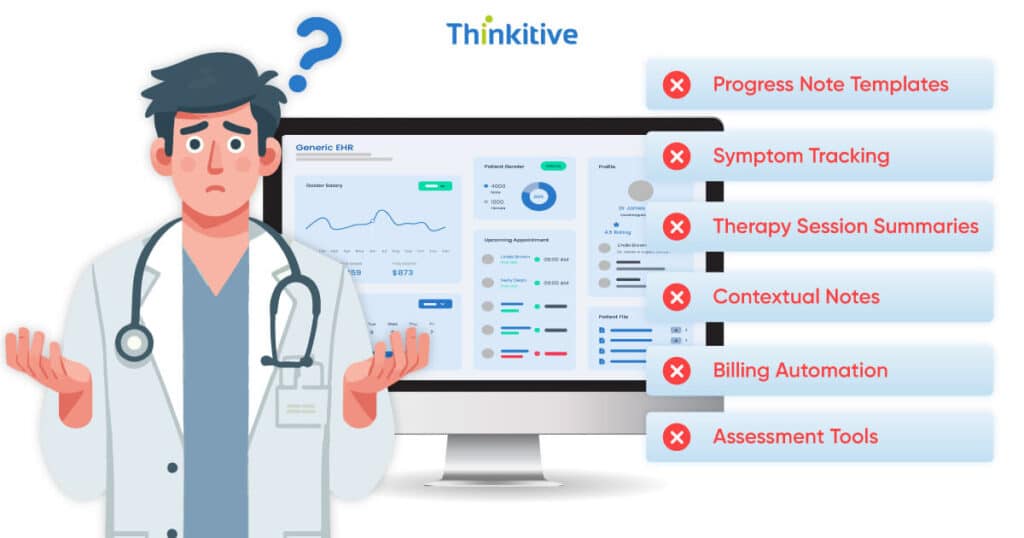
Why are mental health providers documenting like primary care providers?
This was the question that came to my mind. If the way we care for the mind is so fundamentally different from caring for the body, why does documenting look the same? The answer became clear when I looked a little closer; mental health practices often use generic EHRs.
After finding this out, I was shocked. Mental health care functions on emotions, narratives, and detailed progress notes. Whereas medical EHRs are built around vitals, labs, and diagnostics, here, the problem starts. Therapists are forced to fit all the data in generic EHR templates designed around these points.
Now, when patient data such as emotional state and trigger points is filled into templates meant for heart diseases, important data can get lost. That’s why generic templates in mental health EHRs create some long-lasting impact.
The problem is not just the providers spending extra time reporting; it’s the safety risks. Incomplete patient data, compliance risks, and clinician burnout leading to high turnover are some of the more severe consequences of not using customized mental health EHR templates.
So, in this blog, we will explore why mental health EHRs fail with seamless documentation. Let’s dive in and understand the comparison of medical model documentation vs behavioral health templates, all the documentation challenges for therapists, and how custom mental health EHR solutions can help you.
The Medical Model Problem in Mental Health Documentation
When it comes to generic EHR templates, they are good, but they are not suitable for primary care, cardiology, or a healthcare practice that works with vitals and labs. However, mental health is narrative-driven and requires an entirely different structure for templates.
Let’s understand this through an example. A patient comes to the therapist, and the session goes on for 50 minutes. The patient narrates all the emotional changes and trigger points throughout the month. Now, when it comes to documenting, you can’t do it in a SOAP note and rigid checkboxes. Only writing about depressed mood and discussing coping strategies does not explain the complete depth.
The reason is that mental health care does not depend on symptom tracking and vital signs; it works on patterns, triggers, and small changes that happen over time. This means that providers need to document detailed progress notes, and oversimplification of generic templates creates serious problems.
Clinical insights get lost, continuity of care is disrupted, and providers face compliance risks when their documentation doesn’t meet the criteria. Most importantly, clinicians get frustrated and burn out because of the long time spent completing the notes.
In short, using a generic EHR template in behavioral health forces therapists to document like a doctor, which doesn’t align with the way mental health care is delivered.
Clinical Risks of Poor Documentation
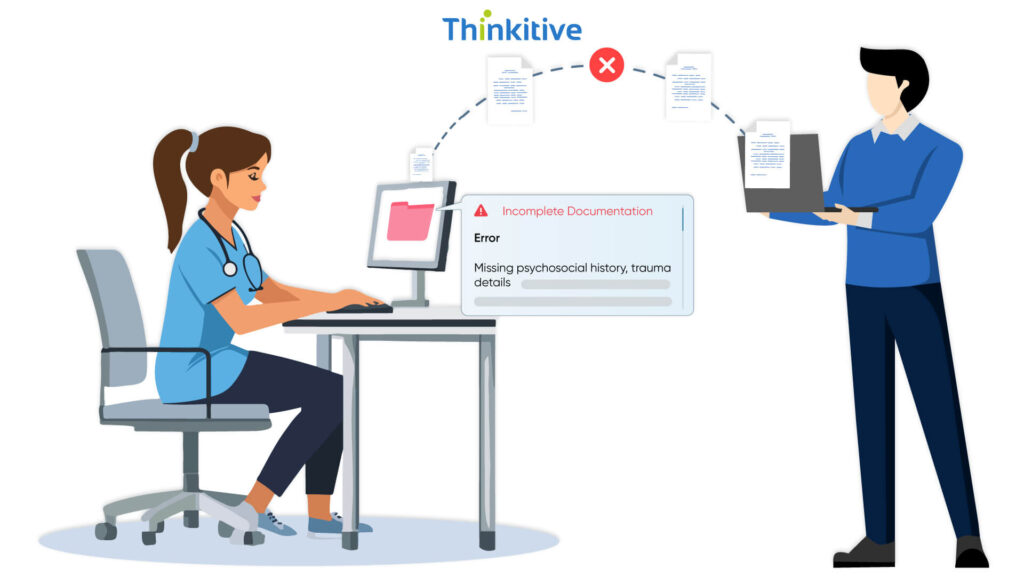
As I said earlier, poor documentation affects more than just efficiency; it threatens patient safety. When the patient data is collected in a SOAP note or DAP note that does not suit mental health workflows, providers are forced to use free-text fields. Doing this brings one of the biggest problems with generic templates in mental health EHRs: incomplete patient records.
The psychosocial history, trauma details, and long-term behavioral progress often get lost when entered in free-text fields. This happens because, without the right way to search for them, finding this data in the system becomes like looking for a needle in a haystack.
However, this loss of data means increased clinical risks for the patients, because these are the very details that shape care plans. Then there are compliance risks. With a mixed coding system in mental health billing, compliance becomes a lot more complicated.
With missed notes, the risks of improper coding and documentation gaps are high, which can violate the behavioral health reporting standards set by CMS, Medicaid, and other accrediting bodies. And what looks like a minor documentation error can quickly escalate into denied claims, financial penalties, or audit failures.
In addition, poor documentation also disrupts continuity of care. Without a complete mental health history, future therapists do not get the complete picture of the patient’s health, forcing them to start all over. So, using standard templates can endanger both practices and patients.
How Custom Mental Health Templates Solve These Problems
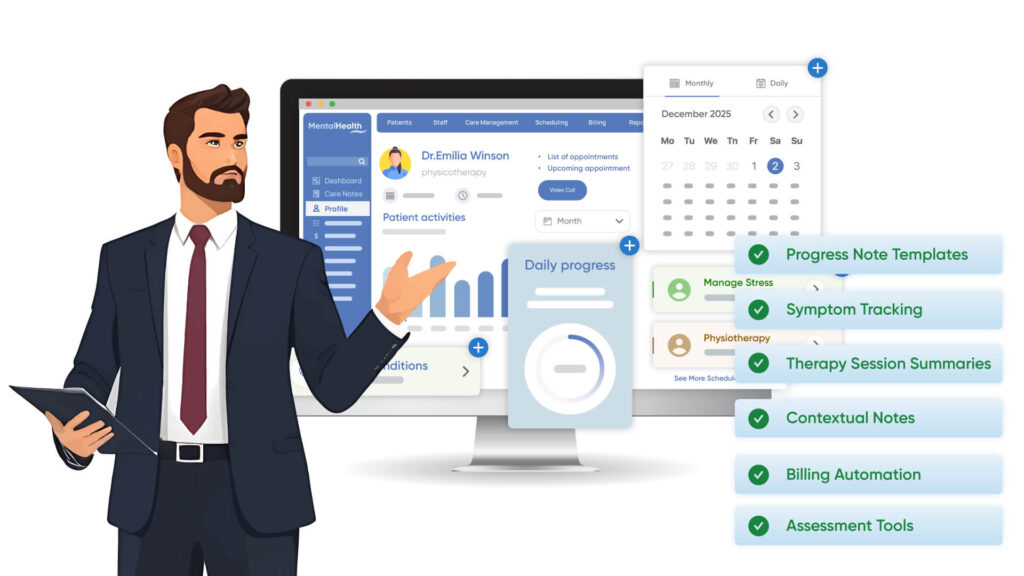
So, how can you streamline all of these? The answer is simple: using custom mental health EHR templates, designed specifically to align with behavioral health workflows. Unlike the one-size-fits-all systems, custom templates can be tailored for different therapies such as psychotherapy, group sessions, or rehab programs.
These templates provide much more freedom for therapists and add all the crucial data without the fear of losing it. The best point about these templates is that there are built-in fields for progress tracking, outcome measures, and psychosocial data. This makes it easier to follow the patient journey and help deliver more personalized care.
Another key advantage is flexibility, as custom templates can be adapted as clinical practices grow and evolve. At the same time, these systems support compliance with standards like DSM-5 diagnoses, behavioral health billing codes, and even specialized privacy regulations such as 42 CFR Part 2.
Most importantly, custom templates reduce unnecessary clicks and eliminate the need to re-enter data. This gives providers the needed breathing room and also allows them to focus more on patient care rather than documenting.
And the overall outcome is better documentation, stronger compliance, and higher clinician satisfaction.
Conclusion
In a nutshell, generic EHR templates force mental health providers to document like a general physician. This significantly increases the risks to patient health and chances of compliance violations; moreover, it also builds provider burnout, ultimately leading to turnover.
On the other hand, a custom mental health EHR template easily supports multiple session needs. It gives providers flexibility and allows progress tracking, outcome measurement, and efficient recording of psychological data. You get adaptable templates as clinical practices evolve, and this becomes an advantage in mental health care, where treatments are never static.
Talk to our healthcare software experts to develop a mental health EHR that perfectly fits your workflows and unique practice-specific needs.
Frequently Asked Questions
Mental health EHR templates are customized digital forms built for therapy and behavioral care workflows. Unlike generic medical templates, they capture emotions, psychological history, and progress notes. They matter because they save clinicians time, reduce frustration, improve compliance, and ensure patients’ stories aren’t lost in rigid checkboxes.
Generic EHR templates are built for medical care, tracking vitals, labs, and diagnoses, not for therapy’s narratives, emotions, and progress notes. When therapists are forced into these rigid structures, the depth of mental health care gets reduced to checkboxes, stripping away context and making documentation feel unnatural and incomplete.
Mental health professionals struggle with generic EHR templates because they are built for physical medicine, labs, vitals, and diagnoses, not narratives or emotions. This mismatch forces therapists to squeeze rich patient stories into rigid SOAP notes, leading to lost details, compliance risks, burnout, and weaker therapeutic connections with patients.
Medical model documentation is structured around vitals, labs, and diagnoses, great for physical health, but too rigid for therapy. On the other hand, behavioral health documentation is narrative-driven, focusing on emotions, triggers, and progress over time. It captures the patient’s story, not just their symptoms, making context essential.
Using generic templates in mental health EHRs often forces therapists to document like medical doctors, which strips away the nuance of patient stories. Important details like emotions, trauma history, and progress can get lost, leading to compliance risks, poor continuity of care, clinician burnout, and frustrated patients.
Poor documentation practices compromise patient care by omitting psychosocial details, progress markers, and treatment context essential for effective therapy. These gaps can disrupt continuity of care, increase compliance risks, and hinder clinical decision-making, ultimately leading to fragmented treatment and poorer patient health outcomes.
Yes, generic templates often force clinicians to click through irrelevant fields and cram nuanced patient stories into rigid boxes. Over time, this repetitive, mismatched documentation drains energy, impacting patient time, and leaves providers feeling like clerks rather than therapists, fueling frustration and burnout.
Custom mental health EHR templates should include features like built-in fields for psychosocial history, progress tracking, outcome measures, and DSM-5 codes. They should be flexible, reduce unnecessary clicks, and support compliance, making documentation smoother and giving therapists more time to focus on patient care.
Custom documentation workflows make compliance easier by guiding providers to capture the right details, DSM-5 diagnoses, billing codes, or 42 CFR Part 2 privacy notes, without guesswork. This reduces errors, protects against audits, and lowers legal risks, so clinicians can focus more on patient care than paperwork.
Practices should consider custom mental health EHR software because it aligns with how therapists actually work. It captures narratives, emotions, and progress notes without forcing data into rigid medical templates. It reduces clinician frustration, improves documentation accuracy, supports compliance, and frees providers to spend more meaningful time with patients.


