PHQ-9, GAD-7, & Beyond: Automating Assessment Integration in Mental Health EHRs

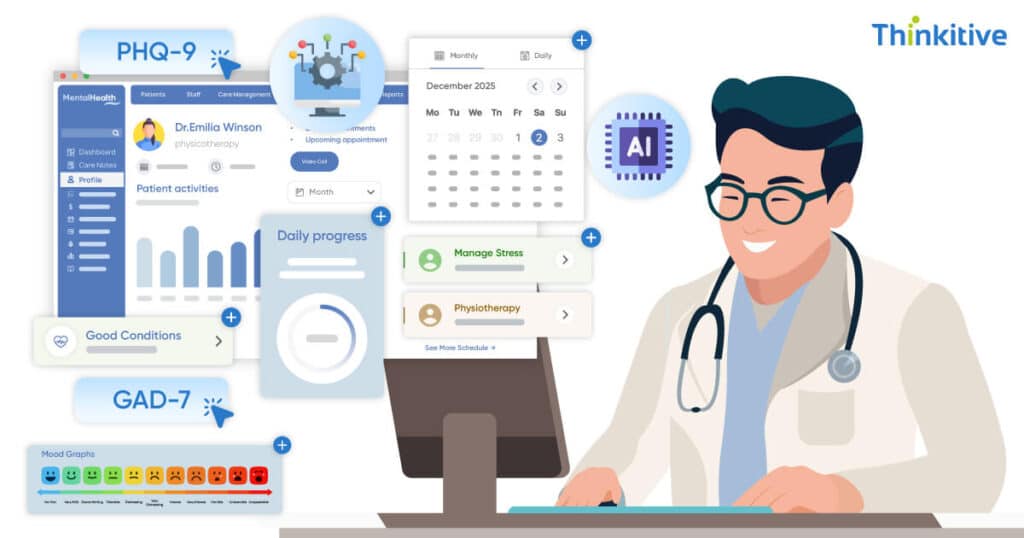
In behavioral health, each session brings new changes for the patient’s health that are not always visible. However, generic EHRs often miss these changes and can’t capture the signs. The reason? Lack of integration with standardized assessments like the PHQ-9 and GAD-7.
The PHQ-9 (Patient Health Questionnaire-9) is a test for understanding the scale and frequency of depression and for understanding how the severity of anxiety disorder GAD-7 (General Anxiety Disorder-7) plays a crucial role.
Moreover, these assessments are screening tools that make it easier for clinicians to understand what the patient is feeling in detail. However, this task is more challenging than it seems.
This is because many practices often use manual scoring and document the outcome of mental health assessments, which can be time-consuming and error-prone. Another contributor to increasing the difficulty is that the generic EHR can’t support the assessments properly. These EHRs lack the necessary tools to assess and score the assessments accurately without any manual intervention.
This is where automating PHQ-9 and GAD-7 in mental health EHRs changes everything. It streamlines behavioral health assessments in behavioral health with EHR, and when paired with custom mental health EHR development, it becomes easy to support this integration and measurement-based care assessments.
In this blog, we will explore how important standardized assessments are and how, with EHR assessment dashboards and seamless PHQ-9 integration in EHR, along with GAD-7 integration in EHR, improves accuracy and enhances treatment outcomes.
Let’s get started, without further ado!
Why Standardized Assessments Are Critical in Behavioral Health
For physical conditions, there are many ways to verify the progress or to know the side effects of treatments. However, in behavioral health and mental conditions, there are only standardized assessments to act as a validating tool.
Most importantly, assessments such as PHQ-9 and GAD-7 support measurement-based care assessments. Without these standardized assessments, evaluating improvements or identifying regressions is nearly impossible, making it difficult to optimize care.
Beyond the clinical role, these assessments also make it easier to provide proof of treatment effectiveness, as many insurers require it for approving the claims. Automating these assessments with the PHQ-9 integration with EHR and GAD-7 integration with EHR or other mental health EHR features for outcome tracking ensures accuracy and reliability of data.
Finally, by streamlining behavioral health assessments with EHR, clinicians can track symptom severity, guide treatment decisions, and measure patient progress. This eliminates the reliance on intuition and brings certainty and evidence-based decision-making.
The Challenge: Manual Assessment Workflow in Generic EHRs

Even with standardized tools like the PHQ-9 and GAD-7, many behavioral health practices still rely on manual workflows for documentation. Clinicians often enter scores into generic EHR templates, spreadsheets, or even paper charts, a process that is not only time-consuming but also prone to human error. A simple misentry can skew a patient’s progress record, making measurement-based care assessments less reliable and potentially impacting treatment decisions.
Another critical limitation is the lack of longitudinal tracking. Manual systems rarely provide an easy way to visualize trends over time, forcing clinicians to sift through multiple entries to assess improvement or deterioration. This makes it difficult to make informed decisions about therapy adjustments or care planning.
One more challenge is the fragmentation of data. Practices may use multiple platforms, including EHRs, spreadsheets, and external reporting tools, leaving patient data scattered across systems. This not only slows down workflows but also increases the risk of inconsistencies, miscommunication, and incomplete records.
So, automating these processes with PHQ-9 integration in EHR, GAD-7 integration in EHR, and other mental health EHR features for outcome tracking addresses these pain points. It ensures accurate, consistent, and streamlined behavioral health assessments with EHR, giving clinicians a clear, longitudinal view of patient progress while improving workflow efficiency.
Automating Assessments Integration: How It Works
While generic EHRs fall short of supporting the measurement-based care assessments in behavioral health, a custom mental health EHR solution seamlessly supports them. Behavioral health EHRs streamline automated mental health assessments effortlessly, transforming how clinicians track and score patient assessments.
The first step in this process begins with digital patient intake. When the intake process is ongoing, tools like PHQ-9 and GAD-7 are also embedded in the process. The scoring is done automatically, eliminating all the manual scoring and errors, saving much of the clinicians’ time.
After this step, the captured details are directly updated in EHR, effectively managing the patient’s longitudinal record. This longitudinal view of patients’ journey over weeks, months, or years is crucial for making informed decisions based on holistic data rather than incomplete notes.
This whole process is enhanced by integrated EHR assessment dashboards with improved visibility. These dashboards allow clinicians to understand trends and symptom progression better as all data is on a single screen. Moreover, automated alerts notify providers of high-risk scores or worsening symptoms, enabling timely intervention.
In short, the automation of assessments improves efficiency and enhances patient safety with evidence-based decisions.
Best practices for integrating assessments in behavioral health EHRs
Download ChecklistBenefits of Automation in Mental Health EHRs
If you read this, you might have understood that adopting automated assessments in behavioral health EHRs is more than just a luxury. This adoption brings many benefits for both patients and clinicians.
Here are the benefits:
| Benefit | Description |
| Time Savings | Automatic calculation and recording of PHQ-9, GAD-7, and other assessments reduces manual entry. |
| Accuracy | Minimizes errors in scoring and documentation, ensuring reliable measurement-based care assessments. |
| Treatment Optimization | Real-time dashboards and trend visualizations help clinicians adjust care plans effectively. |
| Compliance | Standardized reports are ready for audits, payers, and regulatory requirements, reducing administrative burden. |
In short, leveraging automation practices not only brings convenience but also efficiency and productivity. With time saved, providers can concentrate on patient care more and see more patients in the same time frame.
Ultimately, streamlining behavioral health assessments with EHR enhances clinical outcomes and strengthens operational effectiveness simultaneously.
Future Trends in Behavioral Health Assessments
The future of behavioral health assessments, especially automated behavioral health assessments, will depend on AI. The results are becoming more accurate with assessments being AI-scored and predictive analytics helping identify high-risk patients.
One of the most significant impacts of this trend is going to be on personalization and proactive care. It allows providers to intervene early before the situation becomes a crisis that can’t be handled easily, saving patient lives.
In addition, mental health is integrating more assessments than the PHQ-9 and GAD-7, expanding the scope of measurement-based care. Now, automated assessments go beyond just assessing anxiety and stress; they include substance use and sleep assessments.
Another trend shaping the future is interoperability. Care continuity and coordination are enhanced by seamless sharing of automated assessment results across multiple providers. By streamlining data flow, the behavioral health EHR automation supports coordinated care plans and improves patient outcomes.
In short, trends such as AI, interoperability, and additional assessments are making mental health care smarter, connected, and outcome-driven.
Conclusion
In a nutshell, behavioral health assessments are an integral and crucial part of mental health care. However, generic EHRs do not support these assessments properly, leading to manual scoring and increased errors.
That’s why automated mental health assessments, PHQ-9 integration with EHR, and GAD-7 integration with EHR play an important role. With this, clinicians can easily provide measurement-based care assessments, improving care quality and clinical ROI.
So, want to go from manual scoring to automated assessment? Learn how your practice can automate mental health assessments and enhance patient care.
Frequently Asked Questions
The PHQ-9 is a standardized questionnaire that measures depression severity. It helps clinicians objectively assess patient symptoms, track changes over time, and guide treatment decisions, making it a key tool for measurement-based care assessments and improving mental health outcomes.
The GAD-7 is a validated screening tool for generalized anxiety disorder. By quantifying symptom severity allows clinicians to monitor anxiety trends, adjust treatment plans, and evaluate intervention effectiveness, supporting evidence-based care and accurate outcome tracking in behavioral health.
Most generic EHRs lack built-in automation for PHQ-9 and GAD-7 scoring. Clinicians often rely on manual entry and calculation, which can be time-consuming, error-prone, and misaligned with longitudinal tracking, highlighting the need for specialized behavioral health EHR automation.
Integration ensures accurate scoring, eliminates manual entry errors, and centralizes data for longitudinal tracking. It streamlines workflows, improves measurement-based care assessments, enhances decision-making, and allows real-time monitoring through dashboards, ultimately improving efficiency and patient outcomes.
Automated assessment integration produces standardized, error-free reports ready for audits, payers, and regulatory requirements. It ensures accurate documentation, supports adherence to mental health regulations, and reduces administrative burden, strengthening compliance and transparency for behavioral health practices.
Beyond PHQ-9 and GAD-7, EHRs can automate anxiety scales, stress assessments, substance use screens, PTSD checklists, sleep quality measures, and other validated behavioral health tools. Automation allows longitudinal tracking, trend analysis, and comprehensive outcome monitoring across multiple mental health domains.


