EHR API Integration: Using RESTful APIs and FHIR for Data Exchange

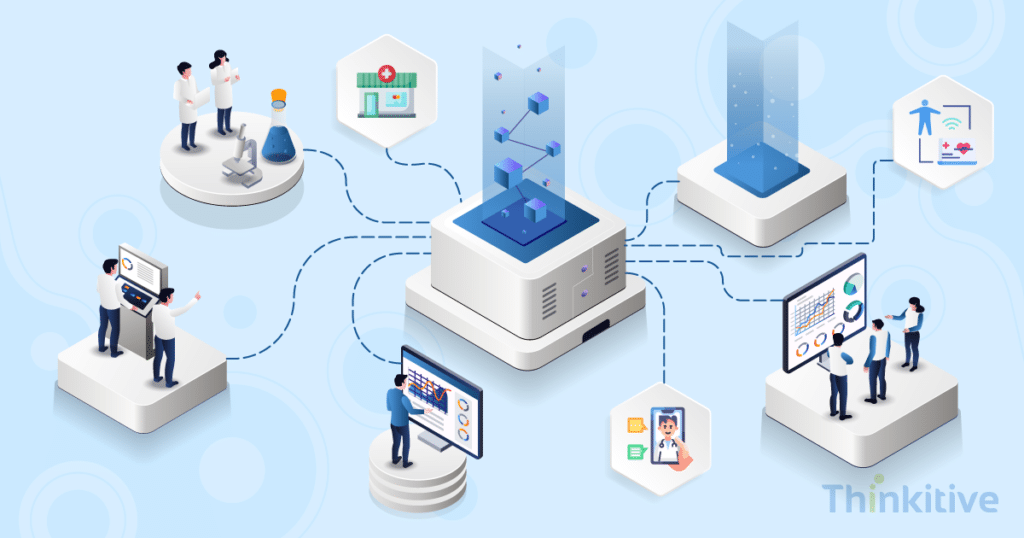
Healthcare practices depend on various systems for their day-to-day administrative tasks and even care delivery. This makes interoperability as one of the core requirements of modern-day healthcare practices.
This is the reason why almost 70% of US hospitals are now enabling patient access to healthcare information through standards-based APIs. Furthermore, as the healthcare landscape is moving towards a connected ecosystem, EHR API integration powered by RESTful APIs and FHIR standards acts as the foundation for secure, real-time healthcare data exchange.
Let’s try to understand this with an example. You see, as a healthcare provider you have to depend on EHR systems, Laboratory systems, Billing platforms, Telehealth platforms, etc. Now, when these systems are not connected, communication is interrupted leading to fragmented patient records, duplicate data, delayed clinical decisions and inefficient workflows.
To address these challenges, healthcare organizations are turning to EHR API integration for seamless data exchange. And since most modern integration approaches leverage RESTful APIs and FHIR standards to connect with systems, exchange information in real-time and improve interoperability, RESTful healthcare APIs have become a strategic priority for practices.
But during our interactions with various practices, the question that keeps on repeating is ‘How EHR API integration works with FHIR?’
Well, let’s try to find the answer to that and also know the role of RESTful APIs and FHIR in healthcare data exchange. So, without further ado, let’s get started!
Understanding How EHR API Integration Works
Let’s start with the basics and try to understand how EHR API integration works with FHIR and explore the benefits of API-based EHR integration.
RESTful Healthcare APIs & Request-Response Interoperability Models
Basically, the RESTful healthcare APIs allow healthcare applications to exchange data using standard HTTP methods such as GET, POST, PUT and DELETE. Here, instead of sending large batches of information, systems can request specific data and receive real-time responses, enabling faster and more efficient interoperability.
Role of FHIR API Integration in Exchanging Patient, Observation, Medication & Encounter Data
FHIR API integration standardized how healthcare data is structured and shared. This is done with the help of predefined resources such as Patient, Observation, Medication and Encounter. This allows EHRs, healthcare applications and other external systems to exchange clinical information consistently across different platforms.
Using HTTPS, JSON/XML & OAuth 2.0 for Secure Healthcare Interoperability Workflows
API-based EHR connectivity uses HTTPS to encrypt data during transmission, while JSON and XML provide standardized formats for exchanging data. On top of that, with OAuth 2.0, secure authentication and authorization processes are ensured, allowing only approved users and applications to access protected health information.
Difference Between API-Driven Interoperability & Traditional Message-Based Integrations
Traditional integrations often rely on batch processing, custom interfaces and message-based standards, which are often difficult to maintain. API-driven interoperability on the other hand, supports real-time data access, simpler integrations, improved scalability and faster communication between healthcare systems.
Importance of Standardized APIs in Modern Healthcare API Interoperability Environments
Standardized APIs have a special importance in modern healthcare. You see, they reduce integration complexity by providing a common framework for data exchange. Due to this, interoperability across EHRs, healthcare applications, laboratories, payers, and patient-facing platforms while supporting scalable and future-ready healthcare ecosystems.
Core Components of API-Based EHR Connectivity
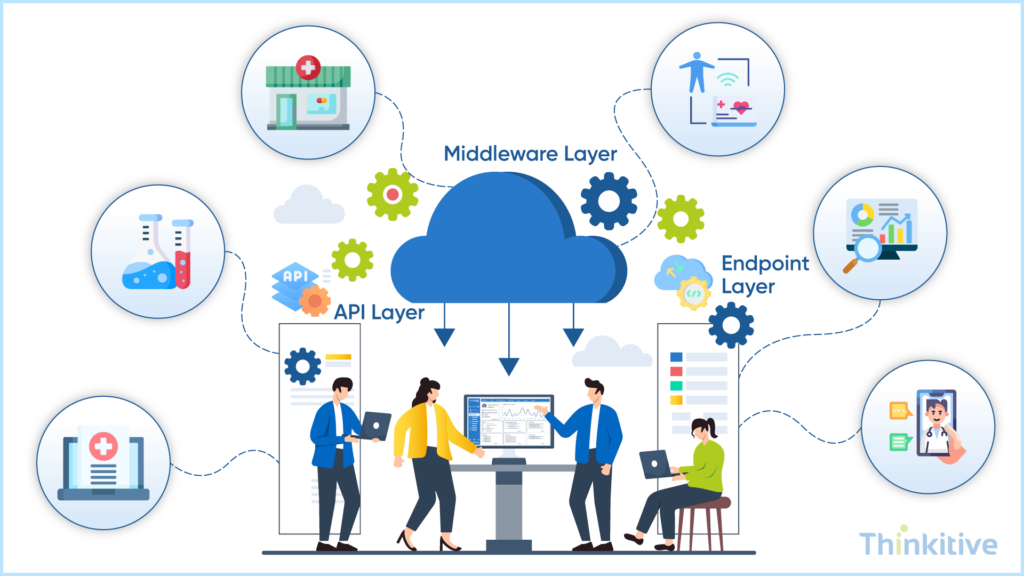
Now that you know how EHR API integration works with FHIR, let’s take a look at the core components of API-based EHR connectivity.
APIs, Middleware, & EHR Endpoints Within Interoperability Ecosystems
API-based EHR connectivity relies on three major components: APIs, middleware and EHR endpoints. Here the APIs enable systems to exchange data, middleware acts as the integration layer that manages communications and data transformation. And last, the EHR endpoints serve as the access points where clinical information can be retrieved or updated. All these components together create a connected healthcare interoperability ecosystem.
Managing Secure Access Using OAuth 2.0 & SMART App Launch
In these environments ensuring security of the data is crucially important as healthcare APIs require strong security controls to protect sensitive data. Here, OAuth 2.0 provides secure authentication and authorization securing the gateway, on the other hand, SMART App Launch builds on OAuth standards to allow third-party healthcare applications to access EHR data safely without exposing user credentials.
Supporting Real-Time Interoperability Through Webhooks & Event-Driven Workflows
Many modern healthcare systems are increasingly using webhooks and event-driven workflows to support real-time interoperability. Now, instead of continuously requesting data from connected systems, these connected systems receive automatic notification when an event occurs. For instance, a new lab result, patient admissions, or appointment updates can trigger the notification improving responsiveness and workflow efficiency of the entire system.
The importance of standardized architecture for scalable healthcare API interoperability is that, these standardized API architecture ensures consistent communication between healthcare applications, EHRs, payers, laboratories, patient-facing platforms, etc.
Standardization simplifies integrations, reduces maintenance costs, improves scalability and enables practices to expand their interoperability capabilities as healthcare technology ecosystems evolve.
Benefits of API-Based EHR Integration
API-based EHR integration delivers benefits beyond simple connectivity. This helps healthcare practices improve interoperability, patient experiences, operational efficiency and long-term scalability. On that note, here are some of the exclusive benefits of API-based EHR integration:
| Benefit | Business Impact |
| Faster Interoperability | Connect EHRs, labs, billing systems, and healthcare applications faster than traditional interface-based integrations. |
| Real-Time Clinical Workflows | Enable instant access to patient records, lab results, and clinical updates to support care coordination and decision-making. |
| Better Patient Engagement | Power patient portals, mobile health apps, telehealth platforms, and remote patient monitoring solutions. |
| Cloud-Native Scalability | Improve healthcare API interoperability across cloud-based healthcare ecosystems and future integrations. |
| Analytics & Digital Innovation | Support AI applications, healthcare analytics, population health initiatives, and emerging digital health technologies. |
Real-World Challenges in EHR API Integration
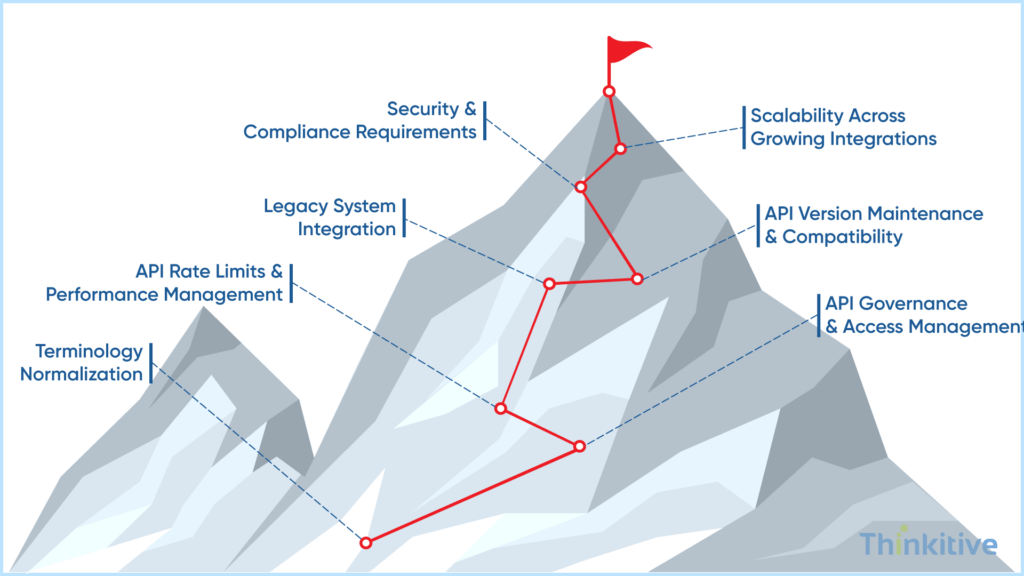
RESTful API integration for the healthcare system, especially with EHRs is quite a challenging task. On that note, let’s know some of the real-world challenges in EHR API integration and tried and tested solutions on how you can overcome these challenges:
Managing Interoperability Inconsistencies Across EHR Vendors & FHIR implementations
FHIR provides a common framework for data exchange, but despite this EHR vendors often implement standards differently. Now, these variations can create compatibility challenges, which might require additional customization and data mapping, just to ensure seamless interoperability.
The best way to deal with this is by giving clear instructions about maintaining consistency and overview before final implementation.
Handling Terminology Normalization Using SNOMED CT, LOINC, RxNorm & ICD-10 Standards
Healthcare data often uses different clinical terminologies across systems. Here, normalizing data using standards such as SNOMED CT, LOINC, RxNorm and ICD-10 helps in maintaining consistency, improving data quality and supporting accurate information exchange.
Managing API Governance, Rate Limits, & Version Maintenance Across Healthcare Systems
As your practice grows you will naturally integrate more applications into the system. Here the integrated applications must manage API access policies, monitor usage limits and maintain compatibility across evolving API versions. Furthermore, effective governance helps in ensuring security, reliability and long-term interoperability.
Balancing API Modernization with Legacy Healthcare Infrastructure
Many healthcare organizations rely on legacy systems that were simply not designed for modern APIs. Here, integrating these systems with API-based architectures often requires middleware, data transformation and phased modernization strategies.
A successful EHR API integration requires more than technology alone. You see, an enterprise interoperability strategy helps organizations establish standards, governance processes and integration frameworks that support scalable, secure and sustainable healthcare data exchange.
Security, Compliance & Enterprise Readiness
As healthcare organizations are expanding their API-based interoperability, security, compliance and governance become critical for protecting data and supporting large-scale healthcare data exchange.
On that note, here are some of the security, compliance and enterprise readiness factors that you must consider:
| Area | Why It Matters |
| HIPAA Compliance | Protects ePHI through encryption, audit logging, access controls, and secure data transmission practices. |
| API Security | OAuth 2.0, SMART on FHIR, and role-based access controls help ensure only authorized users and applications can access healthcare data. |
| Regulatory Alignment | Compliance with ONC requirements, TEFCA, and interoperability regulations supports secure and standardized data exchange. |
| Enterprise Governance | Establishes policies for API access, monitoring, version management, and long-term interoperability scalability. |
| API-First Readiness | Creates a flexible foundation for real-time data exchange, healthcare innovation, and future interoperability initiatives. |
Conclusion: Building the Future of Healthcare Interoperability
Traditional integration approaches struggle to support the growing demand for real-time data exchange, seamless application connectivity and cross-organizational interoperability. Here, API-driven architectures and EHR API integration, these challenges can be easily addressed by enabling healthcare systems to exchange information more efficiently, securely and consistently.
Furthermore, an API-first interoperability strategy allows healthcare providers, payers, technology, vendors and digital health innovators to build flexible healthcare ecosystems that can evolve as per your needs and requirements.
Giving immediate operational benefits, EHR API integration plays a strategic role in long-term healthcare transformation. From supporting emerging technologies like AI, to RPM, PHM, etc., API-based connectivity will help you be better positioned to deliver coordinated care, improve outcomes and create future-ready healthcare environment that support both providers and patients.
On that note, let’s get started, starting with your system readiness assessment from our EHR integration expert.
Frequently Asked Questions
EHR API integration is the process of connecting electronic health record systems with external applications, healthcare platforms, and third-party services using application programming interfaces (APIs). It enables secure and standardized data exchange between systems, improving interoperability, workflow efficiency, and access to patient information across healthcare environments.
Understanding how EHR API integration works with FHIR starts with recognizing that FHIR provides standardized healthcare data formats and API structures. Through FHIR API integration, healthcare applications can securely request, retrieve, update, and exchange resources such as patient records, medications, encounters, and clinical observations using REST-based communication methods.
RESTful healthcare APIs are web-based interfaces that use standard HTTP methods such as GET, POST, PUT, and DELETE to exchange healthcare data. These APIs enable real-time communication between EHRs, healthcare applications, patient portals, and other systems while supporting scalable and efficient interoperability.
The benefits of API-based EHR integration include faster interoperability, real-time data exchange, improved patient engagement, support for mobile health applications, easier integration with cloud-based systems, and greater scalability for future healthcare innovation and digital transformation initiatives.
FHIR API integration improves healthcare API interoperability by providing standardized data models and exchange protocols that allow different healthcare systems to communicate consistently. This reduces integration complexity, improves data quality, and enables seamless information sharing across providers, payers, laboratories, and healthcare applications.
Healthcare API interoperability requires strong security controls such as HIPAA-compliant data protection, OAuth 2.0 authentication, SMART on FHIR authorization frameworks, encryption through HTTPS/TLS, audit logging, and role-based access controls. These measures help protect sensitive patient information and ensure secure data exchange.
Yes. API-based EHR connectivity can coexist with legacy healthcare systems through middleware, integration engines, and data transformation layers. Many healthcare organizations adopt a phased modernization approach that allows modern APIs to work alongside existing infrastructure while gradually improving interoperability capabilities.
Common challenges in RESTful API integration for healthcare systems include variations in EHR vendor implementations, inconsistent FHIR support, terminology mapping issues, API governance requirements, rate limits, version management, security compliance obligations, and integration with legacy healthcare technologies.


