In-House vs Outsourcing: What’s Better for Building EHR

The rise of healthcare practices needing customized software solutions, especially the EHR solutions, has been in demand for a while now. But on the contrary, a significant healthcare practice amongst them is re-evaluating and re-considering their EHR development strategies in 2026.
You see, many practices in their quest to build their own EHR system often end up building a customized version of their off-the-shelf EHR with a few features here and there.
Now, if you look at the growing demands in EHR software systems lately, then it clearly shows an upward trend for scalable, interoperable, and AI-ready solutions. And this is where the re-evaluation process starts.
You see, due to the pre-defined features and functionalities, restructuring the entire software can be quite difficult. On top of that, for a few healthcare organizations that want to develop custom software but are confused whether to hire an in-house team or outsource the entire development, it can be daunting.
In fact, this question even troubles some of the most prominent practices, and this question can be argued to be one of the reasons why we see hospitals having a dedicated healthcare IT department.
Having said that, both of these choices come with their own distinctive advantages and disadvantages. So, let’s discuss these prospects of in-house vs outsourcing healthcare software development.
On that note, let this blog be your build your own EHR software guide and allow you to make an in-house vs outsource EHR building choice much clearer. Without further ado, let’s get started!
Understanding the In-House EHR Development Model
As discussed earlier, both these choices come with their own pros and cons. Let’s first discuss the in-house EHR development model and what you need to consider for this.
So, as the name suggests, it is a model where you have to build and manage an internal healthcare software development team, where you hire everyone that you require to handle and manage your systems.
This makes it much easier for you to keep an oversight on the team and take complete ownership of the workflows. In simple terms, some decide that the features and functionalities of the clinical and administrative are all done by the team you hire.
In-house EHR software development offers greater control over customization, infrastructure, and the growth prospects of the software. Compared to the off-the-shelf EHR software systems that you are using, this is indeed something that you would find easy and considerable.
However, the downside is the hiring process. Since you are most probably a healthcare provider with very little experience and knowledge of software development, the hiring process quickly turns into a nightmare.
Moreover, in case the hire turns out not to be so good, then replacing them with someone else can be a time-consuming and difficult process. This makes the venture quite difficult to manage on a long-term development scale, compliance, and managing responsibilities across the team.
Understanding the Outsourced EHR Development Model
On the other hand, you get a choice of working with a specialized medical app development partner. So, basically, what you will do is hire a medical app development partner and use their healthcare software development team to build your EHR, the way you want.
In simple terms, you will explain how you want your EHR software to be, and they will build it for you.
Now, the major advantage you get when outsourcing EHR development is that you get access to their experienced healthcare engineering and their interoperability experts to make your EHR software a part of the healthcare connected ecosystem.
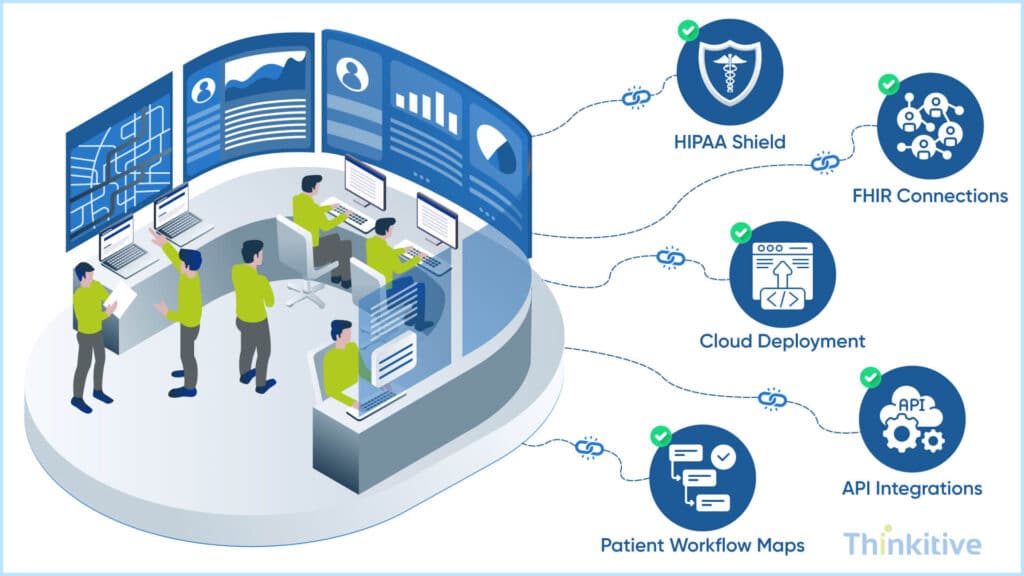
Apart from that, since they are specialized in EHR development, you can develop your software faster and make it more scalable. Despite the lucrative advantages like quick access to talent and time-to-market, the major advantage of outsourcing EHR development comes in leveraging their expertise in HIPAA compliance, FHIR, and HL7 standards consistency, and cloud infrastructure.
However, to point out some of the common reasons why healthcare organizations choose to outsource their EHR development is simply because someone who is an expert in that field is taking care of that thing.
In simple words, EHR software development is complicated, and when you are building your own EHR, imagine the things that you would have to look after, right from the HIPAA compliance to building workflows, coding, reviewing, testing, integration bridges, and the list goes on.
So, to avoid all these things and be a pivot, giving them the directions to build the EHR system is the reason why many healthcare organizations choose to outsource EHR development.
Build vs Buy EHR: Comparing Cost, Delivery Speed & Long-term ROI
This in-house vs outsource EHR building can loosely translate as buying vs building the EHR system. That is why, even in this, certain factors like cost, scalability, and delivery speed are to be considered.
Specifically, understanding the long-term operational impact of choosing an internal team or outsourcing EHR development must be important. On that note, here is a table to simplify these things for you:
| Factor | In-House Development | Outsourced Development |
| Initial Investment | Higher upfront costs for hiring, infrastructure, tools, and internal processes | Lower initial investment with flexible pricing and engagement models |
| Hiring Costs | Requires internal recruitment, training, and long-term employee retention | Talent acquisition and team management handled by the outsourcing partner |
| Development Speed | Slower due to hiring timelines, onboarding, and internal coordination | Faster delivery with experienced healthcare development teams already in place |
| Healthcare Compliance Expertise | Requires building internal HIPAA, HL7, and FHIR expertise | Access to pre-established healthcare compliance and interoperability expertise |
| Scalability | Scaling depends on internal hiring capacity and budget | Easier to scale teams and resources based on project requirements |
| Maintenance Responsibility | Internal team manages updates, support, and ongoing optimization | Can be partially or fully managed by the external development partner |
| Time-to-Market | Longer implementation and deployment cycle | Accelerated development and faster product launches |
| Long-Term ROI | Greater long-term ownership and internal control | Faster operational ROI with reduced overhead and quicker execution |
Managing Compliance, Security & Technical Complexity
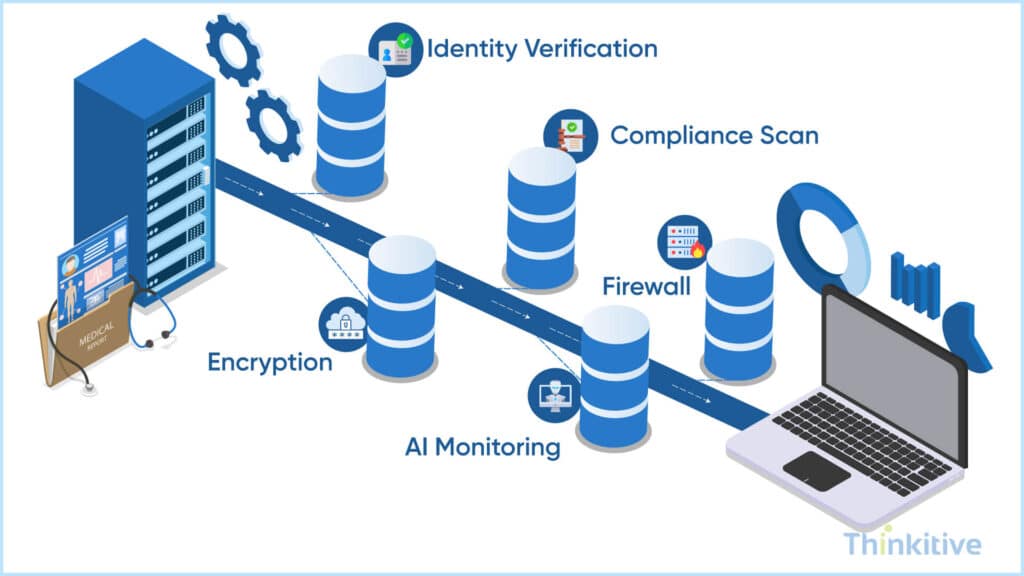
We have lightly touched on some of the core aspects in development, like compliance, security, and the technical complexity of the EHR development. And we also know that managing them on a team level can determine the future aspects of your software.
And both sides have completely different sides and a story that runs in opposite directions. Let’s see how:
Suppose you have an in-house team, then this would require you to hire dedicated resources who hold expertise in HIPAA, HITECH, and ONC compliance management. Now, these can be found in the same person, or would have to hire different people for different compliances.
This difference between the capabilities is because HIPAA has different requirements and can be quite vast. On the other hand, ONC and HITECH have quite similar requirements, but knowing them also requires immense technical and domain knowledge.
In the other scenario, when you outsource EHR development, they provide you with pre-established interoperability and compliance implementation experience. This way, it becomes easier for you to understand the path of compliance management. Also, if they don’t have the required compliance in their offerings, then you can insist and negotiate with them.
Now, by analyzing both scenarios, it is clear that in-house teams may struggle with limited healthcare IT expertise. In this case, a wrong hire can complicate long-term stability, continuity, and control over the EHR problem. The same problem can be experienced with outsourcing EHR development if your dependency on your vendor becomes too much.
Note: EHR software development requires specialized knowledge of clinical workflows, compliance regulations, interoperability, and data security, given the sensitive nature of the data it deals with. That is why strong governance processes and experienced healthcare technology teams may help you reduce implementation risks and improve project outcomes.
How to Choose the Right Healthcare Software Vendor
If you have decided to outsource EHR development, then how to choose a healthcare software vendor perfect for your EHR development is something that should trouble you, right?
Well, in this section, let’s see how to choose the right healthcare software vendor.
First things first, review the healthcare company’s industry experience and technical expertise. This is the best way to evaluate any EHR software development company. During this evaluation stage, check them for interoperability and compliance.
This is important because interoperability gives your system the ability to communicate with other systems. And compliance, on the other hand, makes your software secure.
Along with this, assess the communication processes, scalability, and delivery models. These are also some of the core components that can land you one of the finest EHR development vendors for your project.
Hybrid Development Models: Combining Internal & External Expertise
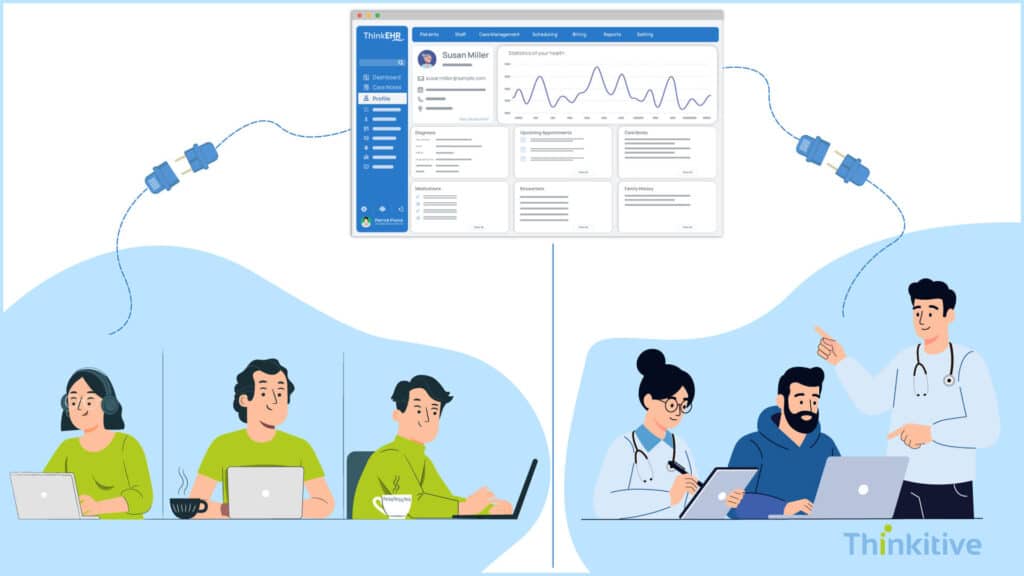
There is also a midway point that you can choose for your EHR development. You see, rather than completely outsourcing your EHR development, you can hire an internal team that can define the workflows, take ownership of data, and make strategic planning for your EHR development.
Now, the other aspects of development can be outsourced to EHR development companies. You can utilize their specialized engineering capabilities to actually build the software exactly the way you want.
This will not only give you more control over the delivery of the project, but operations can be easier to handle. However, the major advantage is that you can develop it exactly the way you want.
Lately, these models are becoming more common and popular because they support faster innovation, give both teams enough flexibility in execution, and provide you with long-term flexibility in managing and upgrading the software.
Which Development Model is Right for Your Healthcare Organization?
Depending on your unique needs and preferences, the right model can be quite hard to say. But there are certain aspects that you need to look at before making a final decision.
First things first, start with your practice first, evaluate your organizational size, budget for EHR development, compliance complexity that might arise, and the technical maturity of your system.
Once you know these things, further aspects become quite clear. You see, on the basis of this, you can talk to the vendors or the candidates that you’ve shortlisted for hiring. Moreover, this will also help you understand delivery timelines and scalability requirements. These two factors are the two factors that can majorly influence your development decision.
So it is best to either hire the complete team internally or completely outsource the development project. And if you’re still confused, then hybrid is always an option. If you’re still confused, then use this decision matrix for making this decision:
| Organization Type | Recommended Model | Reason |
| Small Clinics | Outsourced Development | Lower upfront investment, reduced hiring burden, and faster implementation timelines make outsourcing more practical for smaller healthcare providers. |
| Mid-Sized Practices | Hybrid Model | A hybrid approach balances internal operational oversight with external technical expertise and scalability. |
| Enterprise Health Systems | In-House or Hybrid | Large healthcare organizations often require deeper customization, stronger governance, and greater control over data, infrastructure, and workflows. |
| Fast-Growth Healthcare Startups | Outsourced or Hybrid | External healthcare development teams help startups accelerate product development, scale quickly, and access specialized EHR expertise. |
| Organizations with Strong Internal IT Teams | In-House Development | Established technical teams can maintain greater ownership, customization flexibility, and long-term operational control. |
| Organizations with Limited Technical Resources | Outsourced Development | Outsourcing provides immediate access to experienced healthcare software engineers, compliance specialists, and interoperability expertise without extensive internal hiring. |
Note: Healthcare organizations evaluating long-term EHR strategy should also review a comprehensive guide to building custom EHR software before making implementation decisions.
Conclusion
The choice between having an internal team and outsourcing your entire development efforts can be quite dilemmatic. In such cases, the best way to make the decision is to weigh the pros and cons of hiring an EHR development company and hiring your development team.
After this, check your organizational goals, technical expertise, budget expectations, and scalability requirements to ensure they are in check, so that you can develop the EHR software exactly the way you want.
On that note, I hope this blog gives you detailed insights about in-house vs outsource EHR building and helps you make the right decision for sustainable healthcare growth. And most importantly, keep the most important aspects in balance, like compliance, operational control, delivery speed, and long-term innovation.
And to nudge you in the right direction, you can get a free consultation from experts here.
Frequently Asked Questions
The main difference in in-house vs outsource EHR building is who manages the development process. In-house development relies on an internal healthcare software development team responsible for architecture, compliance, maintenance, and operations, while outsourced development uses an external partner with specialized healthcare technology expertise. The right choice depends on budget, scalability, internal capabilities, and long-term business goals.
The build vs buy EHR decision refers to whether a healthcare organization should create a custom EHR platform or purchase an existing commercial solution. Building offers greater customization, workflow flexibility, and ownership, while buying can reduce implementation time and operational complexity. Many organizations also review a comprehensive build your own EHR software guide before deciding which approach aligns best with their clinical and operational requirements.
In many cases, organizations that outsource EHR development reduce upfront hiring, infrastructure, and operational costs compared to building large internal engineering teams. Outsourcing also provides faster access to healthcare-specific expertise, which can accelerate implementation timelines and improve short-term ROI. However, long-term costs depend on project scope, maintenance needs, and vendor engagement models.
The biggest risks in in house vs outsourcing healthcare software development include reduced direct oversight, communication gaps, vendor dependency, and potential data security concerns. Organizations can minimize these risks by selecting experienced healthcare technology partners with strong compliance practices, transparent development processes, and proven interoperability expertise.
An effective healthcare software development team typically includes software engineers, UI/UX specialists, QA engineers, healthcare compliance experts, cloud architects, and interoperability specialists familiar with HL7 and FHIR standards. Organizations should also establish strong governance, security policies, and collaboration between technical and clinical stakeholders to ensure successful EHR development.
When selecting a medical app development partner, healthcare providers should evaluate healthcare domain expertise, HIPAA compliance capabilities, interoperability experience, cybersecurity practices, scalability, and previous EHR implementation projects. A strong partner should also understand clinical workflows and provide long-term support for integrations, updates, and regulatory changes.
Understanding how to choose a healthcare software vendor involves evaluating technical expertise, healthcare compliance knowledge, communication processes, scalability, and post-deployment support capabilities. Healthcare organizations should also review case studies, interoperability experience, development methodologies, and security standards before selecting a vendor.
The primary pros and cons of hiring an EHR development company depend on business priorities and internal capabilities. Advantages include faster development, healthcare-specific expertise, lower hiring overhead, and easier scalability. Potential drawbacks may include reduced direct control, vendor dependency, and the need for strong communication and governance processes throughout the project lifecycle.
Yes, many healthcare organizations adopt hybrid models that combine internal leadership with outsourced technical expertise. This approach allows organizations to maintain strategic control while leveraging external healthcare specialists for development, interoperability, cloud infrastructure, cybersecurity, and scalability. Hybrid engagement models are increasingly common for organizations balancing operational oversight with faster innovation.


